What it comes to The widest color range on this shelf by a clear margin — 2500 to 9900 kelvin in published 100 K steps, with an OLED readout and a measured aluminum body. For matching an existing source by eye it is the most adjustable light here. It publishes no output figure of any kind and no color accuracy index of any kind, which is precisely the pair the buying advice on this shelf says to read first, and its twenty-hour battery claim names no brightness.
What the maker commits to in print
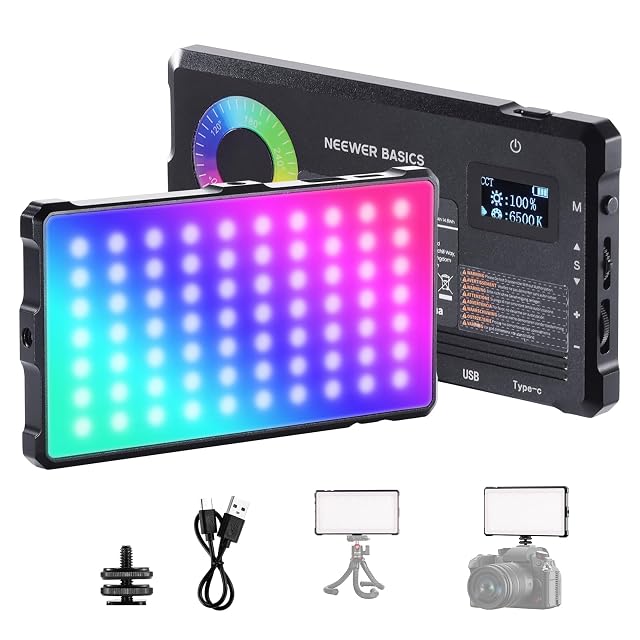
Color temperature from 2500K warm to 9900K cool in 100 K increments, with a high-definition OLED screen showing brightness, color temperature and battery status
A built-in 4,000 mAh rechargeable lithium-polymer battery allowing “a duration of 20 hours”, charged over USB-C from a wall charger, power bank or car charger
A high-precision circuit board working with 180 “high lumens” LED beads, with brightness adjustable from 1 to 100 per cent in 5 per cent increments
High-strength aluminum alloy, moisture-proof and resistant to falls, 5.9 × 3.0 × 0.4 in, 7.65 oz
Supplied: the light, a camera stand (holder), a USB cable and a manual
NO lux. NO lumens. NO distance. NO wattage. NO CRI. NO TLCI. Nothing about
flicker.
Seven thousand four hundred kelvin of range
Two and a half thousand to nine thousand nine hundred. The widest on this shelf.
And the increment is published — 100 K — which almost nothing here does. Seventy-five
positions across the range, fine enough to match a tungsten bulb or an overcast
sky by eye.
The published NEEWER pair covers 3200 to 5600. The ULANZI VL49 RGB and the
published Rollei reach 9000.
And twenty hours, with no brightness attached
Four thousand milliamp-hours at 3.7 volts is about fifteen watt-hours.
Twenty hours of it is a draw of well under one watt.
The NEEWER SL90C on this shelf publishes 113 minutes AT FULL from the same 4,000
mAh — about eight watts.
Both are true of the same cell. One is the bottom of the dimming range; one is the
top.
A runtime without a brightness is the least plannable claim on this shelf.
The two figures the buying advice asks for, both missing
“Read the color accuracy index before the output figure.”
No index. No output.
Thirteen of the fourteen pages here publish an index, from 90+ to 98. This is
the only one that publishes none.
On a BI-Color panel that matters more than elsewhere: mixing a warm emitter and a
cool one to make 5000 K can land visibly green, and green skin is not a
white-balance shift — it is a repair.
“180 high lumens LED lamp beads”
Which uses the word lumens as an adjective for a bead rather than as a measurement
of the fixture.
A bead can be any power. One hundred and eighty of them says nothing about what
leaves the panel.
What it does measure is the body
Aluminum alloy, moisture-proof, fall-resistant.
Five point nine by three by nought point four inches. Seven point six five
ounces.
Three figures and a material, on a page with no photometry at all.
And the name on the box
Sold as PEZAX. Titled ENEGON. Reference “de-Cable-23h-165”.
None of it changes the panel. All of it changes a warranty claim.
Record the ASIN: it is the only identifier here that will still mean something in
a year.
Availability
About $39 on the American Amazon store when this page was last checked.
Everything in this section is the figure Keepa carried on the day of the last update to this page. Availability and prices shift without notice.
Prices quoted in this text were read on 8 October 2026. The live price is at the top of the page.
What it does well, and what it gives up
Strengths
Two thousand five hundred to nine thousand nine hundred kelvin, the widest here
A hundred-kelvin increment, published
Five per cent dimming steps, published
An OLED screen for brightness, temperature and battery
Aluminum alloy, moisture-proof, with dimensions and weight
USB-C from a wall charger, power bank or car
Compromises
No output figure of any kind
No color accuracy index of any kind
Twenty hours with no brightness attached to it
Nothing about flicker
Stepped dimming, not stepless
Sold as PEZAX and titled ENEGON
Specifications
Output in lux with its distance
NEITHER PUBLISHED. No lux, no lumens, no distance, no wattage — in five bullets. What appears instead is "180 high lumens LED lamp beads", which uses the word lumens as an adjective for a bead rather than as a measurement of the fixture. This shelf's introduction makes output the first of three published figures a continuous light is compared on; this page gives none of it, and five of the ten American lights on this shelf share that gap
Color temperature range
2500K TO 9900K IN 100 K INCREMENTS — the WIDEST range on this shelf, a 7,400 K span, against 2500–9000K on the ULANZI VL49 RGB and the published Rollei and 3200–5600K on the published NEEWER pair. And the increment is published, which almost nothing here does: 100 K steps means 75 positions across the range, fine enough to match a tungsten bulb or an overcast sky by eye. This shelf's introduction warns that a mixed panel peaks in the middle; with no output figure at all, there is no peak to be lower than
Accuracy indices
NONE PUBLISHED. No CRI, no TLCI, no index of any kind, and this is the ONLY page on this shelf to omit it entirely — the published RaLeno gives CRI 95 or better in its fifth bullet, and the twelve other pages here all publish a figure. This shelf's buying tip is unambiguous: "read the color accuracy index before the output figure. A dim light with faithful color is easier to work with than a bright one that turns skin green." On a bi-color panel mixing warm and cool emitters, the index is also where the mixing shows — a cheap mix can be visibly green at the middle of its range, which is exactly where it will be used
Dimming
1 TO 100 PER CENT IN 5 PER CENT INCREMENTS, stated — twenty steps, and the increment is published where most of this shelf says only "dimmable". Five per cent steps are fine enough for practical work and are not stepless: the NEEWER SL90C and the published Rollei dim continuously, and a stepped dimmer cannot be faded on camera
Flicker
NOT MENTIONED
Power options
A 4,000 mAh lithium-polymer cell claimed to allow "A DURATION OF 20 HOURS" — the longest runtime on this shelf — AND NO BRIGHTNESS IS NAMED FOR IT. That is the figure to read carefully: twenty hours from 4,000 mAh means a draw of a fraction of a watt, which is the panel at its 1 per cent setting rather than anywhere usable. The NEEWER SL90C publishes 113 minutes AT FULL from the same 4,000 mAh, and the two figures are compatible: one is the bottom of the range and one is the top. Charging is by USB-C from a wall charger, a power bank or a car charger
Mount
A "DIGITAL SLR CAMERA STAND (HOLDER)" supplied, and nothing else described — no cold shoe named, no thread size, no spigot. The page says the panel is "easily mountable on digital SLR cameras, camcorders, tripods and lamp holders", which is a compatibility claim rather than a fitting. What IS published, unusually, is the body: aluminum alloy, moisture-proof and fall-resistant, 5.9 × 3.0 × 0.4 inches and 7.65 oz
Amazon reference
B08K7H42D7
EAN
0736067820892
What people ask before they commit
Is twenty hours believable?
Yes, at a brightness nobody would use. Four thousand milliamp-hours at 3.7 volts is about 15 watt-hours of energy; twenty hours of it means a draw of well under one watt. The NEEWER SL90C on this shelf publishes 113 minutes at FULL brightness from the same 4,000 mAh, which works out at around 8 watts. Both figures can be true of the same cell — one is the bottom of the dimming range and one is the top. This shelf's introduction asks for a runtime with a stated brightness, and this page gives the number without the condition, which makes it the least plannable claim on the shelf.
How much does a missing CRI figure matter?
It is the one thing the buying advice for this shelf says to read first. The color rendering index scores how faithfully a source reproduces known colors, and a bi-color panel is where it shows most: mixing a warm emitter and a cool one to make 5000 K can land visibly green, and green skin is the most expensive thing to repair afterwards because it is not a simple white-balance shift. Thirteen of the fourteen pages on this shelf publish a figure, from 90+ to 98. This is the only one that does not. For anything with a face in it, that is a reason to choose differently.
Why does the brand name differ from the title?
The listing is sold under PEZAX and titled ENEGON, and the reference reads "de-Cable-23h-165" — which looks like a cable listing’s internal code rather than a light’s model number. None of that affects the panel, and all of it affects after-sales: a warranty claim, a spare charger or a replacement needs a seller who answers to the name on the box. The page offers "24/7 customer support" and no model number of its own. Record the ASIN before buying, because it is the only identifier on this page that will still mean something in a year.
Where this one places on its bench
At $39, it is the 8 cheapest of the 11 models in this category published here.
Cheapest on the bench$10
Median$30
Dearest on the bench$52
This one against the other photo equipment
photo equipment from the same category, at nearby prices. Only what all of them publish is shown: a column with holes compares nothing.
Model
Price
Output in lux with its distance
Color temperature range
Accuracy indices
Dimming
ENEGON Bi-color panel, 2500–9900 K, 20 hours
$39
NEITHER PUBLISHED. No lux, no lumens, no distance, no wattage — in five bullets. What appears instead is "180 high lumens LED lamp beads", which uses the word lumens as an adjective for a bead rather than as a measurement of the fixture. This shelf's introduction makes output the first of three published figures a continuous light is compared on; this page gives none of it, and five of the ten American lights on this shelf share that gap
2500K TO 9900K IN 100 K INCREMENTS — the WIDEST range on this shelf, a 7,400 K span, against 2500–9000K on the ULANZI VL49 RGB and the published Rollei and 3200–5600K on the published NEEWER pair. And the increment is published, which almost nothing here does: 100 K steps means 75 positions across the range, fine enough to match a tungsten bulb or an overcast sky by eye. This shelf's introduction warns that a mixed panel peaks in the middle; with no output figure at all, there is no peak to be lower than
NONE PUBLISHED. No CRI, no TLCI, no index of any kind, and this is the ONLY page on this shelf to omit it entirely — the published RaLeno gives CRI 95 or better in its fifth bullet, and the twelve other pages here all publish a figure. This shelf's buying tip is unambiguous: "read the color accuracy index before the output figure. A dim light with faithful color is easier to work with than a bright one that turns skin green." On a bi-color panel mixing warm and cool emitters, the index is also where the mixing shows — a cheap mix can be visibly green at the middle of its range, which is exactly where it will be used
1 TO 100 PER CENT IN 5 PER CENT INCREMENTS, stated — twenty steps, and the increment is published where most of this shelf says only "dimmable". Five per cent steps are fine enough for practical work and are not stepless: the NEEWER SL90C and the published Rollei dim continuously, and a stepped dimmer cannot be faded on camera
1090 LUX AT 0.5 M, stated — and the distance is the point. This shelf's introduction says the distance is part of the measurement and a figure without it cannot be compared with anything; of the nine American lights on this shelf, only this and the ULANZI VL49 RGB publish both. Eleven hundred lux at half a meter is a quarter of the published NEEWER 660 pair’s 3300 lux at 1 m (3 ft) once both are scaled to the same distance, which is what the scaling is for
2700K to 7500K in CCT mode, stated, a 4800K span. Narrower at both ends than the ENEGON’s 2500–9900K and the ULANZI VL49 RGB’s 2500–9000K on this shelf, and wider than the published NEEWER 660 pair’s 3200–5600K. This shelf's introduction notes that a light mixing warm and cool emitters usually reaches its highest output in the MIDDLE of the range rather than at the ends, and this one has 45 warm and 45 cool beads to mix
CRI 97, stated in the title — the JOINT HIGHEST on this shelf among the American lights, level with the ALTSON D6 and the NiceVeedi pair, and behind only the published Rollei’s 98. This shelf's buying tip says to read the accuracy index before the output figure, and 97 is the figure that makes a skin tone usable as recorded. NO TLCI: the published Rollei is the only page on this shelf to give one
STEPLESS from 0 to 100 PER CENT in CCT mode, stated. Stepless rather than stepped is the better arrangement and not all of this shelf has it — the ULANZI VL49 offers five fixed levels and the ALTSON ten. A true zero means the panel can be faded out rather than switched off, which matters when it is the fill rather than the key
NEITHER PUBLISHED. No lux, no lumens, no distance, no wattage — only "70 LEDs of high performance" per light. This shelf's introduction makes output the first figure, and on a pair of lights sold as a studio set rather than a pocket fill the omission matters more: a panel on a 57-inch stand is two meters from the subject, where illuminance is a quarter of what it is at a meter
3000K TO 6000K, stated, plus 16 EXTRA Colors beyond the cool and warm whites. Three thousand kelvin is warm tungsten and six thousand is a cool daylight, a 3,000 K span — narrower than everything else adjustable on this shelf except the published NEEWER pair. Sixteen fixed colors is not the same as an RGB panel’s 360 degrees of hue: the NEEWER SL90C and the ULANZI VL49 RGB here mix any shade
CRI 90+, stated — the WEAKEST index published on this shelf, level with the EMART spotlights and the ULANZI K20 and behind the 95 of five lights, the 96 of the published NEEWER pair, the 97 of the SL90C and the ALTSON and the 98 of the published Rollei. This shelf's buying tip says to read the index before the output, and above 90 is usable rather than good: the error in a 90-CRI white LED sits mostly in deep red, which is where skin lives
TEN BRIGHTNESS LEVELS from 10 TO 100 PER CENT, "conveniently controlled by wires" — a WIRED IN-LINE CONTROLLER rather than buttons on the panel, which on a light at the top of a 57-inch stand is the right arrangement: you adjust it from where you are standing. And the controller is BACKLIT, "so you can operate the lights even in a dark environment", which no other page on this shelf mentions
600 LUMENS PER LIGHT — and lumens are not lux. Lumens measure the total light LEAVING a fixture; lux measures how much ARRIVES on a surface, which is why this shelf's introduction asks for lux with a distance. The two cannot be converted without knowing the beam angle, and no beam angle is published here. Six hundred lumens from a 12-LED spotlight is a narrow, concentrated beam rather than a panel wash, so the lux at half a meter could be high and the coverage small. This and the published ULANZI K20 are the two pages on this shelf that publish a flux instead of an illuminance
5500 K, FIXED, described as a "perfect daylight temperature" — and then the mechanism that moves it: TWO WHITE, TWO ORANGE and TWO BLUE GEL FILTERS, two color gel filters, stated to change the kelvin temperature for cooler or warmer photos. That is color temperature by subtraction rather than by mixing: an orange gel in front of a 5,500 K source makes it warmer and dimmer, where a bi-color panel fades between emitters and loses nothing. The ULANZI VL49 on this shelf is the only other fixed-temperature light here, and it has no gels
CRI 90+, stated — the JOINT WEAKEST index on this shelf with the Torjim pair and the ULANZI K20, behind the 95 of five lights, the 96, the three at 97 and the 98 above them. On a spotlight intended for tabletop product work the index matters as much as on a portrait light: a 90-CRI source renders a red product slightly brown, and a product photograph that needs its color corrected is a product photograph that will be returned
NOT PUBLISHED AT ALL — no range, no steps, no mention. This is the ONLY light on this shelf with no dimming described, which on a 600-lumen spotlight means the only ways to reduce it are distance, a gel and switching one of the pair off. This shelf's introduction lists dimming among the things it compares; this page lists a swivel, a bracket, a temperature and a warranty
What sets the models apart, in photo equipment
If price decides: EMART EM-7W-LTL, two spotlights, 600 lm each, at $30.
Highest Color temperature range in the table: EMART EM-7W-LTL, two spotlights, 600 lm each (5500 K, FIXED, described as a "perfect daylight temperature" — and then the mechanism that moves it: TWO WHITE, TWO ORANGE and TWO BLUE GEL FILTERS, two color gel filters, stated to change the kelvin temperature for cooler or warmer photos. That is color temperature by subtraction rather than by mixing: an orange gel in front of a 5,500 K source makes it warmer and dimmer, where a bi-color panel fades between emitters and loses nothing. The ULANZI VL49 on this shelf is the only other fixed-temperature light here, and it has no gels).
Where the price stands, among photo equipment
Details checked on October 8, 2026.
What use this one answers, among photo equipment
Matching an existing light source by eye across a very wide range, where the color index is not the deciding factor
What buyers actually choose
Amazon reports what buyers took in the month before this page was last checked: at least 400.
The figure is a floor, rounded by Amazon, and read through Keepa — it says what buyers picked, not what a maker claims.
Sources
Specifications: the manufacturer sheet for photo equipment and the matching Amazon product page. Prices and availability: Keepa. Every figure on this page names its source.
CRI 97+, the JOINT HIGHEST on this shelf with the NEEWER SL90C · 60 LED beads · THREE light modes, white, natural and warm, across 2500K to 6500K · TEN brightness levels · 2,200 mAh with TWO runtimes published at TWO brightnesses: 15 H at 10 PER CENT and 4 H at 50 · a 160-DEGREE rotating panel AND a 180-DEGREE rotatable 1/4 inch head, with a CLIP and a HOT SHOE mount supplied · 3.9 × 2.8 × 0.78 IN, 95 G · a storage pouch · NO output figure · NOTHING about flicker · $9.68
Ten dollars for the joint-highest color index on this shelf, a clip, a hot shoe and a pouch.
Best for: Video calls, selfies and makeup at a desk, where a faithful color index at ten dollars is the whole point
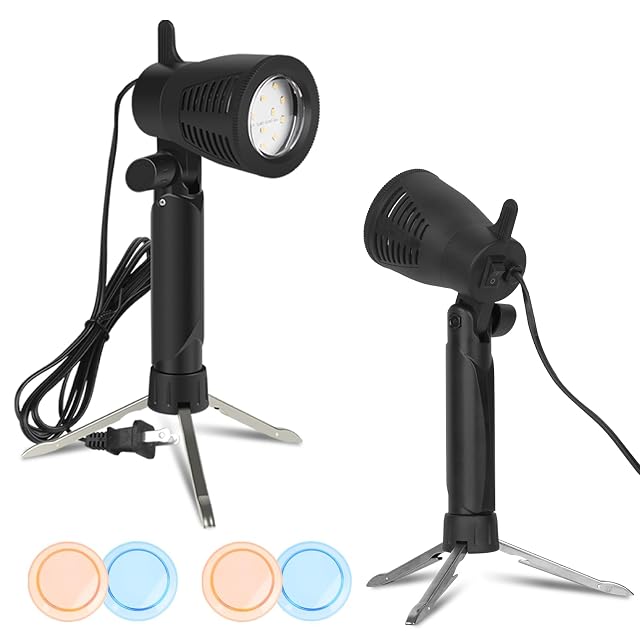
TWO TABLE-TOP SPOTLIGHTS · 600 LUMENS each — a LUMINOUS FLUX, not an illuminance, so it cannot be compared with the lux figures on this shelf · 12 LEDs per light · CRI 90+, the joint weakest here · 5500 K FIXED, with SIX GEL FILTERS to shift it — two white, two orange, two blue · a head swivelling 180 DEGREES · a RETRACTABLE SPRING BRACKET that folds into the base · NO dimming published at all · NO battery · 18 MONTHS of after-sales cover · NOTHING about flicker
Two spotlights that publish lumens where this shelf asks for lux — and gels instead of a dimmer.
Best for: Lighting a light tent or a tabletop set-up from two sides, where a concentrated beam and a folding stand matter more than a dimmer
1090 LUX AT 0.5 M — one of only three outputs on this shelf published WITH its distance, and the highest among the pocket panels · 2700K to 7500K in CCT mode · CRI 97, joint highest here with the ALTSON D6 and the NiceVeedi pair · 138 beads: 45 WARM, 45 COOL and 48 RGB · THREE MODES, CCT, HSI and FX with 17 SCENES · 360-degree hue selection · STEPLESS 0 to 100 per cent · 4,000 mAh for 113 MINUTES at full, with a USB OUTPUT that charges a phone · 15 × 8 × 1.2 cm (5.9 × 3.1 × 0.5 in), 235 g · cold shoe adapter and 1/4 inch holes · NOTHING about flicker
The brightest pocket panel on this shelf that publishes its distance — and the only light here that will also charge your phone.
Best for: A pocket key or fill light where color accuracy comes first and the panel has to earn its place in the bag twice over