Skip to content

A background for filming at home: cloth, support, light

A background is bought in three stages and most people buy them in the wrong order. The cloth comes first because its material decides how much retouching every frame needs; the support second, because a cloth on the floor is a cloth with creases; the light third, because a background lit by the same lamp as the face is what makes a room look like a bedroom. These five follow that order, and the figures below — fabric weight, load rating, colour accuracy — are the ones the listings actually publish.

Cloth, support, light — and most people buy them backwards

The cloth decides how much retouching every frame needs. The support decides whether the cloth hangs flat. The light decides whether the result looks like a set or like a sheet pinned to a wall. Bought in the other order, each purchase corrects the last one.

A hundred and twenty grams per square metre

That is the one fabric weight published on this shelf, and it is the figure that says how a cloth falls. Heavy cloth hangs straight and pulls its own creases out; light cloth moves in a draught and shows what is behind it.

Eight kilograms, on the only support that rates itself

A backdrop stand holds cloth, and cloth is not heavy — the load figure matters because it says whether a second crossbar or a light can go up on the same frame. One system on this shelf publishes it.

The background is a separate exposure

Lit by the key, a wall is a bright patch behind a face. Lit dimly and on its own, it becomes depth. This is the step that separates a home setup from a room with a camera in it, and it costs one small panel.

Creases are removed one photograph at a time

Which is why the material choice at the top of this list outranks everything below it. A steam iron, a day hanging, or a cloth that never creased: the third is cheaper than the first two repeated for a year.

What goes in the bag, and why

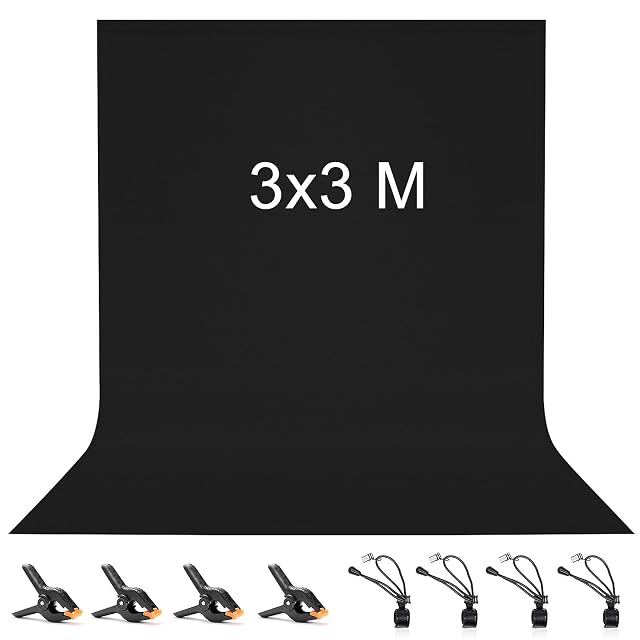
  1. Vevelux 3 by 3 m black, 120 g per square metre, eight clamps

    100 per cent polyester, and the ONLY page on this shelf to publish a weight: 120 g per square metre, density 75D by 200D · 3 by 3 m · non-reflective, said not to shrink, fade or pill, and to crease less than others · creases admitted after long transport, with ironing up to 150 °C permitted · SUPPORT NOT INCLUDED, stated in the second bullet · a 7 cm pole pocket for a crossbar, said to suit most backdrop stands · EIGHT clamps supplied: four spring clips and four backdrop clamps · machine washable, hand washing advised for stains · edges finished against tearing

    Nine square metres of black polyester at 120 g per square metre — the only fabric weight published on this shelf — with eight clamps, for 27 €.

    Best for: A full-length black background on an existing crossbar, where the cloth has to hang flat and the clamps have to come with it.

    ≈ 27 €
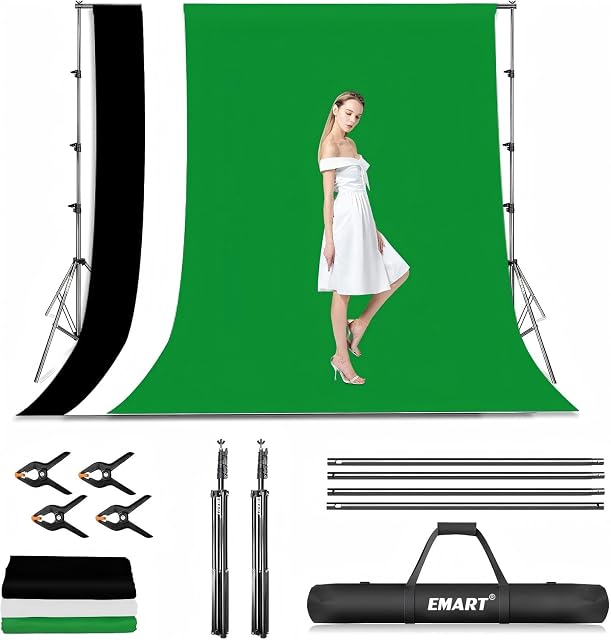
  2. EMART 2.6 by 3 m system, three cloths, 8 kg load

    A COMPLETE SYSTEM, not a cloth: a 2.6 by 3 m aluminium-alloy support PLUS three 1.8 by 2.8 m backdrops in white, green and black · the cloth material is NOT NAMED — only "very thick and firm" · LOAD CAPACITY 8 kg, the only load figure on this shelf · height and width both adjustable · four clamps and a nylon carry bag · black finish said not to rust or rub off · the cloths fold, wash and iron · no ironing temperature published · no weight per square metre published

    A 2.6 by 3 m aluminium stand rated at 8 kg with three 1.8 by 2.8 m cloths, four clamps and a bag, for 80 € — the only load figure published on this shelf.

    Best for: A first complete backdrop setup — three colours, a stand and the clamps to hold them — where the stand has to be rated for what is hung on it.

    ≈ $85 / £70 / 80 €

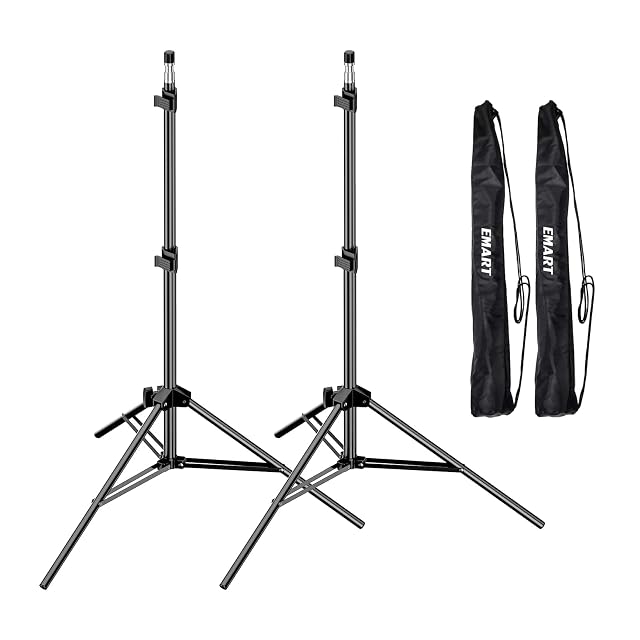
  3. EMART EM-LS703-2, two stands, 87 to 210 cm, 1 kg each

    Two stands in the pack · 87 to 210 cm · folded 73 cm · declared load 5 kg · 1/4 inch screw thread · aluminium alloy with a black finish · 1 kg each · two nylon carry bags · no section count published · no spigot size published

    Two stands for 37 €, each reaching 210 cm and carrying 5 kg at 1 kg apiece — and the only page here to publish both a folded length and a weight.

    Best for: A first two-light setup at home, where a flash or a small LED panel goes on each stand and both have to travel in a bag.

    ≈ $33 / £35 / 37 €

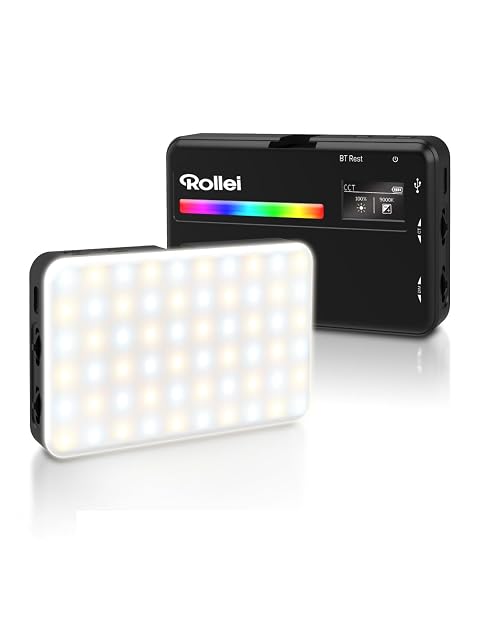
  4. Rollei LUX Compact RGB, 8 W, CRI and TLCI 98

    8 W · no output in lux and no distance published · 2500K to 9000K · 360 RGB colours and 13 effects · CRI and TLCI both 98 · stepless dimming from 0 to 100 per cent · internal cell, no runtime published · OLED screen and app control · 125 g · no mount published

    A phone-sized panel at 24 € whose colour accuracy is published twice over — CRI and TLCI both 98, the highest figures of the four here — with no output in lux and no runtime.

    Best for: A pocket light for faces and small objects where faithful colour matters more than power, and the light lives within arm’s reach of the subject.

    ≈ £27 / 24 €

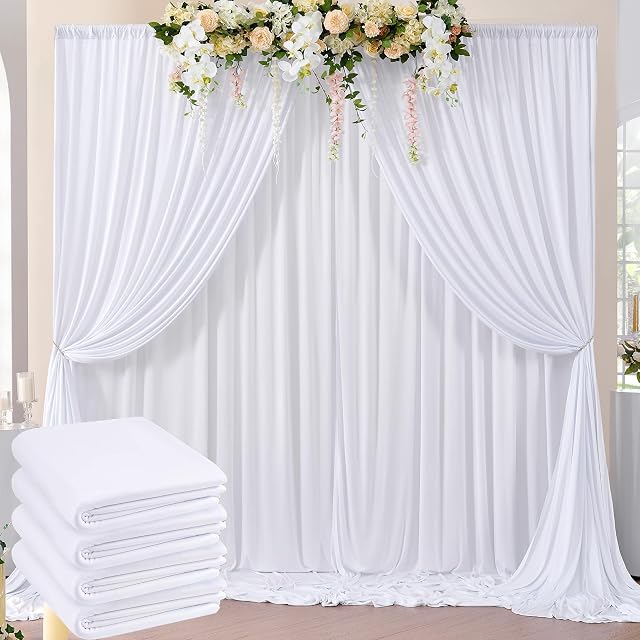
  5. Htper 6 by 3 m white, four panels of 1.5 m

    100 per cent polyester with a softener, described as very soft and crease-free · FOUR SEPARATE PANELS of 1.5 m wide by 3 m high, 6 by 3 m in total — the only multi-panel backdrop on this shelf · crossbar hole design, so it drapes or hangs without clamps · SUPPORT NOT INCLUDED, stated in the third bullet · machine washable many times without fading, ironable, better with a steam iron · no ironing temperature published · no weight per square metre published · no opacity claim

    Six metres of white polyester in four separate 1.5 m panels for 60 € — a curtain wall rather than a single sheet, and the widest surface on this shelf.

    Best for: A wide backdrop for a wedding, a party or a group, where six metres of white has to cover a wall and the panels can overlap.

    ≈ 57 €

What people ask before they commit

Which material creases least?

The one that hangs heaviest. A cloth published at 120 g per square metre falls straighter than one that publishes nothing, and card does not crease at all — which is why the tabletop sets on this site are card rather than fabric. Polyester sold as wrinkle-resistant is describing a tendency, and the creases still show under any light that rakes across them.

Green screen or plain colour?

Green only if the background is going to be replaced. Keying demands even lighting across the whole cloth and a subject standing well clear of it, which in a small room is harder than lighting a plain grey properly. A dark background that is genuinely dark is easier and looks deliberate.

How far from the background should the subject stand?

Far enough that the light on the face does not reach it, which is usually more than a small room allows. The practical substitute is to light the background separately and dimly — one small panel aimed at it does more than moving the subject 30 cm forward.

Each amount in a write-up is what the listing showed when that page was written. The figure next to the product is pulled in as you read, and it is the one that counts.

The tool we use ourselves

Settled on a lens? Now buy it at the right price.

Bodies, lenses and lighting are marked down almost continuously, and a struck-through figure says nothing by itself about what the same reference was actually asking a month ago. UniverTrack holds the week-by-week record of every retailer, so a reduction is measured against a price that genuinely stood rather than one written for the banner — and it says when the moment to buy has really arrived.

Real price historyBuy-now alertsAI buying assistant
Try free for 14 days →
No commitment · Cancel in one click · 5 languages