Skip to content

Lighting a small room: what to buy, and in what order

A small room is lit in a fixed order: one soft source near the face, then something to stop it spilling onto the wall behind, then a background of its own. These five follow that order rather than a price ladder. The figure to compare is the colour rendering index, published by most of them, because a light that renders skin badly costs an hour in correction for every hour saved in setup.

The order is fixed, and it is not the price ladder

One soft source near the face. Then something to stop it reaching the wall. Then a background lit on its own terms. A room lit in that order looks deliberate; a room lit by adding lamps until it is bright looks like a room with lamps in it.

Why the key light comes first and costs most

Everything after it is a correction of what it does. A hard key needs subtracting, a badly placed one needs filling, an inaccurate one needs grading. The panel and the softbox at the head of this list are doing the work the other three only adjust.

Ninety-five, and what falls below it

The colour rendering index is published by most of these, and below about 90 the reds go first — which on a face is exactly what shows. Correction afterwards is per-frame work on video, so an accurate source is bought once and saves time every session.

Fifty centimetres, a metre away

That is roughly where a small softbox stops being a lamp and starts being a window. Size relative to the subject is what softens a shadow; a diffusion sheet on a small panel changes the texture and not the geometry.

The light nobody buys first and everybody wants third

Something aimed at the background. A wall lit by the same lamp as the face is what makes a room read as a bedroom, and a single small panel turned away from the subject fixes it.

What goes in the bag, and why

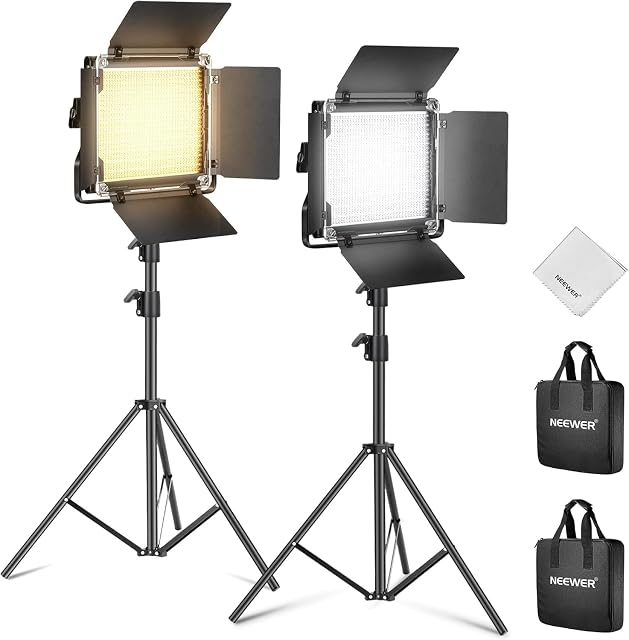
  1. NEEWER 660 bi-colour pair, 3300 lux at 1 m, CRI 96+

    Two panels of 660 LEDs, 330 warm and 330 cool · 40 W each · 3300 lux at 1 m · 3200K to 5600K · CRI 96 or better · brightness 0 to 100 per cent · mains adapter supplied or NP-F550 and NP-F970 cells, not supplied · barn doors and U-brackets with 360 degree tilt · two stands from 66 to 190 cm · panels 232 by 200 by 48 mm · LCD screen · two carry bags

    The only light of the four here that publishes an illuminance with its distance — 3300 lux at 1 m — as a pair of 660-LED panels with stands, barn doors and bags for 194 €.

    Best for: A two-light setup for portraits, product work or streaming where the panels go on stands, the barn doors control spill, and a socket is available.

    ≈ 194 €
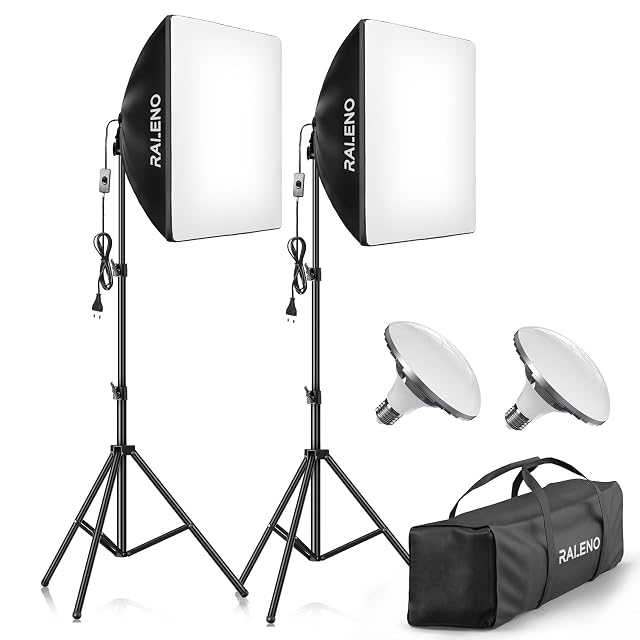
  2. RaLeno PS30 kit, two 50 by 50 cm boxes, 50 W LED each

    A COMPLETE KIT, not a modifier: two 50 by 50 cm boxes, two 50 W LED lamps, two stands, two white diffusers, a bag · E27-style lamp housings · boxes rotate through 210 degrees · stands fold to 68 cm and extend to 200 cm · silver stone-grain inner coating, silk front, 0.2 cm Oxford outer shell · LEDs rated about 30,000 hours · not dimmable · no mount type published · no depth published · no grid

    Two 50 by 50 cm boxes with 50 W LED lamps, two stands and a bag for 66 € — a complete two-light kit, and the page says plainly that it does not dim.

    Best for: A first two-light setup for product or portrait work at home, where a fixed daylight output is enough and nothing will be swapped later.

    ≈ 66 €

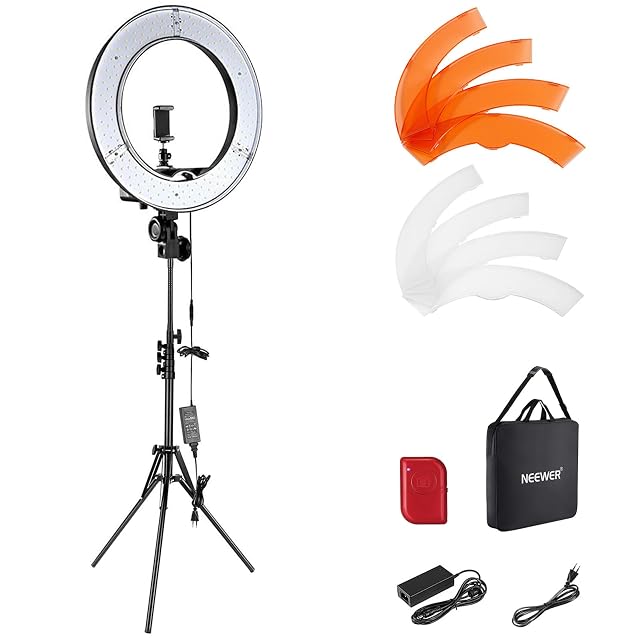
  3. NEEWER 18 inch, 45 cm, 55 W at a fixed 5600K

    18 inch, 45 cm outer diameter · 55 W · fixed 5600K · 240 LEDs · dimmable 0 to 100 per cent · no colour accuracy index · 155 cm aluminium-alloy light stand · colour filter set supplied instead of bi-colour mixing · soft tube, ball head and hot shoe adapter for cameras · phone holder · universal mains adapter · carry bag · no UV or IR emission claimed

    The largest and dearest ring here — 18 inches, 45 cm, 55 W of daylight from 240 LEDs — with a camera shoe adapter, colour filters and a 155 cm stand, at 107 €.

    Best for: Portrait, beauty and salon work at a proper distance, where 45 cm of daylight-balanced source and a camera mount are the reasons to buy.

    ≈ $96 / 107 €

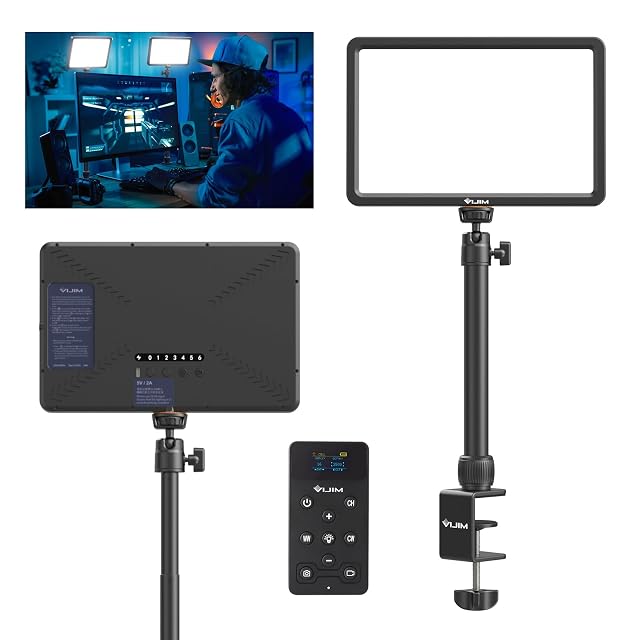
  4. ULANZI K20 key light, 10 W, 600 lumens, 192 LEDs

    10 W · 600 lumens — a luminous flux, not an illuminance · 2500K to 9000K · 192 LEDs behind an 11 inch panel · 120 degree beam · CRI above 90 · 0 to 100 per cent brightness · edge-lit · magnetic remote with 7 channels and 30 m range · metal C-clamp for desks up to 50 mm, height 30 to 80 cm, 360 degree ball head

    An 11 inch key light that clamps to a desk and comes with a magnetic remote reaching 30 metres, for 48 € — publishing 600 lumens, which measures total light output rather than what lands on a face.

    Best for: A desk for streaming or calls, where the clamp, the remote and an 11 inch soft source matter and a mains socket is always within reach.

    ≈ £47 / 46 €

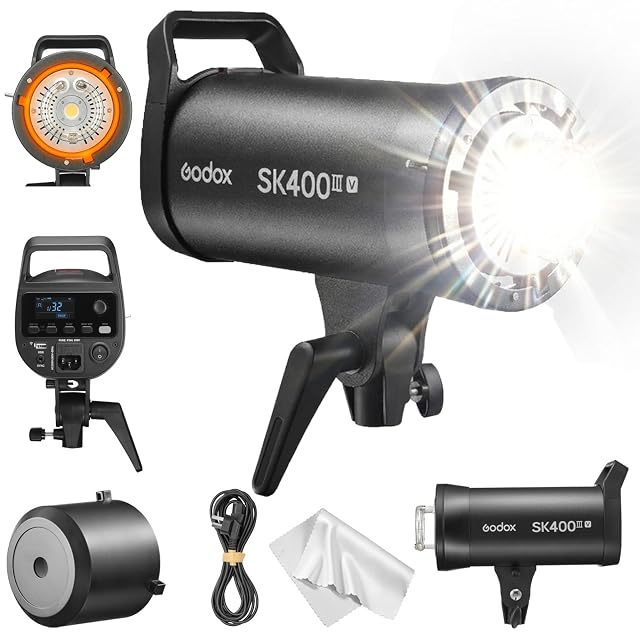
  5. Godox SK400III-V, 400Ws, GN65 at ISO 100

    400Ws · guide number 65 at ISO 100 · 1/32 to 1/1 in 50 steps, five stops · recycle 0.1 to 1.5 s · 10 W LED modelling lamp dimmable from 5 to 100 per cent · standard Bowens bayonet · Godox 2.4G X system built in · colour temperature 5600K plus or minus 200K

    The one head on this shelf that publishes everything the shelf is compared on: 400 watt-seconds, a guide number with its sensitivity, a recycle time of 0.1 to 1.5 seconds and fifty steps of adjustment, for 199 €.

    Best for: A studio head bought to be built on, where the X system and the Bowens mount decide every purchase that follows and the published figures make it comparable.

    ≈ $179 / £169 / 199 €

What people ask before they commit

One big light or two small ones?

One big one, first. A single source close to the face gives a shadow that falls in one direction, which reads as natural; two equal sources give two shadows and a flat, televisual look. The second light is for the background or the hair, not for filling the other side of the face — that job belongs to a reflector or a wall.

What does a colour rendering index above 95 buy?

Skin that needs no rescuing. A source that renders known colours faithfully means less correction afterwards, and on video that correction has to be applied to every frame. Below about 90 the reds go first, which on a face is precisely what shows.

Do I need a softbox if the light already has a diffuser?

The size of the emitting surface is what softens a shadow, not the material in front of it. A small panel with a diffusion sheet is still a small source. A softbox works by making the light physically larger relative to the face, which is why a 50 cm box a metre away behaves quite differently from the same lamp bare.

Each amount in a write-up is what the listing showed when that page was written. The figure next to the product is pulled in as you read, and it is the one that counts.

The tool we use ourselves

Settled on a lens? Now buy it at the right price.

Bodies, lenses and lighting are marked down almost continuously, and a struck-through figure says nothing by itself about what the same reference was actually asking a month ago. UniverTrack holds the week-by-week record of every retailer, so a reduction is measured against a price that genuinely stood rather than one written for the banner — and it says when the moment to buy has really arrived.

Real price historyBuy-now alertsAI buying assistant
Try free for 14 days →
No commitment · Cancel in one click · 5 languages