A phone-sized panel at 24 € whose colour accuracy is published twice over — CRI and TLCI both 98, the highest figures of the four here — with no output in lux and no runtime.
The bottom line Two accuracy indices at 98, the widest colour range here and stepless dimming for 24 € make this the colour-critical choice among the small panels. It publishes no lux, no distance, no runtime and no mount, so four of the seven lines this shelf compares stay blank.
On the listing
Five bracketed bullets. A portable, versatile light described as smartphone-sized and pocketable; CRI and TLCI of 98 for faithful colour rendering; 360 RGB colours, a variable colour temperature from 2500K to 9000K and 13 built-in lighting effects; 8 watts with stepless brightness from 0 to 100 per cent; and control by a dial, by the Rollei Candela app, and an OLED screen showing status, wireless connection, battery level and brightness.
Ninety-eight, twice
The only page of the four here to publish two colour indices. CRI and TLCI measure the same idea by different standards, and TLCI is the stricter of the pair because it weights the errors a camera records rather than those an eye notices. The buying advice for this shelf says to read the accuracy index before the output figure, and this listing leads with it.
Two and a half thousand to nine thousand kelvin
Wider at both ends than any other panel here: warmer than candlelight at one extreme, cooler than daylight shade at the other. As on any bi-colour fixture the maximum output usually sits in the middle of that range rather than at the ends, which this page does not mention — and cannot, since it publishes no output at all.
Eight watts, which is not a brightness
Consumption, not delivery. The hub above asks for lux at a stated distance precisely because wattage says nothing about what reaches a subject. Among these four panels the units are lux-with-distance, lux-without, lumens, and watts — four scales, no common ground.
What a cell without a runtime leaves open
The title names an integrated battery and no bullet gives its capacity or how long it runs at full brightness. For a light whose whole argument is that it travels, that is the figure a buyer needs most.
Availability
Between 24 € and 35 € on the German, French, Italian and Spanish Amazon stores when this page was last checked.
The American and British Amazon stores carry it too, priced in local currency. Those amounts are deliberately absent from the range above, which reads euro stores only.
Everything in this section is the figure Keepa carried on the day of the last update to this page. Availability and prices shift without notice.
Prices quoted in this text were read on 13 September 2026. The live price is at the top of the page.
What it does well, and what it gives up
Strengths
CRI 98 and TLCI 98, two indices published rather than one, and the highest of the four here
2500K to 9000K plus 360 RGB colours and 13 effects, the widest colour range of these four panels
Stepless dimming, an OLED status screen and app control, at 24 €
Compromises
No output figure in lux and no distance, so brightness cannot be compared with anything
An internal cell with no capacity and no runtime published
No mount named, and nothing about flicker at any frame rate
Specifications
Output in lux with its distance
Not published in lux, at any distance. The fourth bullet gives 8 watts, which is electrical consumption and not light delivered — the hub above is explicit that a figure without its distance cannot be compared with anything. Of the four panels here, one publishes lux with a distance, one publishes lux without, one publishes lumens, and this one publishes watts
Colour temperature range
2500K to 9000K, in the third bullet — the widest range of the four panels here, wider at both ends than the 3200K to 5600K of the studio pair above it. The same bullet adds 360 RGB colours and 13 built-in lighting effects
Accuracy indices
CRI 98 and TLCI 98, both published in the second bullet and again in the title. Two indices rather than one: CRI scores how faithfully known colours render, TLCI is the television equivalent and is the more demanding of the two. Ninety-eight on both is the highest figure of the four here, and publishing the pair is what the buying advice for this shelf says to look for first
Dimming
Stepless from 0 to 100 per cent, in the fourth bullet. Stepless rather than in fixed levels, which matters when a light is being matched to a room rather than set from a chart
Flicker
Not addressed on the listing. No frame rates are named and no flicker-free claim appears, which on a light sold for video is the line worth having — the hub above lists it among the things to read beyond the numbers
Power options
An integrated cell, named in the title, with no capacity and no runtime published. Nothing on the page says how long it lasts at full brightness, and no mains or camera-plate option is described
Mount
Not published on the listing. The first bullet says the light is smartphone-sized and fits in a pocket, and no cold shoe, thread or spigot is named — so how it attaches to anything is not stated
Amazon reference
B09BVMC937 (same reference on 6 Amazon marketplaces)
EAN
4048805285655
What people ask before they commit
What is the difference between CRI and TLCI?
Both score how faithfully a light renders known colours, on a scale to 100. CRI is the older general index, built around how a human eye judges eight or more test colours; TLCI was designed for television cameras and weights the errors a sensor actually records, which makes it the harder test to pass. A light publishing 98 on both — as the second bullet does — is claiming accuracy by two different standards.
Why is 8 watts not a brightness figure?
Because watts describe how much electricity the panel consumes, not how much light arrives on a subject. Two panels of the same wattage with different emitters and diffusion put very different light on a face. The hub above asks for lux with a stated distance, because that is a measurement of delivered light. This page publishes neither.
What do the 13 effects do?
The third bullet names them as built-in lighting effects alongside the 360 RGB colours, without listing them. On lights of this kind they are usually animated patterns — a flicker that imitates a television or a fire, a pulse, a police light — used as background interest in video. They are creative presets rather than a specification, and the page treats them as such.
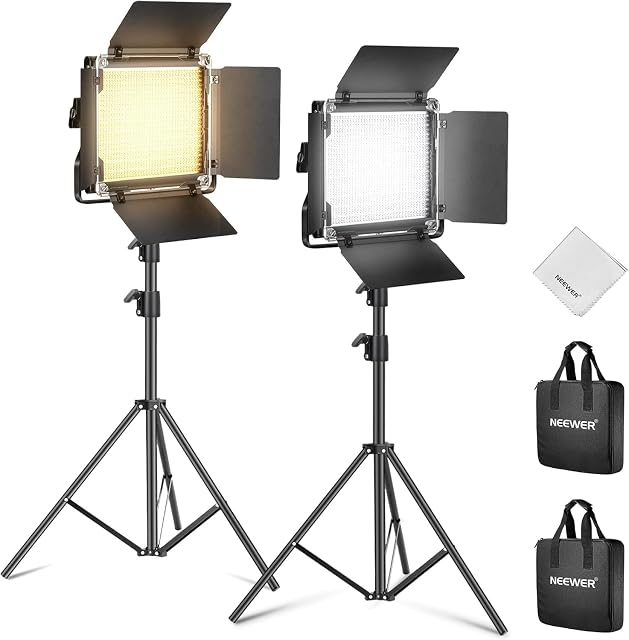
Two panels of 660 LEDs, 330 warm and 330 cool · 40 W each · 3300 lux at 1 m · 3200K to 5600K · CRI 96 or better · brightness 0 to 100 per cent · mains adapter supplied or NP-F550 and NP-F970 cells, not supplied · barn doors and U-brackets with 360 degree tilt · two stands from 66 to 190 cm · panels 232 by 200 by 48 mm · LCD screen · two carry bags
The only light of the four here that publishes an illuminance with its distance — 3300 lux at 1 m — as a pair of 660-LED panels with stands, barn doors and bags for 194 €.
Best for: A two-light setup for portraits, product work or streaming where the panels go on stands, the barn doors control spill, and a socket is available.
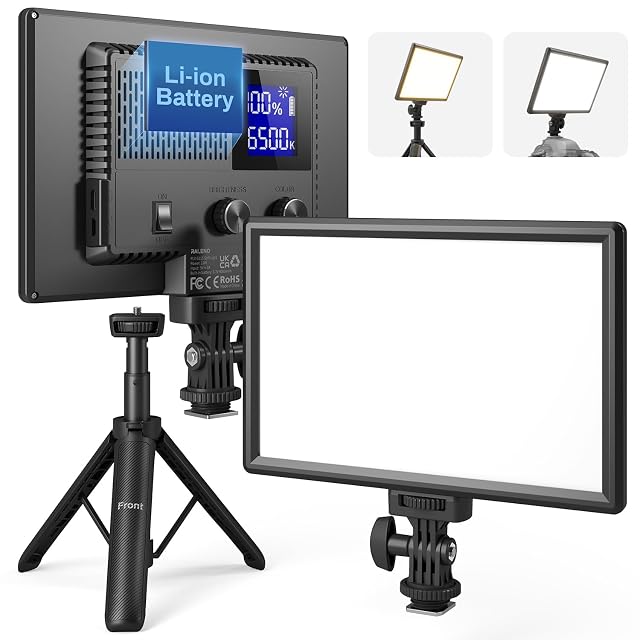
12 W · 600 lux published without a distance · 2500K to 6500K · 116 LEDs · CRI 95 or better · brightness 0 to 100 per cent · 4000 mAh cell, up to 90 minutes at full brightness · pass-through charging over USB-C and USB · 388 g · extendable mini tripod supplied · four-layer diffuser
A panel with a published runtime — 90 minutes at full brightness from 4000 mAh — pass-through charging and a mini tripod in the box for 37 €, with 600 lux quoted at no distance at all.
Best for: Video calls, streaming and desk work where the light has to run for an hour and a half without a mains lead and the tripod is already included.
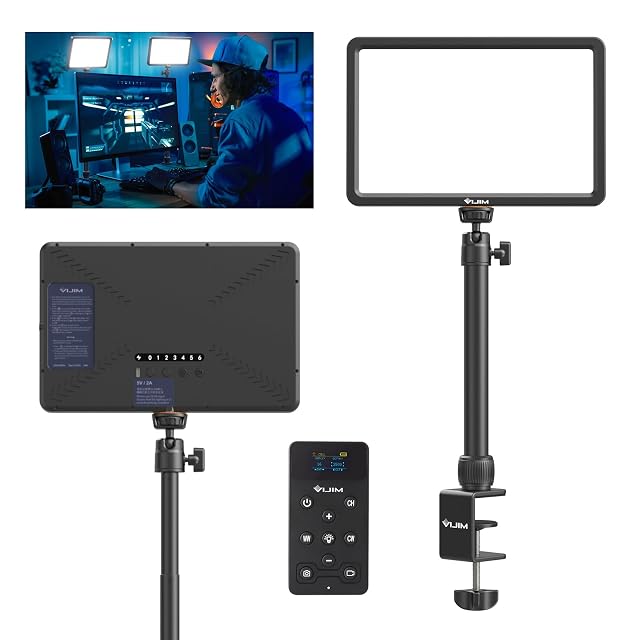
10 W · 600 lumens — a luminous flux, not an illuminance · 2500K to 9000K · 192 LEDs behind an 11 inch panel · 120 degree beam · CRI above 90 · 0 to 100 per cent brightness · edge-lit · magnetic remote with 7 channels and 30 m range · metal C-clamp for desks up to 50 mm, height 30 to 80 cm, 360 degree ball head
An 11 inch key light that clamps to a desk and comes with a magnetic remote reaching 30 metres, for 48 € — publishing 600 lumens, which measures total light output rather than what lands on a face.
Best for: A desk for streaming or calls, where the clamp, the remote and an 11 inch soft source matter and a mains socket is always within reach.