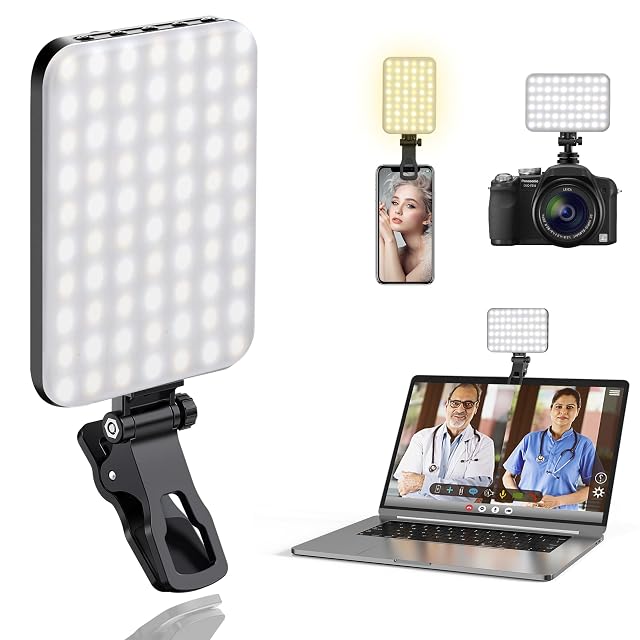
What it comes to A hundred and twenty grams with a softbox already on the front, three cold shoes, both ends of its runtime published and the bead division given — which is the only quantitative thing on a page with no output figure at all. For twenty dollars on a gimbal or a phone rig it is the lightest soft fill here. It publishes no lux, no lumens, no wattage, no dimming range and nothing about flicker.
What the maker commits to in print
“The VL-81 LED video light is an upgraded version of VL49 2000mah led video light. It comes with 81 beads, CRI95 + 3200k-5600k, brighter, bigger angle. Softbox design, not dazzling”
Forty-one white light beads plus forty warm light beads, color temperature 3200K to 5600K, adjustable quickly for the scene
A built-in 3,000 mAh lithium battery: three hours to charge, up to 150 minutes at maximum brightness, up to 480 minutes at minimum
Three cold shoes, so a microphone or a second light can be carried, and a hot shoe base for the camera
7.6 × 8.9 × 2.5 cm (3 × 3.5 × 1 in), 120 g
NO lux. NO lumens. NO wattage. NO dimming range. Nothing about flicker.
It compares itself to a light that publishes nothing either
“Brighter, bigger angle” than the VL49.
And the VL49’s own page on this shelf publishes no output figure, so the chain
leads nowhere.
“Output is quoted in lux at a stated distance.”
Five of the nine American lights here publish none. A buyer cannot tell whether
this panel will light a face at a meter.
The only clue is the bead count: 81, against 60 on the VL49 RGB — which DOES
publish 800 lux at 0.5 m (1.6 ft).
The bead division, which is the one number that works
Forty-one white. Forty warm.
A bi-color panel makes 3200 K by running its warm beads and 5600 K by running its
cool ones. Between the two it runs both.
“A light that mixes warm and cool emitters usually reaches its highest output in
the middle of that range rather than at the ends.”
Forty-one and forty is almost exactly balanced, so the loss at either extreme is
symmetrical and about half.
On a page with no photometry, that is the only quantitative thing on it — and only
this and the NEEWER SL90C publish the counts.
A softbox that is part of the panel
“Softbox design, not dazzling.”
Eighty-one small beads behind clear plastic give eighty-one tiny catchlights in an
eye. A diffuser turns them into one.
A built-in front cannot be lost and cannot fall off mid-shot. What you give up is
the option of a harder light — the VIJIM on this shelf has a silicone cover that
comes OFF.
A hundred and twenty grams
The lightest light on this shelf.
Two hundred and thirty-five grams for the NEEWER SL90C. Two hundred and sixty for
the VIJIM.
On a gimbal, where every gram is paid for twice in balance and in motor load, 120 g (4.2 oz)
is the figure that decides whether the light comes along.
Both ends of the runtime
A hundred and fifty minutes at maximum. Four hundred and eighty — eight hours — at
minimum.
A three-to-one draw, published at both ends.
The ENEGON on this shelf claims twenty hours and names no brightness at all.
Availability
About $20 on the American Amazon store when this page was last checked.
Everything in this section is the figure Keepa carried on the day of the last update to this page. Availability and prices shift without notice.
Prices quoted in this text were read on 8 October 2026. The live price is at the top of the page.
What it does well, and what it gives up
Strengths
A hundred and twenty grams, the lightest here
A softbox built into the front, not a separate cover
The bead division published: 41 white, 40 warm
Both ends of the runtime: 150 and 480 minutes
Three cold shoes and a hot shoe base
Twenty dollars
Compromises
No output figure of any kind
No dimming range published
3200K to 5600K is the narrowest adjustable range here
Nothing about flicker
No TLCI
"Brighter than the VL49" is a comparison, not a measurement
Specifications
Output in lux with its distance
NEITHER PUBLISHED. ULANZI says the VL-81 is "brighter, bigger angle" than the VL49 it upgrades, which is a comparison rather than a measurement, and gives no lux, no lumens, no distance and no wattage. Five of the nine American lights on this shelf publish no output at all, and this is one of them. This shelf's introduction makes it the first of three figures a continuous light is compared on
Color temperature range
3200K TO 5600K, stated, from 41 WHITE and 40 WARM beads — and the DIVISION of the beads is published, which only this and the NEEWER SL90C do on this shelf. That matters because a bi-color panel reaches its extremes by turning one set off: at 3200 K the forty warm beads are working and the forty-one white ones are not, so the output at either end is roughly half what it is in the middle. This shelf's introduction says exactly this, and a page that publishes the counts lets you work out how much
Accuracy indices
CRI 95, stated in the title and the first bullet. The shelf median, behind the 97 of the NEEWER SL90C, the ALTSON and the NiceVeedi pair and the 98 of the published Rollei. No TLCI
Dimming
NOT PUBLISHED AS A RANGE. The page says the color temperature "can be adjusted quickly" and names no brightness steps, no percentage range and no statement of whether the dimming is stepless or stepped — which is unusual for ULANZI, whose VL49 RGB on this shelf publishes 0 to 100 per cent and whose plain VL49 publishes five fixed levels. The runtimes imply a range exists: 150 minutes at maximum against 480 at minimum is a three-to-one draw
Flicker
NOT MENTIONED
Power options
A 3,000 mAh internal cell with BOTH ENDS PUBLISHED — 150 MINUTES at maximum and 480 MINUTES, eight hours, at minimum — and a 3-hour charge over USB-C. Eight hours at minimum is the second longest low-brightness figure on this shelf behind the ALTSON’s 15 hours at 10 per cent, and publishing both ends is the honest form the ENEGON’s bare "20 hours" is not
Mount
THREE COLD SHOES plus a HOT SHOE base, so the panel sits on a camera and carries a microphone and a second light at the same time — the same arrangement as the ULANZI VL49 RGB. And the figure that makes it: 7.6 × 8.9 × 2.5 CM and 120 G, the LIGHTEST light on this shelf, against 235 g (8.3 oz) for the NEEWER SL90C and 260 g (9.2 oz) for the VIJIM. A SOFTBOX FRONT is built in rather than supplied separately
Amazon reference
B089ZS8CC6
EAN
0782902335212
What people ask before they commit
Why does the bead division matter?
Because it tells you where the light is dimmest. A bi-color panel makes 3200 K by running its warm beads and 5600 K by running its cool ones; in between it runs both. So the maximum output is in the MIDDLE of the range and either extreme is roughly half of it — which this shelf's introduction states and almost no page demonstrates. Here the counts are published: 41 white and 40 warm, almost exactly balanced, so the loss is symmetrical and about half at each end. On a panel that publishes no output figure at all, the bead counts are the only quantitative thing on the page.
Is a built-in softbox better than a clip-on diffuser?
Better in practice and worse in flexibility. A softbox front is part of the panel: it cannot be lost, it cannot fall off mid-shot, and the beam is diffused every time without a decision. ULANZI puts it plainly — "softbox design, not dazzling" — which is the right description of what it fixes: 81 small beads behind clear plastic give 81 tiny catchlights in an eye, and a diffuser turns them into one. What you give up is the harder light: a clip-on diffuser like the VIJIM’s silicone cover on this shelf comes off when you want a crisper shadow.
How can a light publish no output at all?
By comparing itself to its predecessor instead. "The VL-81 LED video light is an upgraded version of VL49 2000mah led video light. It comes with 81 beads, CRI95 + 3200k-5600k, brighter, bigger angle." Brighter than a light whose own page on this shelf also publishes no lux figure, so the chain leads nowhere. Five of the nine American lights here do the same thing. The practical consequence is that a buyer cannot tell whether this panel will light a face at a meter, and the only clue is the bead count — 81, against 60 on the VL49 RGB that does publish 800 lux at 0.5 m (1.6 ft).
Where this one places on its bench
At $20, it is the 4 cheapest of the 11 models in this category published here.
Cheapest on the bench$10
Median$30
Dearest on the bench$52
This one against the other photo equipment
photo equipment from the same category, at nearby prices. Only what all of them publish is shown: a column with holes compares nothing.
Model
Price
Output in lux with its distance
Color temperature range
Accuracy indices
Dimming
ULANZI Select VL-81, 81 beads behind a softbox
$20
NEITHER PUBLISHED. ULANZI says the VL-81 is "brighter, bigger angle" than the VL49 it upgrades, which is a comparison rather than a measurement, and gives no lux, no lumens, no distance and no wattage. Five of the nine American lights on this shelf publish no output at all, and this is one of them. This shelf's introduction makes it the first of three figures a continuous light is compared on
3200K TO 5600K, stated, from 41 WHITE and 40 WARM beads — and the DIVISION of the beads is published, which only this and the NEEWER SL90C do on this shelf. That matters because a bi-color panel reaches its extremes by turning one set off: at 3200 K the forty warm beads are working and the forty-one white ones are not, so the output at either end is roughly half what it is in the middle. This shelf's introduction says exactly this, and a page that publishes the counts lets you work out how much
CRI 95, stated in the title and the first bullet. The shelf median, behind the 97 of the NEEWER SL90C, the ALTSON and the NiceVeedi pair and the 98 of the published Rollei. No TLCI
NOT PUBLISHED AS A RANGE. The page says the color temperature "can be adjusted quickly" and names no brightness steps, no percentage range and no statement of whether the dimming is stepless or stepped — which is unusual for ULANZI, whose VL49 RGB on this shelf publishes 0 to 100 per cent and whose plain VL49 publishes five fixed levels. The runtimes imply a range exists: 150 minutes at maximum against 480 at minimum is a three-to-one draw
800 LUX AT 0.5 M, stated, with a 120-DEGREE illumination angle also given — which matters because a wide beam spreads the same light over more area, so 800 lux across 120 degrees is a different proposition from 800 lux in a narrow spot. One of three outputs on this shelf published with its distance, and the beam angle is a figure only this and the published ULANZI K20 give
2500K TO 9000K, stated as dimmable rather than stepped — the SECOND WIDEST range on this shelf, behind only the ENEGON’s 2500–9900K and level with the published Rollei. Two and a half thousand kelvin is candlelight and nine thousand is deep shade; this shelf's introduction warns that a mixed panel usually peaks in the middle of its range, so the 800 lux figure is unlikely to hold at either end
CRI 95, stated as "topest CRI95" and credited with matching sunlight. That is the shelf median: 98 on the published Rollei, 97 on the NEEWER SL90C and the ALTSON, 96 on the published NEEWER pair, 95 here, on the published RaLeno and on three other American lights, 90+ on the Torjim pair, the EMART spotlights and the ULANZI K20, and nothing at all on the ENEGON alone. No TLCI
0 TO 100 PER CENT, stated, with a BUILT-IN LCD DISPLAY "for accurate readings". The display is the part worth noting: hue, brightness and color temperature shown as numbers rather than guessed from a dial, which is what lets a second light be set to match the first. Three lights on this shelf have a screen
NEITHER PUBLISHED, which is the odd part: its own stablemate the VL49 RGB on this shelf publishes 800 lux at 0.5 m (1.6 ft) from 60 beads, and this publishes nothing from 49. The two lights share a name and a body; one page gives the photometry and the other does not. Five of the nine American lights on this shelf publish no output at all
5500 K, FIXED — and this is the ONLY light on this shelf with no color adjustment of any kind. The page makes the case for it: 5500 K color temperature, stated to show the beauty of natural light. Fifty-five hundred kelvin is noon daylight, which is the right single value if you only ever shoot outdoors or in a daylight-balanced room, and the wrong one in a tungsten kitchen. What a fixed panel cannot do is drift: there is no dial to knock
CRI UP TO 95+, stated, with the consequence given — "to reduce post-grading work". Ninety-five is the shelf median. No TLCI
FIVE STEPS, AND ALL FIVE ARE NAMED: 20, 40, 60, 80 and 100 PER CENT. Naming the steps is better practice than "five levels" and better than "dimmable": you know there is nothing below a fifth, and you know the gaps are even. It also means the light cannot be faded out on camera, and 20 per cent is the floor
1,250 LUX, stated as "the Max brightness illuminance up to 1250Lux" — AND NO DISTANCE. That is the exact fault this shelf's introduction names: "the distance is part of the measurement and a figure given without it cannot be compared with anything". Twelve hundred and fifty lux at 0.5 m (1.6 ft) is a bright pocket panel; the same figure at 1 m (3 ft) would be four times the light, and at 0.3 m (1 ft) rather less than it sounds. Of the nine American lights on this shelf, this is the only one that publishes lux and withholds the distance
3200K TO 6500K, stated as steplessly adjustable with brightness "in one switch" — a 3,300 K span, which is the narrowest of the adjustable panels on this shelf bar the published NEEWER pair’s 2,400 K. Three thousand two hundred kelvin is tungsten and 6,500 is a cool overcast daylight, so the range covers indoor and outdoor and does not reach the candlelight or deep shade of the ENEGON and the ULANZI VL49 RGB
CRI 95+, stated in the title and the first bullet, with the consequence spelled out — delivering accurate color reproduction and reducing the workload of post-production grading. That is the right way to sell an index: not as a number but as hours not spent. Ninety-five is the shelf median; 97 on the NEEWER SL90C and the ALTSON, 98 on the published Rollei. No TLCI
10 TO 100 PER CENT, STEPLESS, "adjustable in one switch". Stepless is right; the floor is not — ten per cent is as dim as it goes, where the NEEWER SL90C and the Glendan-style panels reach zero. A light that will not fade below a tenth cannot be faded out on camera, and as a background accent ten per cent of 1,250 lux is still a visible source
What sets the models apart, in photo equipment
If price decides: ULANZI VL49, 5500 K fixed, 49 beads, at $17.
Highest Color temperature range in the table: ULANZI VL49, 5500 K fixed, 49 beads (5500 K, FIXED — and this is the ONLY light on this shelf with no color adjustment of any kind. The page makes the case for it: 5500 K color temperature, stated to show the beauty of natural light. Fifty-five hundred kelvin is noon daylight, which is the right single value if you only ever shoot outdoors or in a daylight-balanced room, and the wrong one in a tungsten kitchen. What a fixed panel cannot do is drift: there is no dial to knock).
Where the price stands, among photo equipment
Details checked on October 8, 2026.
What use this one answers, among photo equipment
The lightest possible fill on a gimbal or a phone rig, where a soft front matters more than a published figure
What buyers actually choose
Amazon reports what buyers took in the month before this page was last checked: at least 2,000.
The figure is a floor, rounded by Amazon, and read through Keepa — it says what buyers picked, not what a maker claims.
Sources
Specifications: the manufacturer sheet for photo equipment and the matching Amazon product page. Prices and availability: Keepa. Every figure on this page names its source.
CRI 97+, the JOINT HIGHEST on this shelf with the NEEWER SL90C · 60 LED beads · THREE light modes, white, natural and warm, across 2500K to 6500K · TEN brightness levels · 2,200 mAh with TWO runtimes published at TWO brightnesses: 15 H at 10 PER CENT and 4 H at 50 · a 160-DEGREE rotating panel AND a 180-DEGREE rotatable 1/4 inch head, with a CLIP and a HOT SHOE mount supplied · 3.9 × 2.8 × 0.78 IN, 95 G · a storage pouch · NO output figure · NOTHING about flicker · $9.68
Ten dollars for the joint-highest color index on this shelf, a clip, a hot shoe and a pouch.
Best for: Video calls, selfies and makeup at a desk, where a faithful color index at ten dollars is the whole point
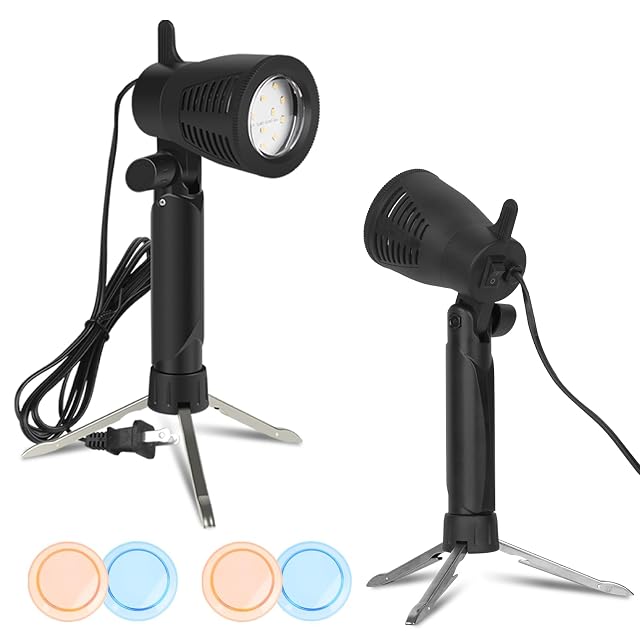
TWO TABLE-TOP SPOTLIGHTS · 600 LUMENS each — a LUMINOUS FLUX, not an illuminance, so it cannot be compared with the lux figures on this shelf · 12 LEDs per light · CRI 90+, the joint weakest here · 5500 K FIXED, with SIX GEL FILTERS to shift it — two white, two orange, two blue · a head swivelling 180 DEGREES · a RETRACTABLE SPRING BRACKET that folds into the base · NO dimming published at all · NO battery · 18 MONTHS of after-sales cover · NOTHING about flicker
Two spotlights that publish lumens where this shelf asks for lux — and gels instead of a dimmer.
Best for: Lighting a light tent or a tabletop set-up from two sides, where a concentrated beam and a folding stand matter more than a dimmer
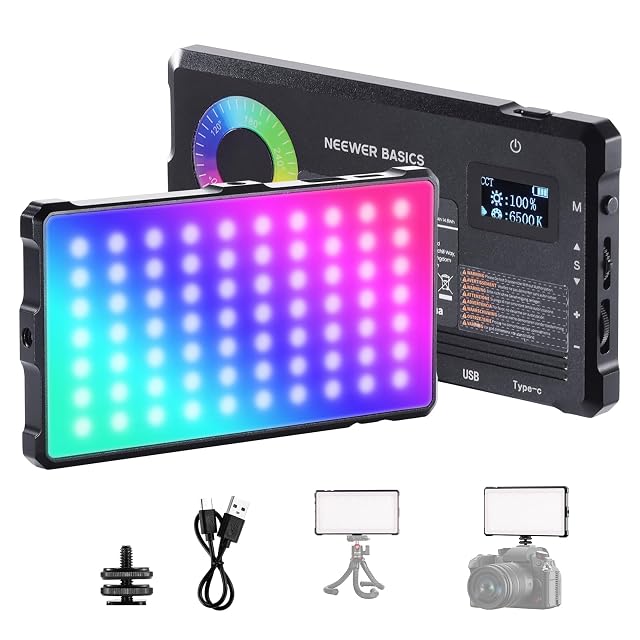
1090 LUX AT 0.5 M — one of only three outputs on this shelf published WITH its distance, and the highest among the pocket panels · 2700K to 7500K in CCT mode · CRI 97, joint highest here with the ALTSON D6 and the NiceVeedi pair · 138 beads: 45 WARM, 45 COOL and 48 RGB · THREE MODES, CCT, HSI and FX with 17 SCENES · 360-degree hue selection · STEPLESS 0 to 100 per cent · 4,000 mAh for 113 MINUTES at full, with a USB OUTPUT that charges a phone · 15 × 8 × 1.2 cm (5.9 × 3.1 × 0.5 in), 235 g · cold shoe adapter and 1/4 inch holes · NOTHING about flicker
The brightest pocket panel on this shelf that publishes its distance — and the only light here that will also charge your phone.
Best for: A pocket key or fill light where color accuracy comes first and the panel has to earn its place in the bag twice over