One focal length, and usually the widest aperture the money buys · review
Sony SEL35F18F, FE 35mm F1.8, 9 blades review
A sealed full-frame 35mm at F1.8 for 499 €, with nine rounded blades and a focus hold button — and a page that names two different focus drive systems for the same lens.
The bottom line Sealing, nine rounded blades and a pair of real controls make this a working lens rather than a collection of adjectives, and those are what 499 € buys. Then the page names two incompatible focus drives, and leaves the thread, the weight and the close-focus distance to be discovered after purchase.
On the listing
Five bullets. A reliability-of-focus bullet arguing that the shallow depth of field at F1.8 makes focus decisive, and crediting a high-precision linear motor autofocus drive with precise, quiet work; beautiful bokeh from a nine-blade circular aperture giving natural-looking results; a dust and moisture resistant design for outdoor reliability in difficult conditions; a powerful DDSSM Direct Drive SSM focus drive said to provide the speed and precision needed for stills and video; and a controls bullet naming a focus mode switch and a customisable focus hold button.
Two motors named for one lens
The first bullet says linear motor. The fourth says Direct Drive SSM. They are different mechanisms with different characteristics, and they sit four sentences apart on the same listing. The page states both and reconciles neither.
Nine blades and a sealing claim
The two things this page publishes that most of the shelf does not. Nine rounded blades shape the background the second bullet is selling, and the third bullet is one of three sealing statements in this entire lot. For a lens carried outdoors every day, that pair is the argument.
The controls, and who they are for
A focus mode switch and a focus hold button belong on a lens used deliberately: framed, focused, held. They cost nothing to leave off, and their presence is the clearest signal of the buyer Sony had in mind.
The measurements that are missing
No thread diameter, which decides what a filter costs. No minimum focus distance, which decides how close the lens works. No weight and no length, which decide what it is like to carry. Four blanks, at 499 €.
Availability
Between 499 € and 599 € on the German, French, Italian and Spanish Amazon stores when this page was last checked.
The American and British Amazon stores carry it too, priced in local currency. Those amounts are deliberately absent from the range above, which reads euro stores only.
Everything in this section is the figure Keepa carried on the day of the last update to this page. Availability and prices shift without notice.
Prices quoted in this text were read on 13 September 2026. The live price is at the top of the page.
What it does well, and what it gives up
Strengths
A dust and moisture resistant design, one of three sealing claims in this catalogue
Nine rounded blades published, on a lens where the background rendering is the reason to buy
A focus mode switch and a customisable focus hold button, controls this shelf otherwise does without
Compromises
Two different focus drive systems named on one page, in the first bullet and the fourth
No filter thread, no minimum focus distance and no weight published at 499 €
No angle of view given, on a lens the title sells as a wide angle for two different formats
Specifications
Focal length
35mm, fixed, in the title, which calls it a wide-angle prime. On the full-frame format it is the reportage length — wider than normal, narrow enough not to distort a face at conversational distance. No angle of view is published
Format
Full frame, with APS-C named in the title alongside it. The compatibility list runs from the A7 series to the A6000 series and the ZV bodies, and the page never says how the framing differs between them
Maximum aperture
F1.8, in the title. The first bullet builds its argument on the consequence rather than the number: at the shallower depth of field F1.8 gives, focus is decisive, which is why it then describes the focus system
Blade count and shape
Nine blades, circular, published in the second bullet and credited with soft, natural-looking bokeh. One of only three blade counts of the eight here
Autofocus motor
The page names two. The first bullet describes a high-precision linear motor autofocus drive system; the fourth names a powerful DDSSM, or Direct Drive SSM, focus drive. These are different mechanisms, both stated on the same listing, and this page does not settle which the lens has
Minimum focus
Not published on the listing, and no magnification ratio. On a 35mm lens used for reportage and for objects on a table, the close-focus distance is a working figure and it is absent
Filter thread
Not published in millimetres. Five bullets cover the focus, the bokeh, the sealing, the drive system and the controls, and none of them gives a diameter
Sealing
Claimed — the third bullet states a dust and moisture resistant design offering the reliability needed outdoors in difficult conditions. Only three pages of the eight here make such a claim, and no ingress standard is cited here either
Weight
Not published in grams, and no length. Two lenses on this shelf publish both for less money
Amazon reference
B07V8X4KGG (same reference on 6 Amazon marketplaces)
EAN
4548736099760
What people ask before they commit
Which focus system does this lens actually use?
The listing names two. The first bullet describes a high-precision linear motor drive; the fourth names a Direct Drive SSM system, which is a different mechanism. Both statements are on the same page and neither is qualified. This page reports the contradiction rather than resolving it, because only the maker can.
Why does the first bullet talk about focus rather than light?
Because of what F1.8 does to depth of field. On a full-frame 35mm at close range the zone that is actually sharp is thin, so a focus system that is nearly right produces a photograph that is wrong. The bullet makes that argument explicitly — the aperture creates the problem, and the drive system is offered as the answer.
What does the focus hold button do on a 35mm lens?
The fifth bullet names it as customisable, alongside a focus mode switch. Held down, it stops the lens from refocusing, which keeps a composed frame from being pulled away by something crossing it. It is a control usually found on longer lenses, and its presence here — along with the sealing — says the lens was designed for working outdoors rather than for occasional use.
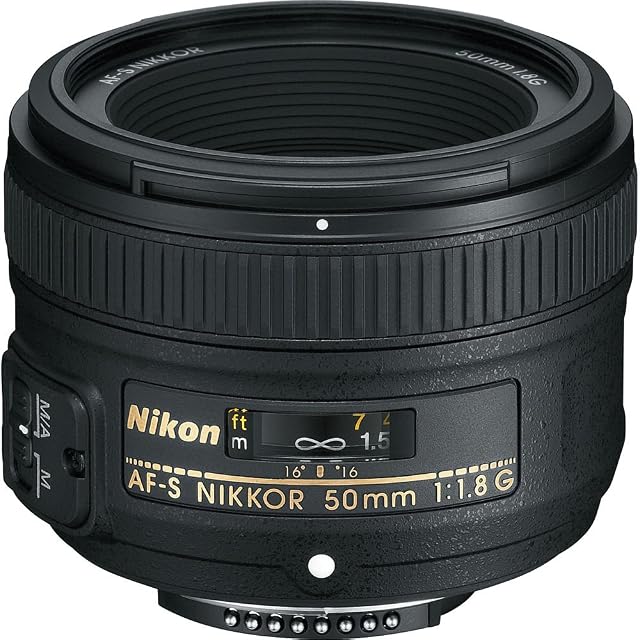
Nikon F mount · FX format, framing as 75mm on a DX body · 50mm · f/1.8 · Silent Wave Motor · two focus modes, autofocus and manual · aspherical element · 58mm filter thread · no blade count published · no minimum focus published · no sealing claimed · no weight published
The classic normal prime on the F mount at 219 €, publishing a 58mm thread, a Silent Wave Motor and its DX framing — on a page that prints the same five bullets twice over.
Best for: A normal prime on an FX body, or a short portrait lens on a DX one, where a motor in the lens and a cheap thread matter as much as the glass.
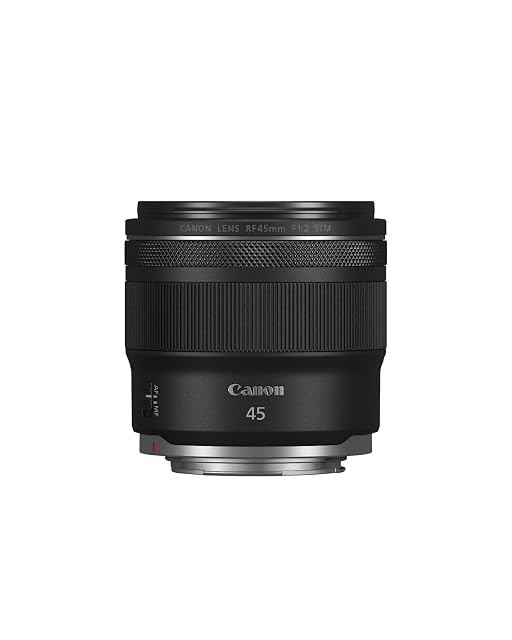
RF mount · 45mm · F1.2 · STM motor · configurable control ring · stated as weighing less than 400 g, which is a ceiling rather than a measurement · no blade count published · no minimum focus published · no filter thread published · no sealing claimed
The widest aperture in this entire lot at F1.2 for 439 €, in a barrel the page says weighs less than 400 g — a ceiling rather than a figure — with no blade count, no thread and no close-focus distance published.
Best for: Street portraits on an EOS R body where F1.2 is the entire point, and the control ring replaces the settings a spare hand would otherwise reach for.
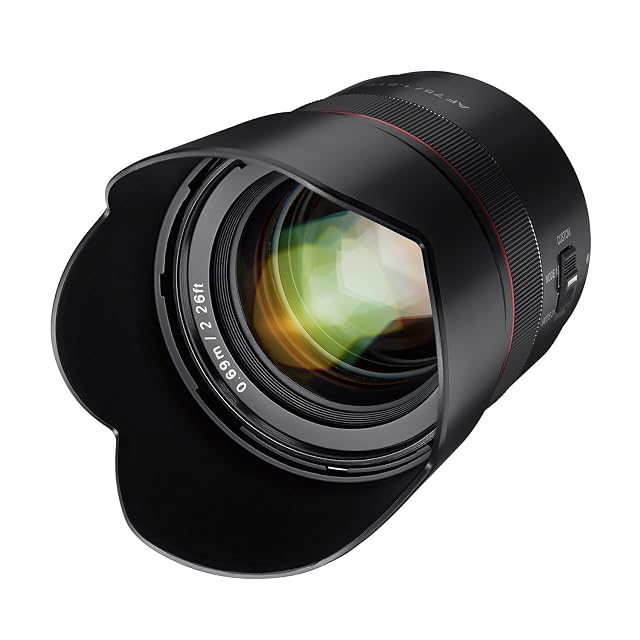
Sony E mount · full frame, and APS-C · 75mm · F1.8, closing to F22 · 9 aperture blades · LSTM autofocus, under 0.2 seconds and 23 dB · minimum focus 69 cm · 58mm filter thread · 230 g · 69mm long · 10 elements in 9 groups, 3 ED and 2 HR · angles of view 32.9 degrees on full frame and 21.9 on APS-C · no sealing claimed
Eight of the nine lines this shelf compares, answered with figures: 230 g, nine blades, 58mm of thread, 69 cm of close focus, and an autofocus timed at under 0.2 seconds and measured at 23 decibels.
Best for: Portraits on a Sony full-frame body where the lens has to stay light, and video where 23 decibels of focusing noise is the specification that matters.