One focal length, and usually the widest aperture the money buys · review
Sigma 35mm F1.4 DG DN Art for Sony E review
The dearest lens of the eight here at 879 €, a full-frame 35mm at F1.4 from Sigma’s Art line — sold on five phrases that publish the aperture and nothing else measurable.
The bottom line F1.4 on full frame from the Art line is a serious lens and the price says so, but the listing is the emptiest in this catalogue in proportion to its cost: one figure, four adjectives, and no blade count, thread, weight, close-focus distance or sealing claim. The 499 € alternative beside it publishes its blades and its sealing.
On the listing
Five phrases, and that is everything: high-performance optics for mirrorless camera systems; fast and quiet autofocus; crystal-clear imaging performance; a Super Multi-Layer coating reducing stray light and ghost images; and a closing line stating that the lens has a maximum aperture of F1.4.
Eight hundred and seventy-nine euros, five phrases
The most expensive page of the eight here, and the least informative. The lens two places down costs 499 €, publishes a blade count and claims a sealed design. This one publishes the number that is already in its name.
F1.4 on full frame, which is the whole page
Two-thirds of a stop past the Sony alternative, two-thirds behind the Canon above it. On a 35mm lens at full frame that aperture is what allows an interior at dusk to be photographed at a sensible sensitivity, and it is the only claim here that can be checked against another product.
The coating is the one technical statement
Flare and ghosting are the characteristic failures of a fast wide lens pointed anywhere near a light source, and the fourth bullet names the remedy. It is the only bullet on the page that identifies a problem before offering a solution.
The third Sigma here, and the third page like this
The 18-50mm on the standard zoom shelf gives five phrases and no figures. The 16mm on the wide-angle shelf gives five phrases and one precisely worded mount seal. This one gives five phrases and an aperture. Across three price points the pattern does not change, and it means the same thing each time: these lenses are not documented where they are sold.
Availability
Between 879 € and 958 € on the German, Italian and Spanish Amazon stores when this page was last checked.
The American and British Amazon stores carry it too, priced in local currency. Those amounts are deliberately absent from the range above, which reads euro stores only.
Listed in the French Amazon catalogue with nothing on sale against the entry: the camera has a page there and no seller behind it.
Everything in this section is the figure Keepa carried on the day of the last update to this page. Availability and prices shift without notice.
Prices quoted in this text were read on 13 September 2026. The live price is at the top of the page.
What it does well, and what it gives up
Strengths
F1.4 on full frame, two-thirds of a stop past the sealed Sony alternative beside it
A Super Multi-Layer coating named against flare and ghosting, which on a fast wide lens used against the light is the relevant failure
An Art-line designation, which is Sigma’s own marking for its optically uncompromised range
Compromises
The dearest lens of the eight here at 879 €, and the only measurable specification on the page is the aperture
No blade count, no thread, no minimum focus, no weight, no sealing claim — five of the nine lines here are blank
Autofocus called quiet with no motor named and no figure given
Specifications
Focal length
35mm, fixed, in the title. The reportage length on full frame, and the page publishes no angle of view to confirm what it frames
Format
Full frame. DG is Sigma’s designation for it, in the product name, and DN marks the mirrorless design. The first bullet says high-performance optics for mirrorless camera systems and never names the sensor size in words
Maximum aperture
F1.4, given in the title and repeated as the fifth bullet, which exists solely to state that the lens has a maximum aperture of F1.4. It is two-thirds of a stop wider than the Sony beside it and two-thirds behind the Canon above it
Blade count and shape
Not published on the listing. This is an Art-line lens at 879 € and the number that shapes its background rendering is absent from a page of five phrases
Autofocus motor
Not named. The second bullet says fast and quiet autofocus and stops there, so whether it is a linear motor, a stepping motor or a ring-type drive cannot be read from the page — and quiet is an adjective where the Samyang two places up publishes 23 decibels
Minimum focus
Not published on the listing, and no magnification ratio
Filter thread
Not published in millimetres. Nothing on the page describes the front of the lens at all
Sealing
Not claimed. The 16mm Sigma on the wide-angle shelf claims a dust and splash-protected mount; this page, for a lens costing more than twice as much, claims nothing
Weight
Not published in grams, and no length. The page contains no physical description of the lens whatsoever
Amazon reference
B093JQ7XPK (same reference on 6 Amazon marketplaces)
EAN
0085126303655
What people ask before they commit
What does the Art designation mean?
It is Sigma’s own line marking, not an industry term. Art denotes the range the maker builds for optical performance ahead of size and weight, as against its Contemporary line, which balances the two — the 16mm and 18-50mm lenses elsewhere in this catalogue are Contemporary. The designation appears in the product name and no bullet explains it.
What is Super Multi-Layer coating for?
The fourth bullet names it as reducing stray light and ghost images. Every glass surface reflects a little of the light that reaches it, and in a lens with many elements those reflections bounce around and land back on the sensor as veiling haze or as distinct ghosts of a bright source. Multi-layer coatings cut the reflection at each surface. On an F1.4 lens with a large front element, it matters.
Why does an 879 € lens publish so little?
The page carries five short phrases: high-performance optics, fast quiet autofocus, crystal-clear imaging, the coating, and the F1.4 aperture. It is the same pattern as the other two Sigma lenses in this catalogue, both of which also publish no measurements. What can be said is that the listing is not where this lens is documented, and a buyer choosing between it and the sealed alternative beside it will have to look elsewhere.
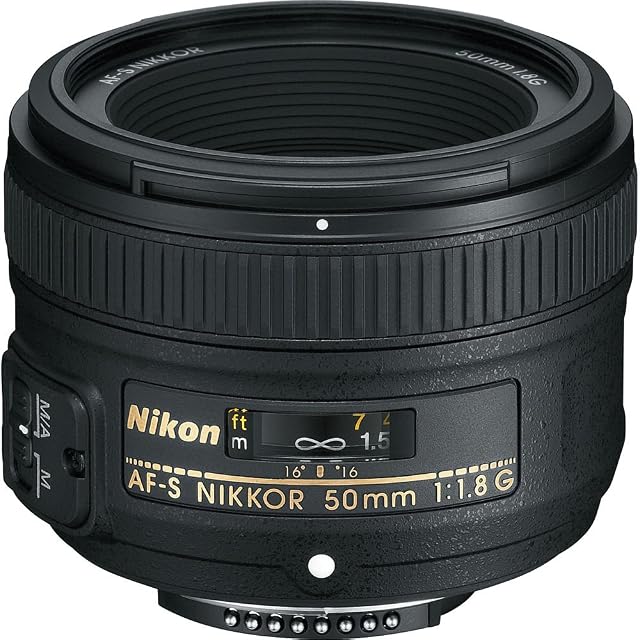
Nikon F mount · FX format, framing as 75mm on a DX body · 50mm · f/1.8 · Silent Wave Motor · two focus modes, autofocus and manual · aspherical element · 58mm filter thread · no blade count published · no minimum focus published · no sealing claimed · no weight published
The classic normal prime on the F mount at 219 €, publishing a 58mm thread, a Silent Wave Motor and its DX framing — on a page that prints the same five bullets twice over.
Best for: A normal prime on an FX body, or a short portrait lens on a DX one, where a motor in the lens and a cheap thread matter as much as the glass.
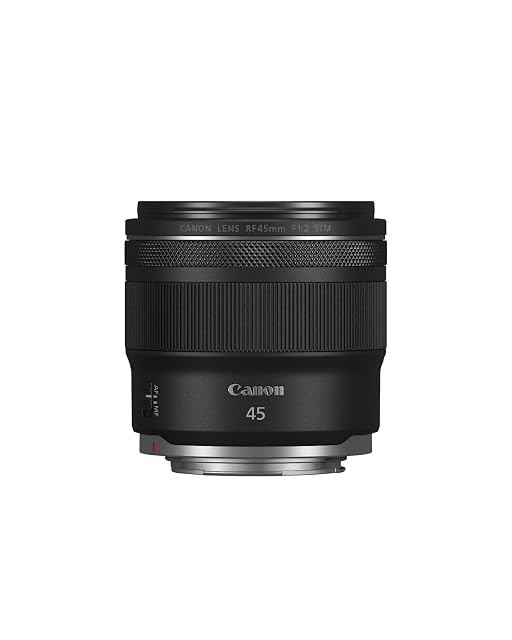
RF mount · 45mm · F1.2 · STM motor · configurable control ring · stated as weighing less than 400 g, which is a ceiling rather than a measurement · no blade count published · no minimum focus published · no filter thread published · no sealing claimed
The widest aperture in this entire lot at F1.2 for 439 €, in a barrel the page says weighs less than 400 g — a ceiling rather than a figure — with no blade count, no thread and no close-focus distance published.
Best for: Street portraits on an EOS R body where F1.2 is the entire point, and the control ring replaces the settings a spare hand would otherwise reach for.
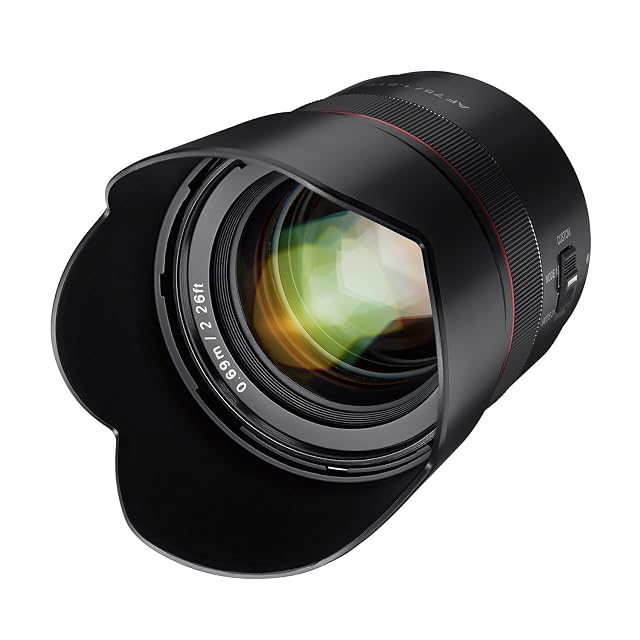
Sony E mount · full frame, and APS-C · 75mm · F1.8, closing to F22 · 9 aperture blades · LSTM autofocus, under 0.2 seconds and 23 dB · minimum focus 69 cm · 58mm filter thread · 230 g · 69mm long · 10 elements in 9 groups, 3 ED and 2 HR · angles of view 32.9 degrees on full frame and 21.9 on APS-C · no sealing claimed
Eight of the nine lines this shelf compares, answered with figures: 230 g, nine blades, 58mm of thread, 69 cm of close focus, and an autofocus timed at under 0.2 seconds and measured at 23 decibels.
Best for: Portraits on a Sony full-frame body where the lens has to stay light, and video where 23 decibels of focusing noise is the specification that matters.