A bulbous front element decides whether filters are possible at all · review
Sony SEL11F18, 11mm F1.8 APS-C prime review
The widest engraving on this shelf at 11mm with an F1.8 maximum, for 460 €, sold on six named elements and two focus motors — and publishing neither a thread, a close-focus distance, a weight nor a sealing claim.
The bottom line Eleven millimetres at F1.8 with six named elements and two focus motors is a serious ultra wide, and the optical description is the most careful on this shelf. Four of the eight lines it is compared on are blank, including the filter question and the close-focus distance that its own vlogging pitch depends on.
On the listing
Five bullets. Three extra-low dispersion elements and three aspherical elements credited with outstanding resolution on an APS-C ultra wide-angle lens with a constant F1.8 aperture, named for vlogging, content creation, video and photography; a seven-blade circular aperture for background blur; two linear motors for fast, accurate focusing; a bullet calling the lens ideal for extreme wide-angle work in architecture and landscape, and for creative perspectives and panoramas; and a box list naming the lens, the front cap, the rear cap, the hood and the manual.
Six elements that do two different jobs
Three ED and three aspherical, counted apart. Colour fringing and edge aberration are different faults with different remedies, and this is the only page on the shelf that states how many elements are aimed at each. It is the strongest part of the listing.
F1.8 held on an eleven millimetre lens
The first bullet calls the aperture constant. On a prime that describes behaviour through focus rather than through zoom, and at 11mm on APS-C the combination of that much coverage and that much light is what separates this from the cheaper lenses here.
The hood is in the box, the thread is not on the page
The box list is precise about what ships: hood, front cap, rear cap, manual. It never gives a diameter, and the page never describes the front element. For an ultra wide that single absence is the difference between a filter costing thirty euros and costing several hundred.
Sold for vlogging, and the working distance is missing
An 11mm lens at arm’s length is the shot the first bullet describes. How close the lens will actually focus is not published anywhere on the page, and neither is the weight of the thing being held out at the end of that arm.
Availability
Between 460 € and 529 € on the German, French, Italian and Spanish Amazon stores when this page was last checked.
The British Amazon store carry it too, priced in local currency. Those amounts are deliberately absent from the range above, which reads euro stores only.
Listed in the American Amazon catalogue with nothing on sale against the entry: the camera has a page there and no seller behind it.
Everything in this section is the figure Keepa carried on the day of the last update to this page. Availability and prices shift without notice.
Prices quoted in this text were read on 13 September 2026. The live price is at the top of the page.
What it does well, and what it gives up
Strengths
Three ED and three aspherical elements, counted separately, against two different families of aberration
F1.8 described as constant, with two linear motors driving the focus
A hood supplied in the box, listed alongside both caps
Compromises
No filter thread published, which on an 11mm lens is the question that decides whether filters are possible at all
No minimum focus distance, on a lens the first bullet sells for vlogging
No weight, no length and no sealing claim, at 460 €
Specifications
Focal length
11mm, fixed, in the title. The shortest on this shelf apart from the TTARTISAN, and the first bullet calls the result an ultra wide angle without printing what that comes to in degrees
Format
APS-C, stated in the title and again in the first bullet, which calls it an APS-C ultra wide-angle lens with a constant F1.8 aperture and names vlogging and content creation among the uses
Maximum aperture
F1.8, described in the first bullet as constant — on a prime that phrasing means the maximum does not change as the lens focuses, which is worth stating on a design where the barrel moves internally. Two-thirds of a stop behind the Sigma below it and a stop past the Samyang
Filter provision
Not published on the listing. The box list names a front cap, a rear cap and a hood, and no thread diameter appears — so whether the hood is the only thing that goes on the front of this lens is not answerable from the page
Distortion type
Not stated on the listing. The fourth bullet names architecture and landscape as ideal uses and describes creative perspectives and panoramas, and never says how the lens renders a straight line
Minimum focus
Not published on the listing, and no magnification ratio — an omission that matters on a lens sold for vlogging, where the distance from the front element to the face holding the camera is the working figure
Sealing
Not claimed. Architecture and landscape are named as uses and no protection against dust or moisture appears, where the Sigma below it claims a protected mount and the Samyang claims weather protection
Weight
Not published in grams, and no length. The page counts six special elements and weighs none of them
Amazon reference
B0B2RZZBPN (same reference on 6 Amazon marketplaces)
EAN
4548736132177
What people ask before they commit
Why are the ED and aspherical elements counted separately?
They correct different problems. The three extra-low dispersion elements deal with wavelengths converging at different points, which shows as coloured fringes on high-contrast edges. The three aspherical elements have non-spherical surface profiles and deal with rays through the outer part of the glass failing to meet where the central ones do — a fault that grows worse the wider a lens gets. The first bullet names both counts for that reason.
What makes an 11mm lens suitable for vlogging?
The arm. Held at arm’s length, a camera is well under a metre from the face, and at that distance most lenses frame a head and nothing else. Eleven millimetres on APS-C takes in the speaker and the room behind them, which is the shot the first bullet is describing. What the page does not publish is how close the lens will focus, which is the other half of that requirement.
Does the supplied hood mean there is no filter thread?
It does not follow either way, and the listing does not say. A bayonet hood can sit outside a thread or in place of one. The box list names the hood and both caps and prints no diameter, so the question stays open on this page — which the hub above identifies as the first thing to check before buying a lens this wide.
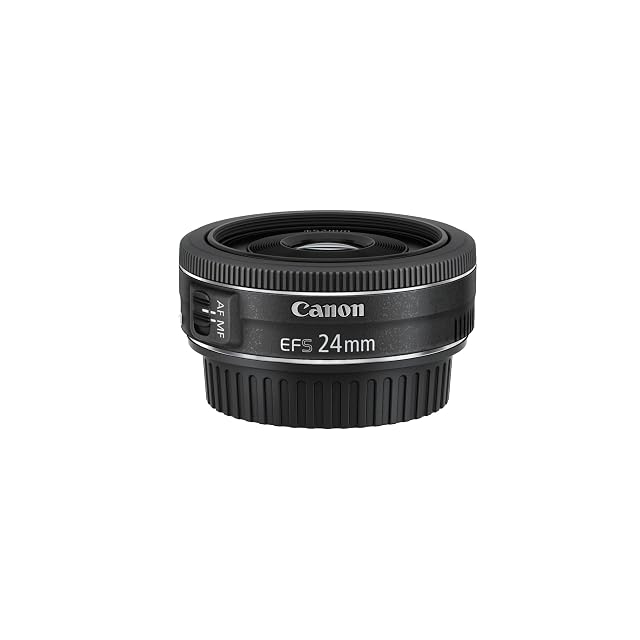
EF-S mount · APS-C · 24mm · F2.8 · 52mm filter thread · angles of view 59°10 by 50°35 by 34°55 · minimum focus about 0.16 m · STM focusing, not compatible with an extender · no distortion type stated · no sealing claimed · no weight published
A 149 € pancake that publishes the two things this shelf most often leaves out — a 52mm filter thread and a minimum focus of about 0.16 m — and carries two catalogue fields that belong to a video camera.
Best for: An EF-S body that needs to become pocketable, where 24mm on APS-C frames much as the eye does and the thread stays cheap.
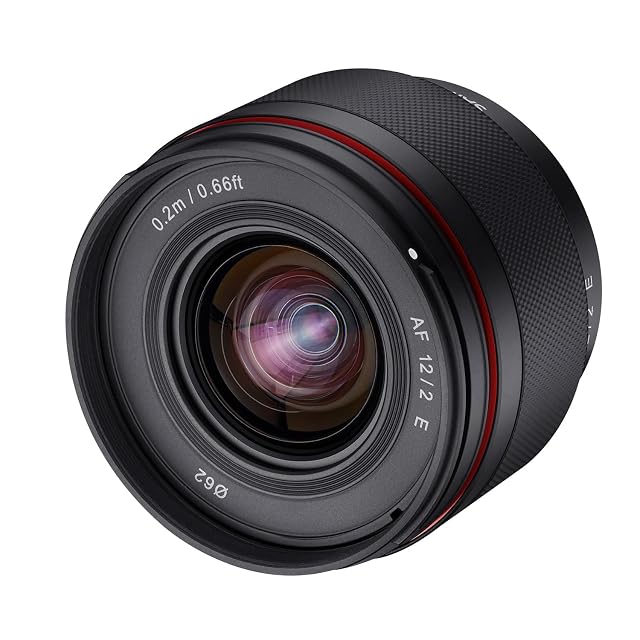
Sony E mount · APS-C · 12mm · F2.0, closing to F22 · 99.1 degree angle of view · 62mm filter thread · minimum focus 19 cm · 12 elements in 10 groups · UMC coating · weather protection claimed · 213 g · 59mm long · detachable hood supplied
The best-documented page of the five here: 213 g, 62mm of thread, 19 cm of close focus, 99.1 degrees, twelve elements in ten groups and a weather-protection claim, for 283 €.
Best for: Astrophotography and interiors on a Sony APS-C body, for someone who wants an ultra wide that autofocuses and whose filters cost what filters normally cost.
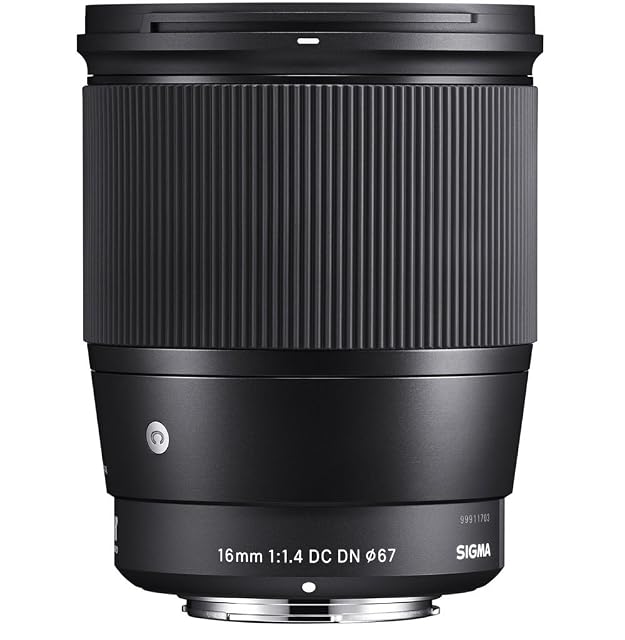
Sony E mount · APS-C · 16mm · F1.4 · dust and splash protection at the mount, stated for the mount alone · quiet autofocus · no filter provision published · no distortion type stated · no minimum focus published · no weight published
The widest aperture on this shelf at F1.4 for 385 €, with a dust and splash-proof mount stated precisely as the mount — and five phrases of copy that answer none of the other seven lines this shelf compares.
Best for: Available light on a Sony APS-C body, where F1.4 at 16mm is the whole reason and the rest will be discovered after purchase.