A bulbous front element decides whether filters are possible at all · review
Samyang AF 12mm F2.0 E, 213 g, 62mm thread review
The best-documented page of the five here: 213 g, 62mm of thread, 19 cm of close focus, 99.1 degrees, twelve elements in ten groups and a weather-protection claim, for 283 €.
The bottom line Seven of the eight lines this shelf compares are answered here, with figures rather than adjectives, and the eighth — the distortion type — is the only blank. At 283 € with autofocus, a 62mm thread and 213 g, it is the most completely described lens in this catalogue.
On the listing
Five bullets, and the fourth one is a specification sheet in miniature. A legendary 12mm F2.0 APS-C lens now with autofocus, for mirrorless Sony APS-C E-mount bodies, named for astrophotography, architecture, landscape and interior work; a compact astro specialist with a 99.1 degree angle of view, F2.0 speed, modern autofocus and a weather protection function; a long compatibility list from the A6700 through the NEX series to the A7C II; a detail bullet giving the angle, the aperture range to F22, a 19 cm minimum focus, 12 elements in 10 groups, UMC coating, a 59mm length, a 62mm filter diameter, a 70mm barrel diameter, 213 g and a detachable hood; and a box list naming the lens, the hood, a pouch, a bayonet cap, a front cap and the paperwork.
Every line this shelf compares, answered but one
Seven of eight, with numbers. The angle of view, the aperture range, the thread, the close focus, the element count, the weight and the length are all printed in a single bullet. Nothing else of the five here comes close, and two pages on this shelf publish no measurements at all.
Two hundred and thirteen grams and sixty-two millimetres
The weight is what makes an ultra wide worth carrying as a second lens, and the thread is what makes it affordable to filter. A 62mm polariser is an ordinary purchase. The hub above warns that the widest lenses turn every filter already owned into a bracket system; this one does the opposite.
Nineteen centimetres from the sensor
The shortest close focus on this shelf. On a 12mm lens that is the distance at which a foreground stone or a flower becomes the subject while the whole horizon stays behind it.
The distortion line, and the standard that is not named
No distortion type. Twelve elements in ten groups are counted, the coating is named, and how the lens renders a straight line is never described. On a 99 degree lens sold for architecture that is the line worth having.
Weather protection without a standard. The claim is made once, in the second bullet, and nothing qualifies it.
Availability
Between 283 € and 296 € on the German, French, Italian and Spanish Amazon stores when this page was last checked.
The American and British Amazon stores carry it too, priced in local currency. Those amounts are deliberately absent from the range above, which reads euro stores only.
Everything in this section is the figure Keepa carried on the day of the last update to this page. Availability and prices shift without notice.
Prices quoted in this text were read on 13 September 2026. The live price is at the top of the page.
What it does well, and what it gives up
Strengths
Every practical figure published: 213 g, 59mm long, 62mm thread, 19 cm minimum focus, 99.1 degrees
Autofocus on an ultra wide at 283 €, where two of the five lenses here focus only by hand
A detachable hood, a pouch and both caps listed in the box, and weather protection claimed
Compromises
No distortion type stated, on a page that counts twelve elements in ten groups
The weather-protection claim names no standard and no extent
F2.0 rather than the F1.8 or F1.4 of the two dearer lenses here
Specifications
Focal length
12mm, fixed, in the title, with the fourth bullet giving what it produces: 99.1 degrees of coverage on APS-C. Both halves are published, which is what the hub above asks for and what most of this shelf does not do
Format
APS-C, stated repeatedly. The first bullet names mirrorless Sony APS-C system cameras with E mount, the third lists the bodies from the A6700 down to the A3000 and the NEX series, and the fourth prints the APS-C angle of view as 99.1 degrees
Maximum aperture
F2.0, with the fourth bullet giving the full range as F2.0 to F22. The first bullet names astrophotography, architecture, landscape and interiors as the uses, all of which are the reasons a wide lens needs the light
Filter provision
62mm thread, published in the fourth bullet alongside a 70mm barrel diameter. There is a thread, it is a common size, and the page prints it — three things the hub above treats as the deciding question on this shelf, and only two lenses here answer all of them
Distortion type
Not stated on the listing. Twelve elements in ten groups are counted and the coating is named, and no description of how straight lines are rendered appears — the one line this otherwise complete page leaves blank
Minimum focus
19 cm, published in the fourth bullet. The shortest close-focus distance on this shelf, and on a 12mm lens it makes a foreground object enormous against a 99 degree background
Sealing
Weather protection is claimed in the second bullet, alongside the autofocus, as a feature of the construction. No ingress standard is cited and no extent is described, so it is a resistance claim in the maker’s words rather than a rating
Weight
213 g, published in the fourth bullet with a length of 59mm. The lightest lens of the five here that publishes a figure at all, and the bullet puts both numbers beside the optical count
Amazon reference
B093BN913R (same reference on 6 Amazon marketplaces)
EAN
8809298887490
What people ask before they commit
What is UMC coating?
Samyang’s designation for its multi-layer anti-reflection coating, named in the fourth bullet among the optical details. Coatings reduce the light that bounces between glass surfaces instead of passing through, which is what causes flare and ghosting. On a 99 degree lens the sun is inside the frame far more often than on a long one, so the coating is doing more work here than usual.
Why is 19 cm close focus interesting on a wide lens?
Because of what a wide angle does with proximity. At 19 cm a small foreground object fills a large part of the frame while the background still stretches across 99 degrees behind it. That exaggerated relationship is the characteristic wide-angle photograph, and it needs a lens that will focus this close to produce it. It is the shortest figure on this shelf.
How much does the weather protection claim cover?
The second bullet names a weather protection function as part of the construction and says no more. No ingress rating is cited, no seal count is given, and no conditions are described. It is a claim worth having on a lens sold for landscape and astrophotography, and it is not a specification that can be compared with anything.
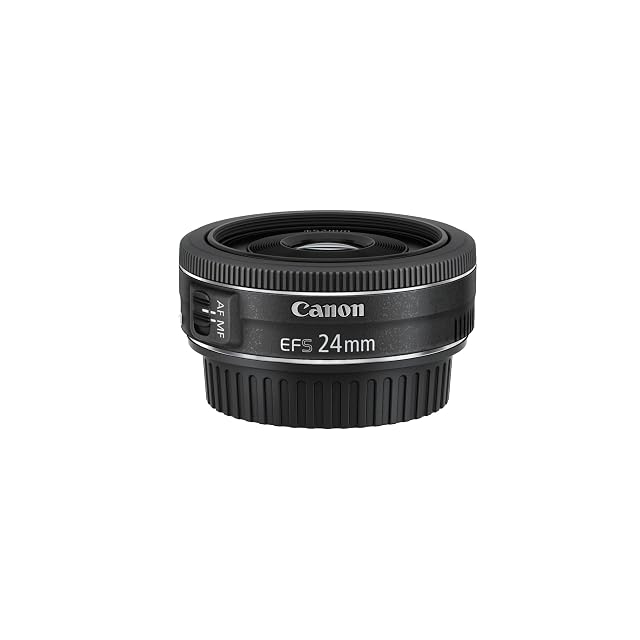
EF-S mount · APS-C · 24mm · F2.8 · 52mm filter thread · angles of view 59°10 by 50°35 by 34°55 · minimum focus about 0.16 m · STM focusing, not compatible with an extender · no distortion type stated · no sealing claimed · no weight published
A 149 € pancake that publishes the two things this shelf most often leaves out — a 52mm filter thread and a minimum focus of about 0.16 m — and carries two catalogue fields that belong to a video camera.
Best for: An EF-S body that needs to become pocketable, where 24mm on APS-C frames much as the eye does and the thread stays cheap.
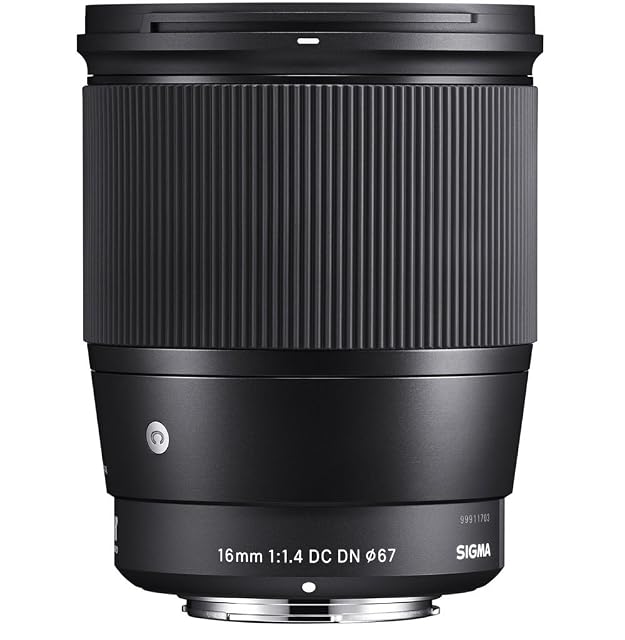
Sony E mount · APS-C · 16mm · F1.4 · dust and splash protection at the mount, stated for the mount alone · quiet autofocus · no filter provision published · no distortion type stated · no minimum focus published · no weight published
The widest aperture on this shelf at F1.4 for 385 €, with a dust and splash-proof mount stated precisely as the mount — and five phrases of copy that answer none of the other seven lines this shelf compares.
Best for: Available light on a Sony APS-C body, where F1.4 at 16mm is the whole reason and the rest will be discovered after purchase.
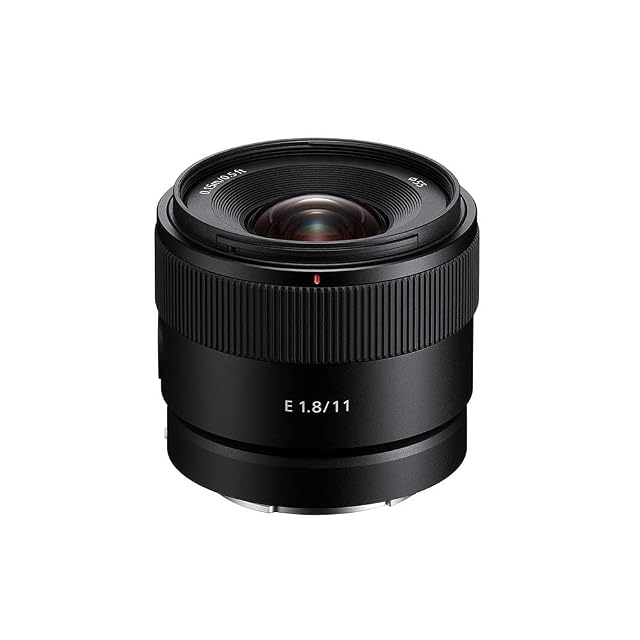
E mount · APS-C · 11mm · F1.8 held as a constant maximum · three ED and three aspherical elements · 7-blade circular aperture · two linear motors · hood supplied · no filter provision published · no distortion type stated · no minimum focus published · no sealing claimed · no weight published
The widest engraving on this shelf at 11mm with an F1.8 maximum, for 460 €, sold on six named elements and two focus motors — and publishing neither a thread, a close-focus distance, a weight nor a sealing claim.
Best for: Handheld vlogging and interiors on a Sony APS-C body, where 11mm at F1.8 covers the room and the arm holding the camera.