One leg, for the places where three are not allowed · review
SIRUI AM-404FL, 190 cm, 12 kg, 3-in-1 base review
Twelve kilograms declared and 190 cm of reach for 129 €, with a base that turns the pole into a low tripod and a collar that pans through 360 degrees without any head at all.
The bottom line Twelve kilograms, 190 cm in four sections, a panning collar that needs no head and a base that stands on its own: this is the only pole here built for a heavy telephoto, and it is priced accordingly. It publishes no folded length, no weight and no lock type, and it is the bulkiest support on the shelf.
On the listing
Five bullets. An innovative quick-release system in which the monopod and the tripod base use the same design — press the sleeve to release the plate, click to lock; a three-in-one design usable as a full monopod with adjustable feet, a free-standing extension pole, or a compact low tripod, named for travel, sport and video; a robust aluminium construction holding up to 12 kg with four sections reaching 190 cm, and a patented quick-release thread in 1/4 and 3/8 inch; a textured rotating collar allowing precise horizontal panning without an additional head; and extended feet of 15 cm with a reinforced base structure for a secure stand on uneven surfaces.
Twelve kilograms
Nearly twice the next figure on this shelf, and six times the cheapest pole’s rating. That is a telephoto rating rather than a camera rating, and it is what separates this pole from the seven below it.
A hundred and ninety centimetres in four sections
Every other tall pole here needs five or six segments to get close. Fewer sections mean wider tubes throughout, and the widest is the one under the camera — which is precisely where flex shows.
Panning without a head
The fourth bullet puts the horizontal movement inside the pole. On every other support here that job belongs to a head bought separately, whose own load rating then becomes the limit for the whole assembly.
A base that lets go
Adjustable feet extended to 15 cm, a reinforced structure, three configurations. The pole stands while the photographer steps away — which is not what a monopod does, and is the reason this one is also the bulkiest here.
Availability
Between 110 € and 129 € on the German, French, Italian and Spanish Amazon stores when this page was last checked.
The American and British Amazon stores carry it too, priced in local currency. Those amounts are deliberately absent from the range above, which reads euro stores only.
Everything in this section is the figure Keepa carried on the day of the last update to this page. Availability and prices shift without notice.
Prices quoted in this text were read on 13 September 2026. The live price is at the top of the page.
What it does well, and what it gives up
Strengths
Twelve kilograms declared, the highest rating on this shelf by a wide margin
190 cm from only four sections, so the top tube is thicker than on any other pole here
A collar that pans through 360 degrees without a head, and a base that makes the pole free-standing
Compromises
A hundred and twenty-nine euros, against 80 € for the Manfrotto below it
No folded length, no weight, and the leg lock type is never named
The three-in-one base adds bulk to a support whose advantage is being quick to move
Specifications
Maximum height
190 cm, in the title and the third bullet — the tallest of the eight here, from four sections. Reaching that height in four segments rather than five or six means a thicker tube at the top than any other pole on this shelf
Folded length
Not published. Five bullets cover the quick-release system, the three configurations, the construction, the panning collar and the feet, and no packed figure appears
Section count
Four, in the third bullet, alongside the height. Four sections for 190 cm is the most favourable ratio here: the koolehaoda needs six to reach 177 cm
Lock type
Not named directly. The first bullet describes a quick-release design shared between the pole and the base — a sleeve that is pressed to release the plate and clicks to lock — which is the camera mount rather than the leg locks. How the sections close is not stated
Declared load
12 kg, in the third bullet, credited to a robust aluminium construction. It is by far the highest figure on this shelf: nearly twice the Manbily’s 7 kg and four times the Amazon Basics ceiling
Foot design
A three-in-one base, in the second and fifth bullets: usable as a full monopod with adjustable feet, as a free-standing extension pole, or as a compact low tripod. The fifth adds extended feet of 15 cm and a reinforced base structure for uneven ground. It is the only page here that claims the pole stands on its own
Material
Aluminium, in the third bullet, described as lightweight yet stable. No weight is published
Head mount
A patented quick-release thread in both 1/4 and 3/8 inch, in the third bullet, with the first bullet explaining the mechanism: pole and base share the same quick-release design, so a camera or an accessory swaps between them in seconds. The fourth adds a textured rotating collar giving precise 360 degree panning WITHOUT a separate head
Amazon reference
B0CHFFS8LC (same reference on 6 Amazon marketplaces)
EAN
6952060056159
What people ask before they commit
What does panning without a head actually mean?
The fourth bullet describes a textured rotating collar built into the pole, so the camera turns horizontally without a ball head or a tilt head fitted. On every other pole here, panning smoothly means buying a head and adding its own load limit to the calculation — the hub above says the lower of the two ratings governs. Here the horizontal movement is in the pole itself.
Is this still a monopod if it stands up?
The second bullet names three configurations, one of which is a compact low tripod. It stands on its own base, which the hub above says a monopod does not — but the base is small, the pole is single, and the intended use remains a pole held in the hand with the feet for stability. A tripod it is not; a monopod that does not fall over the moment it is released, it is.
Why does 190 cm from four sections matter?
Because each section is nested inside the one above, so fewer sections for the same height means every tube is wider — including the one at the top, which is where a pole flexes under a camera. Reaching 190 cm in four segments, as here, gives a thicker top tube than reaching 177 cm in six, as the koolehaoda does. It is also why this pole does not pack as small.
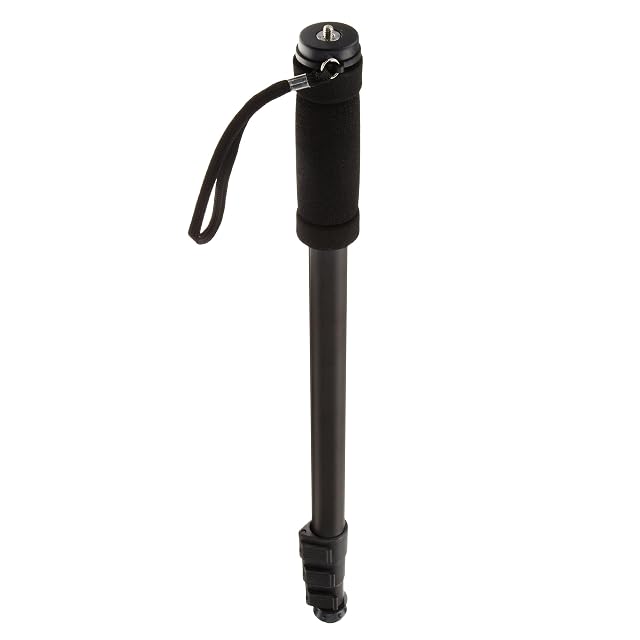
54 to 170 cm · four leg sections · declared load 6.6 lbs, about 3 kg · 1/4 inch universal thread · rubber foot with retractable spikes · padded grip and adjustable wrist strap · carry bag · aluminium · no folded length published · no head included
Eighteen euros, level with the PATONA on this shelf, with a rubber foot that hides retractable spikes and a wrist strap — and no folded length anywhere on the page.
Best for: A first monopod for a long lens at a match or in a hide, where the spikes and the strap matter more than a published packed length.
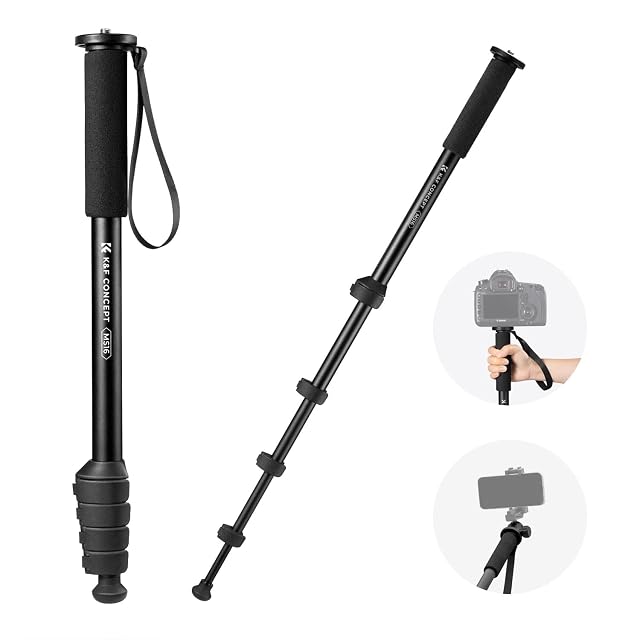
160 cm maximum · folded 43 cm · five sections · flip-lock quick catches · 1/4 inch and 3/8 inch dual interface · two-in-one metal and rubber foot · non-slip cotton grip with a hand strap · aluminium alloy · no declared load published · no head included
Five sections folding to 43 cm for 22 €, with a foot that unscrews to reveal a metal spike and both thread sizes — and no load figure on the page.
Best for: A pole that has to disappear into a small bag, for a camera used at or below 160 cm on mixed ground.
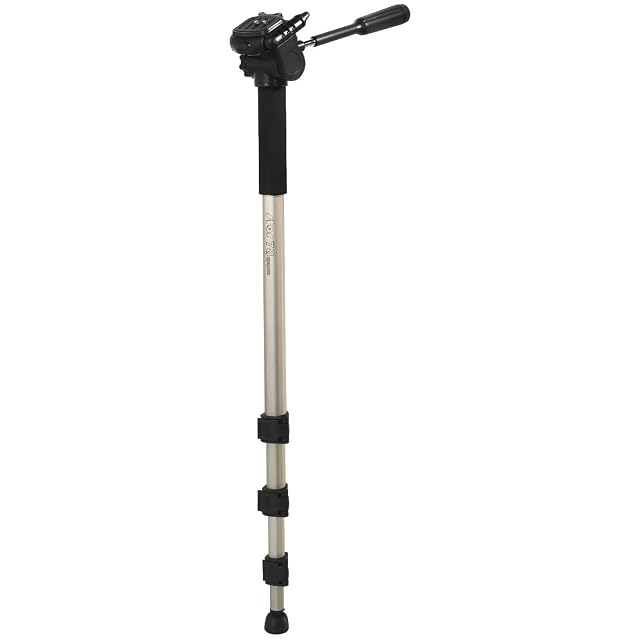
61 to 176 cm · aluminium · rubber foot · quick clamps · 3-way head for landscape, horizontal and portrait framing · non-slip rubber grip · bubble level · 665 g · 1/4 inch thread, maximum profile 26.7 mm · quick-release plate, bag with a carry strap · no section count published · no declared load published
The only monopod here that arrives with a 3-way head and a bubble level, at 28 € and 665 g — and the only one whose tube diameter is published.
Best for: Someone who wants one purchase that works out of the box, where a head, a plate, a level and a bag matter more than a spike.