One leg, for the places where three are not allowed · review
Amazon Basics WT1003, 54 to 170 cm, 3 kg, four sections review
Eighteen euros, level with the PATONA on this shelf, with a rubber foot that hides retractable spikes and a wrist strap — and no folded length anywhere on the page.
The bottom line Eighteen euros for 170 cm, four sections, a bag, a padded grip, a strap and a foot that does both jobs is a complete starting point. It publishes no folded length, no lock type and no weight, and it arrives without the head a monopod needs to be useful.
On the listing
Six bullets. Wide compatibility, holding video cameras, photo cameras and spotting scopes up to 6.6 lbs; a 1/4 inch universal thread for easy attachment; four leg sections extending to a maximum of 67 inches; stability on any surface from a non-slip rubber foot with retractable spikes; a carry bag for transport and storage; and an integrated padded grip with an adjustable wrist strap, credited with comfortable handling over long sessions and a secure grip.
A foot that does both jobs
Rubber outside, spikes inside. On this shelf the usual arrangement is two interchangeable feet and a small bag to lose one of them in. Retractable spikes cover grass and floorboards without a spare part, and it does it at 18 €.
The strap is not an accessory
A monopod stands up only while it is held. The sixth bullet pairs the padded grip with an adjustable wrist strap and names fatigue as the reason — an honest bullet about what using one of these is actually like.
Four sections, and no packed figure
Three joints to close, and no published folded length. For a pole that travels strapped to a bag, that is the number a buyer needs and the page does not have.
No head in the box
A 1/4 inch thread and nothing on it. The pole will hold a camera pointing where the pole leans; pointing it down at a subject needs a tilt head, and that is a separate purchase.
Availability
Between 18 € and 23 € on the German, French, Italian and Spanish Amazon stores when this page was last checked.
The American and British Amazon stores carry it too, priced in local currency. Those amounts are deliberately absent from the range above, which reads euro stores only.
Everything in this section is the figure Keepa carried on the day of the last update to this page. Availability and prices shift without notice.
Prices quoted in this text were read on 13 September 2026. The live price is at the top of the page.
What it does well, and what it gives up
Strengths
A rubber foot with retractable spikes built in, so both surfaces are covered with no parts to lose
A padded grip and an adjustable wrist strap, which is what a monopod is held by all day
Eighteen euros, with a carry bag, and 170 cm of height
Compromises
No folded length published, on a four-section pole
No lock type named, and no weight
A 1/4 inch thread only, with no head — a tilt head has to be bought separately
Specifications
Maximum height
170 cm, in the title, with 67 inches repeated in the third bullet. That is a working height at the eye for most people, and the hub above warns that the top section is the least rigid — so the useful height is a little below the headline
Folded length
Not published. The fifth bullet names a carry bag for transport and storage without giving a packed figure, which on a four-section pole is the number that decides whether it straps to a rucksack
Section count
Four, in the third bullet, described as extending to a maximum of 67 inches
Lock type
Not named. Neither twist collars nor flip levers appear anywhere on the page — and with four sections there are three joints to close, whichever they are
Declared load
6.6 lbs, about 3 kg, in the first bullet, which names video cameras, photo cameras and spotting scopes as what it holds. As always the figure is static, and on a monopod it is also the figure that matters least: the pole carries the weight, and what fails first is the photographer’s arm
Foot design
A non-slip rubber foot with retractable spikes, in the fourth bullet — both in one, so soft ground and hard floors are covered without changing parts. The hub above makes the foot the specification that separates a monopod from a tripod leg, and this is the arrangement that needs no spares
Material
Aluminium, in the title. No weight is published, which is unusual on a page that gives a load figure
Head mount
A 1/4 inch universal thread, in the second bullet, named for cameras and spotting scopes. No 3/8 thread and no head is included, so a ball head is an extra purchase — and on a monopod a tilt head is what makes the pole usable at all
Amazon reference
B00FAYL1YU (same reference on 6 Amazon marketplaces)
EAN
0841710104998
What people ask before they commit
Why does the wrist strap get its own bullet?
Because a monopod is carried in the hand for hours and it falls over the moment it is let go. The sixth bullet names the padded grip and the adjustable strap together, and says they reduce fatigue and keep the grip secure. Other pages on this shelf sell the strap as an afterthought; one of them warns explicitly that the strap is what stops the pole toppling.
What do retractable spikes change?
They remove a decision and a spare part. Most monopods ship either with a rubber foot, or with a rubber foot and a separate metal spike to swap in — and the spike lives in a bag until it is lost. The fourth bullet describes spikes that extend from within the rubber foot, so grass and floorboards are both covered by the same piece.
Do I need a head on a monopod?
Usually yes, and this one includes none. The pole holds the camera upright; a tilt head lets it point down or up without leaning the whole pole, which is how a monopod is actually used for sport. The second bullet gives a 1/4 inch thread, so almost any small head will fit — budget for it, because the pole alone only points where it leans.
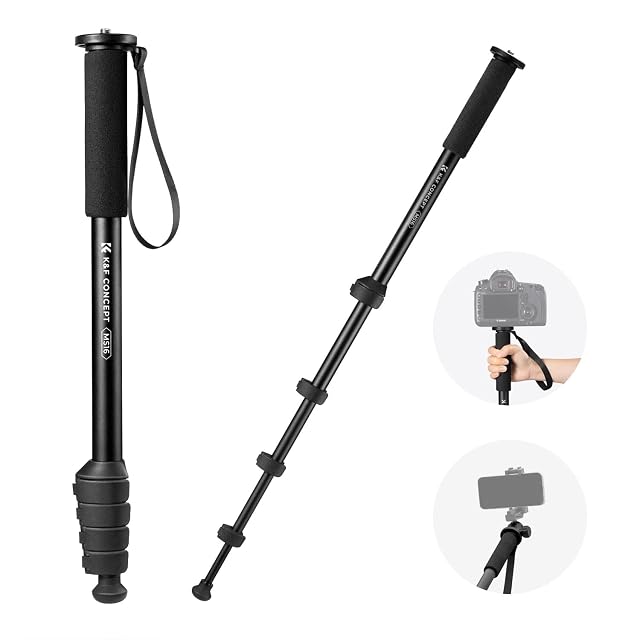
160 cm maximum · folded 43 cm · five sections · flip-lock quick catches · 1/4 inch and 3/8 inch dual interface · two-in-one metal and rubber foot · non-slip cotton grip with a hand strap · aluminium alloy · no declared load published · no head included
Five sections folding to 43 cm for 22 €, with a foot that unscrews to reveal a metal spike and both thread sizes — and no load figure on the page.
Best for: A pole that has to disappear into a small bag, for a camera used at or below 160 cm on mixed ground.
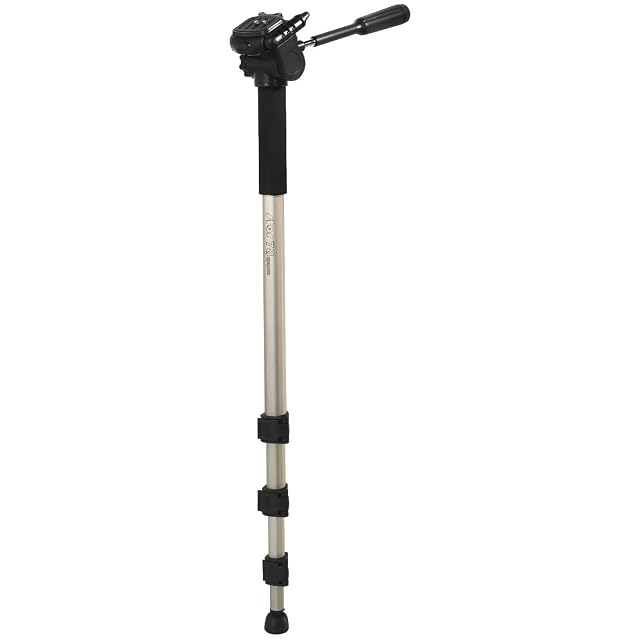
61 to 176 cm · aluminium · rubber foot · quick clamps · 3-way head for landscape, horizontal and portrait framing · non-slip rubber grip · bubble level · 665 g · 1/4 inch thread, maximum profile 26.7 mm · quick-release plate, bag with a carry strap · no section count published · no declared load published
The only monopod here that arrives with a 3-way head and a bubble level, at 28 € and 665 g — and the only one whose tube diameter is published.
Best for: Someone who wants one purchase that works out of the box, where a head, a plate, a level and a bag matter more than a spike.
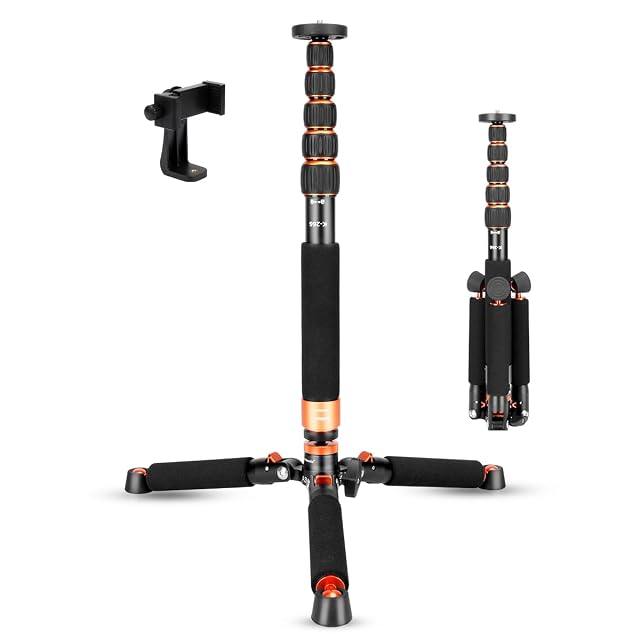
46 to 177 cm · six sections · maximum tube diameter 28 mm · declared load 6 kg · rubber feet with a metal spike · base allowing 360 degree panning and 20 degrees of tilt · universal mounting plate with a switchable 1/4 to 3/8 inch screw · usable as a desktop mini tripod and as a walking pole · aluminium alloy · no folded length published
Six sections and a published 28 mm tube diameter for 63 €, with a switchable thread, a spike, and a base that doubles as a desk tripod.
Best for: A photographer who wants reach and rigidity from the same pole, and who will use the base as a table tripod between shots.