Sensor format decides the lenses, and the lenses outlast the body · review
Panasonic Lumix FZ82D, fixed 20-1200 mm f/2.8-5.9, 18.1 MP review
The one body on this shelf whose lens does not come off: a 20-1200 mm f/2.8-5.9 built in, quoted as a sixty-times range, with an OLED viewfinder that publishes its resolution when dearer cameras here do not.
The bottom line The honest reading of this camera is its second bullet: a sixty-times zoom in one sealed object, with the aperture at the long end written down. What the listing never says is how large the sensor is or whether anything steadies a 1200 mm frame, and those two silences are the price of the reach.
On the listing
An 18.1 MP MOS sensor behind an integrated 20-1200 mm f/2.8-5.9 lens, described as a dynamic sixty-times zoom with a 1 cm macro setting; 4K video at 3840 x 2160 in 30p and 25p; a 4K Photo mode at 30 fps; burst rates given as AFS 10 fps and AFC 6 fps; HD video at 120 and 100 fps; a 2.36 MP OLED live-view finder beside a 1.84 MP touch LCD; a zoom compose assist button; and USB-C charging from mains adapters, computers or power banks.
The lens is the camera
Nothing here comes off. The second bullet names the optic as integrated, and the consequence runs through the whole page: there is no mount to match against future glass, and no body-plus-lens arithmetic to do. What is bought is one focal range, from 20 mm at the wide end to 1200 mm at the long end, with f/2.8 available only at the first of those and f/5.9 at the last.
That range is the argument. A sixty-times zoom in a single object is something no interchangeable-lens body on this shelf can do without two or three lenses and a bag to carry them, and the maker prices it accordingly.
What the page does not say, and why it matters here
Two silences stand out on a camera built around reach. The first is the sensor: MOS and 18.1 MP are both stated, and the size is not, so the format cannot be compared against the APS-C bodies alongside it. The second is stabilisation, which appears nowhere in six bullets. At 1200 mm, hand movement is magnified as much as the subject is, and a listing that describes the zoom in four separate bullets without once claiming to steady it has left out the thing a buyer would most want stated.
Against the rest of this shelf
It is the cheapest body in the family at 419 €, and the only one that publishes a viewfinder resolution. Everything dearer here takes lenses; this one takes none. Read the two facts together and the choice is not about specification at all — it is whether the next lens is ever going to be bought.
Availability
Between 419 € and 449 € on the German, French, Italian and Spanish Amazon stores when this page was last checked.
The American and British Amazon stores carry it too, priced in local currency. Those amounts are deliberately absent from the range above, which reads euro stores only.
Everything in this section is the figure Keepa carried on the day of the last update to this page. Availability and prices shift without notice.
Prices quoted in this text were read on 13 September 2026. The live price is at the top of the page.
What it does well, and what it gives up
Strengths
Publishes its viewfinder resolution, 2.36 MP OLED, which no other body in this family does
The focal range is written at both ends with an aperture for each, 20-1200 mm and f/2.8-5.9, so the cost of the long end is readable before buying
Charges over USB-C from a power bank, stated in its own bullet rather than left to the box contents
Compromises
The lens does not come off, so the sixty-times range is the whole camera and there is no upgrade path through glass
No stabilisation claim anywhere on a listing built around a 1200 mm long end, which is the focal length where stabilisation matters most
Sensor size is never named, only its MOS construction and its 18.1 MP count
Specifications
Sensor format
Not published on the listing — the first bullet gives an 18.1 MP MOS sensor and never its size or format name. MOS describes how the sensor is built, not how big it is, and no dimension appears anywhere on the page
Resolution
18.1 MP — stated in the title and again in the first bullet
Mount
None — the lens is integrated. The second bullet calls it an integriertes 20-1200mm (KB) F2.8-5.9 Objektiv, and nothing on the page offers a bayonet or a second lens. This is the line that separates it from every other body in this family
Stabilisation claims and protocol
Not published on the listing — six bullets describe image quality, the zoom, burst rates, the zoom assist button, the viewfinder and USB-C charging, and not one of them claims stabilisation or names a protocol for measuring it
Viewfinder specification
2.36 MP OLED live-view finder — stated with its resolution in the fifth bullet, alongside a 1.84 MP touch LCD. It is the only viewfinder figure published by any body in this family
Card slots
Not published on the listing — no bullet counts a slot or names a card format, which is true of all seven bodies written in this catalogue
Autofocus modes published
Two modes named by abbreviation in the third bullet, through their burst rates: AFS at 10 fps and AFC at 6 fps. No focus point count and no subject detection appear
Video modes
4K at 3840 x 2160, 30p and 25p, stated in the first bullet; HD at 120 fps and 100 fps in the third; and a 4K Photo mode at 30 fps, which is a stills mode drawn from video frames
Sealing
Not published on the listing — no weather, dust or splash claim is made, and the bullets describe travel and landscape use without mentioning conditions
Amazon reference
B0D8QFQC8W (same reference on 6 Amazon marketplaces)
EAN
5025232964772
What people ask before they commit
Is a bridge camera a mirrorless camera?
It has no mirror, and it also has no mount. That is the distinction worth holding on to: what defines a mirrorless system is the bayonet and the lenses bought against it, and this body has neither. It sits in this family because it competes for the same money and the same buyer, but the lens specification here is the entire purchase rather than half of it, in the way a compact’s is.
What does f/2.8-5.9 mean across a 20-1200 mm range?
Two maximum apertures, not one. The f/2.8 belongs to the 20 mm end and the f/5.9 to the 1200 mm end, and the value moves between them as the barrel extends. At full reach the lens gathers roughly two stops less light than at its widest, which is the figure to weigh against the range itself.
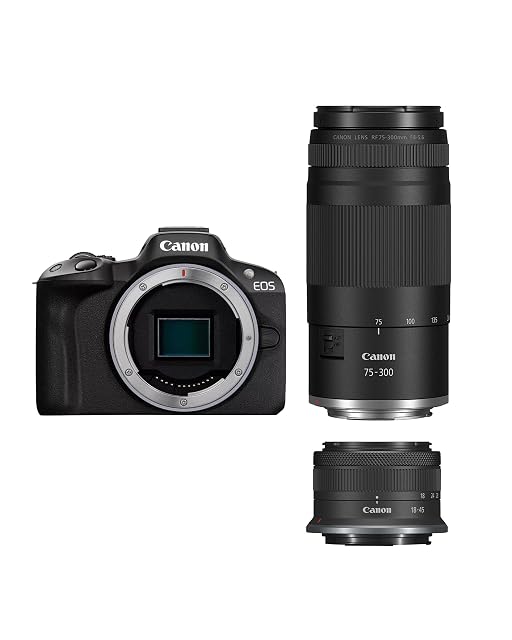
24.2 MP APS-C · two lenses supplied, RF-S 18-45mm f/4.5-7.1 IS STM and RF 75-300mm · 4K 30p oversampled from 6K · deep-learning subject detection · viewfinder, card slots and sealing not published
The only body here that arrives with two lenses, covering 18 to 300 mm between them, and states its sensor format outright while leaving its viewfinder and card provision unwritten.
Best for: A first interchangeable-lens purchase where the two-lens span from wide to 300 mm matters more than the finder or the card count.
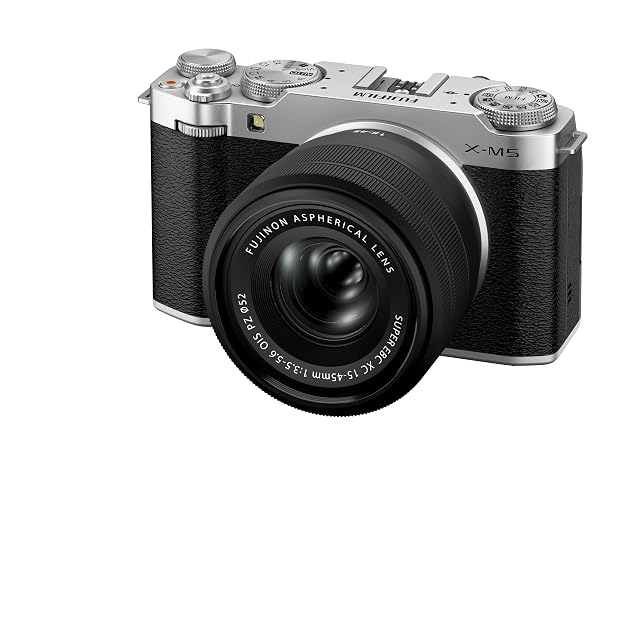
26.1 MP X-Trans · X-Processor 5 · 355 g body stated · kit XC15-45mm f/3.5-5.6 OIS PZ · 6.2K video · 9:16 mode · 20 film simulations · flip screen, no viewfinder named · sensor format, mount name and card slots not published
A 355 g body sold on its twenty film simulations and a 6.2K video figure, with a flip screen in place of any viewfinder and a kit zoom whose stabilisation is named only by the letters OIS.
Best for: Someone buying into film simulations and short vertical video, who composes on a screen and counts every gram.
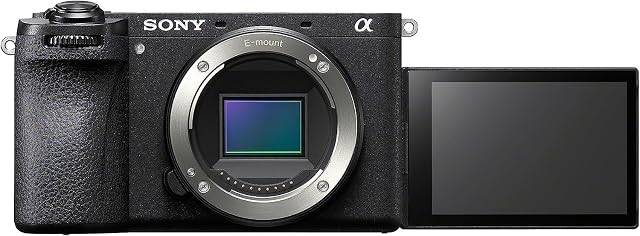
26 MP Exmor R APS-C · BIONZ XR · five-axis in-body stabilisation stated · 4K up to 120p · 4K 30p 10-bit 4:2:2 from 6K · 11 fps burst · S-Cinetone and S-Log3 · dust and moisture resistant magnesium alloy · card slots not published
The only body on this shelf that claims stabilisation in the camera rather than in the lens, and the only one that makes a sealing claim at all — sold as a body alone at the top of this family’s price range.
Best for: Video work that needs log profiles and in-body stabilisation, on a body expected to go out in weather with lenses already owned.