Payload is the specification, and balancing is the skill it demands · review
DJI Osmo Pocket 4, a one-inch camera on its own three-axis gimbal review
Not a stabiliser you mount a camera on but a one-inch camera already mounted on one, publishing a dynamic range figure and a recording time no other product on this shelf comes near.
The bottom line The most capable object on this shelf and the only one that is a camera rather than a mount: a one-inch sensor, 14 stops, D-Log, and nothing to balance. The two catches are in the small print — the runtime belongs to 1080p, and the charger is extra.
On the listing
A 1 inch CMOS sensor recording up to 4K at 240 fps for slow motion with detail claimed in low light; a mechanical three-axis gimbal keeping footage smooth while walking or running, with gimbal modes for deliberate movement; ActiveTrack for distant subjects at up to 4× zoom, with Spotlight follow and Dynamic Framing; intelligent autofocus with subject tracking by lock or registered priority; up to 14 stops of dynamic range and a 10-bit D-Log profile for grading; a pocket-sized body with 107 GB of internal storage, fast charging and up to 240 minutes of recording at 1080p 24 fps; a box holding the gimbal camera, a gimbal clamp, a handle with a quarter-inch thread and a carry pouch; and a closing note that the charger is sold separately, with a 65 W unit recommended.
It is a camera, and that is why its payload lines are empty
Both other products on this shelf are mounts: you balance a camera in them, within a published envelope or an unpublished one. Nothing goes on this. The sensor and the gimbal are one object, assembled and balanced at the factory.
That removes the step that goes wrong — balancing — and it removes the flexibility too. There is no upgrade path through a better camera, because the camera is the product.
The specification that explains the price
A one-inch sensor, which is larger than anything the action cameras in this catalogue publish, and most of them publish nothing at all. Fourteen stops of dynamic range, stated. Ten-bit D-Log, for grading afterwards.
Those three lines together describe a tool for footage that will be worked on, not footage that goes straight out. It is the same argument the dearest action camera on this site makes, with a bigger sensor behind it.
Read the runtime footnote
Two hundred and forty minutes, at 1080p and 24 fps, with a footnote marker attached. The product is sold on 4K and on 4K at 240 fps, and the page publishes no figure for either.
And read the last bullet
The charger is not included, and a 65 W unit is recommended. On a product at this price that is a real cost and a real inconvenience, and it sits at the very bottom of the page.
Availability
Between 453 € and 499 € on the German, French, Italian and Spanish Amazon stores when this page was last checked.
The American and British Amazon stores carry it too, priced in local currency. Those amounts are deliberately absent from the range above, which reads euro stores only.
Everything in this section is the figure Keepa carried on the day of the last update to this page. Availability and prices shift without notice.
Prices quoted in this text were read on 13 September 2026. The live price is at the top of the page.
What it does well, and what it gives up
Strengths
A one-inch CMOS sensor, the largest on this shelf and larger than any action camera of the three here publishes
Publishes a dynamic range figure, up to 14 stops, and a 10-bit D-Log profile for grading
No balancing, no clamping and no card: 107 GB is built in and the camera is already on its gimbal
Compromises
The battery figure belongs to 1080p at 24 fps, not to the 4K modes the product is sold on
No charger in the box, with a 65 W unit recommended separately
It accepts no other camera, so it replaces a rig rather than completing one
Specifications
Declared payload
Does not apply — this product carries no external camera. The gimbal and the camera are one object, so there is no clamp, no weight limit and no dimension limit to publish. Both rivals on this shelf are mounts; this is a camera
Axes
Three, mechanical, stated in the second bullet as keeping footage smooth while walking or running, with gimbal modes for deliberate camera movement
Battery life
Up to 240 minutes at 1080p and 24 fps, stated in the sixth bullet alongside fast charging — with a footnote marker, so the figure belongs to that mode and not to 4K. The eighth bullet adds that the charger is sold separately and recommends a 65 W unit
Balance range
Does not apply — nothing is balanced by the user. The camera is fixed to its own gimbal at the factory, which removes the whole adjustment step the other two products on this shelf require
Follow modes
ActiveTrack for distant subjects at up to 4× zoom, plus Spotlight follow and Dynamic Framing, all named in the third bullet. The fourth adds subject tracking with lock or registered-subject priority
Control ports
Not published as ports — a quarter-inch thread on the handle is named in the seventh bullet, which is a mounting interface rather than a data one, and 107 GB of internal storage removes the need for a card
Folded weight
Not published on the listing — the sixth bullet calls it pocket-sized and publishes no mass
Amazon reference
B0FKTBGNR8 (same reference on 6 Amazon marketplaces)
EAN
0190021158559
What people ask before they commit
Why is this in a gimbal shelf rather than with the cameras?
Because what it replaces is a gimbal and a camera together. The three-axis mechanism is the product’s defining part, and someone shopping for stabilisation will compare it against the two mounts beside it. The honest distinction, and the reason its payload lines read as not applicable, is that nothing external ever goes on it: there is no clamp to fit a camera into.
Is 240 minutes of recording realistic?
At 1080p and 24 fps, which is what the sixth bullet attaches the figure to, and with a footnote marker beside it. The modes the product is actually sold on — 4K, and 4K at 240 fps for slow motion — will draw far more, and the page gives no figure for them. Treat the 240 minutes as the ceiling of the least demanding mode rather than as a working day.
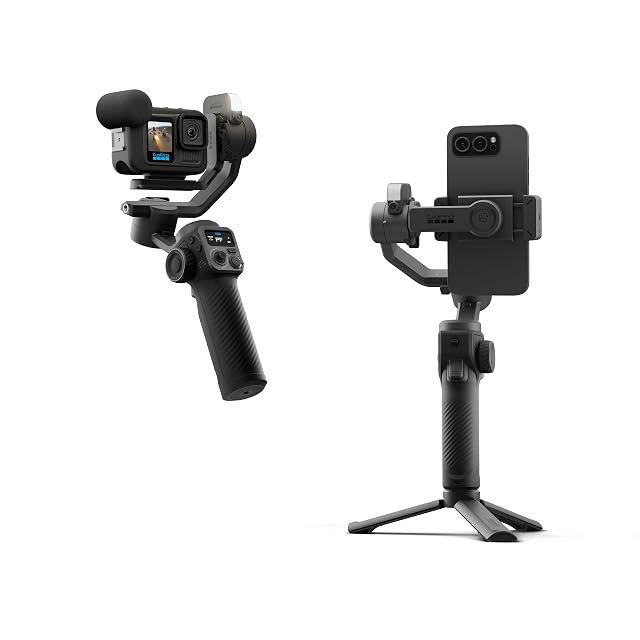
No payload published · three axes · interchangeable mounts for phones, this maker’s cameras and some compacts · AI subject-tracking module, forward or rear facing · built-in fill light · wireless camera control · device charging · 360 degree rotation · Bluetooth only with Hero 9 to 13 Black
A stabiliser that ships with a separate AI tracking module and a fill light, and never publishes the one figure that decides whether a camera fits it.
Best for: Filming yourself with this maker’s recent cameras or a phone, where the tracking module and the fill light do work no rival here does.
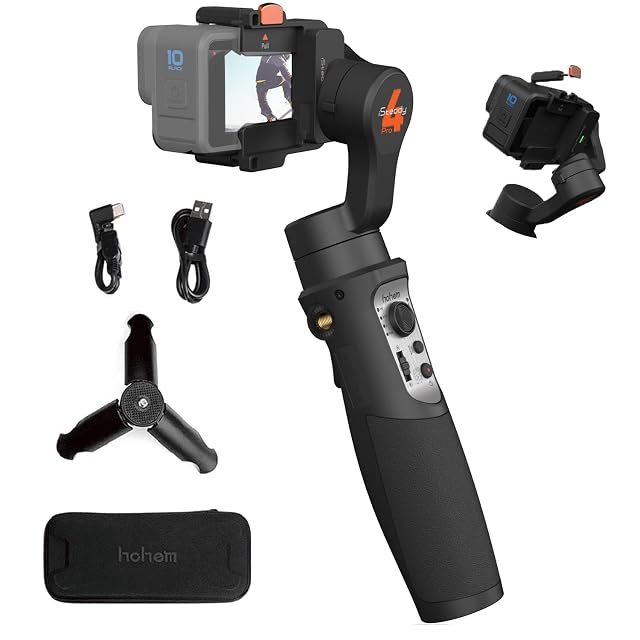
Payload published: up to 150 g, 51 mm tall, 30 mm deep · three axes · iSteady 5.0 algorithm · IPX4 splash resistant · quick-release clip · 3600 mAh, 14 hours stated · works as a power bank · named for GoPro Hero 5 to 13, Osmo Action and Insta360 One R
The only stabiliser here to publish what it can actually carry — 150 g, 51 mm, 30 mm — and the only one with a splash rating and a battery that will charge the camera on it.
Best for: An action camera that runs out of battery before the day does, where the gimbal carrying a charge is worth as much as the stabilisation.
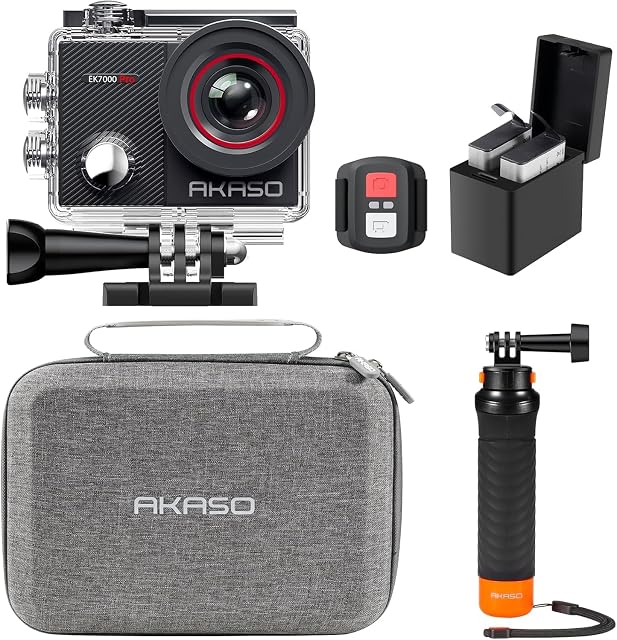
40 m waterproof housing · 4K 30, 2.7K 30, 1080p 60 · 20 MP stills · EIS stated · four selectable view angles: super wide, wide, medium, narrow · 2 inch IPS touchscreen · floating hand grip and bag supplied · no field of view in degrees
An established name at ninety-three euros, selling a touchscreen, three video modes and four selectable view angles — described by name rather than in degrees — with a floating grip in the box.
Best for: Water use where the floating grip and the touchscreen earn their keep, by someone who will buy a spare battery blind.