The magnification ratio is the specification, and 1:1 is the dividing line · review
TAMRON SP 90mm F/2.8 Di Macro 1:1 VC USD for Nikon FX review
A sealed 1:1 macro whose stabiliser is the only one on this shelf described as tuned for the close range — on a page that prints half its bullets twice, once with the accented characters broken.
The bottom line A stabiliser tuned for the close range and a sealed barrel are the right two things for a macro lens used in the field, and the ratio is at least in the product name. The page then publishes no distance, no thread and no weight, and prints half of what it does say twice over with the accents broken.
On the listing
Seven entries containing four claims. Outstanding optical performance optimised for spectacular background blur; a new VC stabiliser optimised for the macro range and providing improved stabilisation there; a sealed construction protecting against the ingress of moisture and dust; and the Di designation, for digital APS-C and full-frame reflex cameras. The first four entries render their accented characters as raw character codes, and three of them then appear again correctly.
A stabiliser tuned for the close range
Only two pages on this shelf address this and one of them is this. The general claim — that stabilisation is worth so many stops — is close to meaningless at life size, because the movement that matters up close is not the movement a conventional system corrects. Saying the system was optimised for the macro range is the right claim to make. Giving no figure for it is consistent with how little such a figure would mean.
Entities that never rendered
Four bullets carry character codes where accented letters should be, and then three of the four are printed again correctly. A catalogue fault, visible on the page, and worth naming here only so that a reader who sees it knows it is not the lens.
One to one, in the product name
Not in a bullet, not in a specification block: in the model designation, between the word Macro and the VC marking. Two lenses on this shelf, both dearer, never state a ratio at all — so a title is enough to put this page ahead of them on the figure that defines the shelf.
Ninety millimetres, and what it costs
The shortest focal length here. At life size that means the front of the lens sits closer to the subject than any 100mm or 105mm lens on this shelf would, with less room for a light and less tolerance for anything that moves. The page never publishes the distance, so the size of that disadvantage cannot be read from it.
Availability
About 457 € on the Italian Amazon store when this page was last checked.
Listed in the German, American, British, French and Spanish Amazon catalogues with nothing on sale against the entry: the camera has a page there and no seller behind it.
Everything in this section is the figure Keepa carried on the day of the last update to this page. Availability and prices shift without notice.
Prices quoted in this text were read on 13 September 2026. The live price is at the top of the page.
What it does well, and what it gives up
Strengths
A stabiliser explicitly described as optimised for the macro range, which only one other page on this shelf attempts
A sealed construction against moisture and dust, on a lens used low to the ground
1:1 in the product name, and both formats covered by the Di designation
Compromises
Half the bullets are printed twice, and the first four have broken accented characters
No working distance, no minimum focus, no thread and no weight published
Ninety millimetres is the shortest focal length on this shelf, so the least room in front of the lens at life size
Specifications
Magnification ratio
1:1, in the product name, where it sits between Macro and VC. No bullet repeats it, so the ratio the hub above calls the specification for this shelf is published in the title alone — which is still more than the Canon or the Sony on this shelf manage
Working distance
Not published on the listing, and no minimum focus distance either. Four claims are made about optics, stabilisation, sealing and format, and no distance of any kind appears
Focal length
90mm, fixed, in the title. The same as the Sony on this shelf and the shortest here, which by the hub’s geometry means the least room in front of the glass at life size
Maximum aperture
F/2.8, in the title. The first bullet claims outstanding optical performance optimised for spectacular background blur, which is the aperture being sold for portraits rather than for close-up work
Stabilisation
VC, and the second bullet makes the claim that matters: the stabiliser is optimised for the macro range and provides improved stabilisation there. No figure in stops is published, and the qualification is still significant — the hub above notes that stabilisation helps less than its figure suggests at high magnification, and this is one of only two lenses on this shelf whose page addresses that at all
Internal focus
Not stated. The sealing bullet describes a construction that keeps moisture and dust out and never says whether the barrel extends as the lens focuses
Filter thread
Not published in millimetres. Nothing on the page describes the front of the lens
Weight
Not published in grams, and no length
Amazon reference
B01C2HH7ZE (same reference on 6 Amazon marketplaces)
EAN
4960371006048
What people ask before they commit
What does it mean for a stabiliser to be optimised for macro?
At normal distances stabilisation corrects the camera tilting. Up close, the movement that ruins a frame is the camera drifting bodily towards or away from the subject, which shifts the focus plane rather than the framing. A system tuned for the macro range is one that addresses that second kind of movement. The second bullet claims exactly this, and gives no figure for it — the same approach Canon takes with its Hybrid system on this shelf.
What does Di mean?
It is Tamron’s designation, and the fourth bullet spells it out: for digital APS-C and full-frame reflex cameras. It marks a lens whose coatings and internal baffling were computed for digital sensors, which reflect more light back into the lens than film did. It tells you the lens covers the full-frame image circle and will also work, framed more tightly, on the smaller format.
Why are some of the bullets written twice?
The listing carries seven entries containing four claims. The first four use HTML character codes that were never converted — so the German words for optical, stabiliser and protects appear with markup in place of their accented letters — and three of them are then repeated correctly. It is a catalogue fault rather than anything about the lens, and nothing should be read into the repetition.
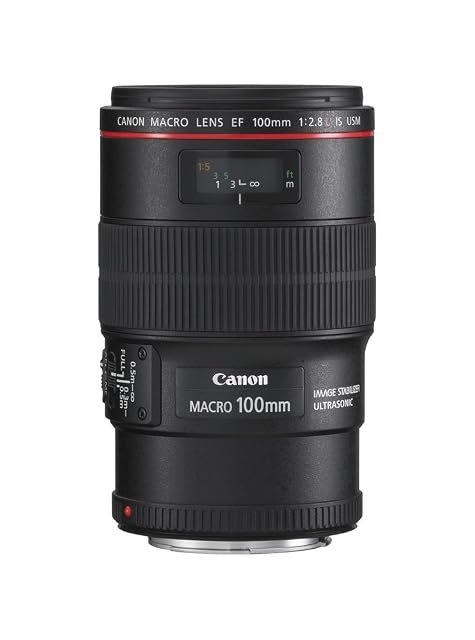
Canon EF mount · 100mm · F2.8 · Hybrid IS, no stop figure published · focus limiter · 9-blade aperture · UD element · L-series sealing against dust and splashes · 67mm filter thread · hood ET-73 and pouch LP1219 supplied · no magnification ratio published · no working distance published · no internal focus stated · no weight published
A sealed L-series macro with a focus limiter, Hybrid stabilisation and a 67mm thread for 762 € — and a listing that never once states the magnification ratio this shelf is built around.
Best for: Field macro work in unreliable weather on an EF body, where the limiter, the sealing and the hybrid stabilisation are what separate it from cheaper glass.
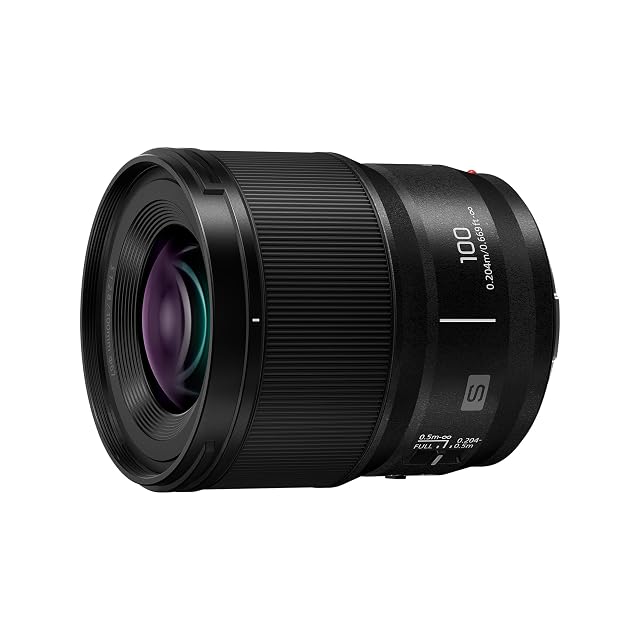
L mount · full frame · 100mm · F2.8 · 1:1 magnification · minimum focus 20.4 cm · 298 g · 3 aspherical elements · dual-phase linear motor, focus breathing suppressed · protection against dust, splashes and cold claimed · no working distance published · no stabilisation named · no internal focus stated · no filter thread published
A full-frame 1:1 macro weighing 298 g at 949 €, publishing its ratio, its minimum focus and its mass — and carrying a smallest-and-lightest claim the listing itself dates to 8 January 2024.
Best for: Full-frame macro work carried on foot, and video where a lens that does not change framing as it focuses is worth the price on its own.
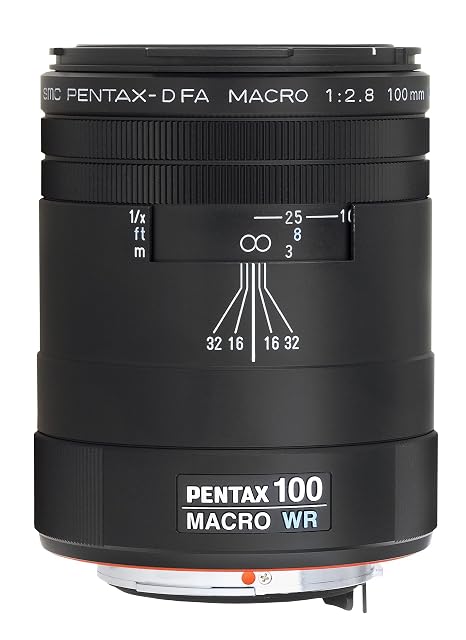
Pentax K mount · full frame · 100mm · F2.8 · 1:1, given as 1.00x · 13 cm from the front of the lens to the subject · stabilisation in the camera body, not in the lens · rear-element extension focusing · rounded iris from wide open to F5.6 · weather-resistant construction with dedicated seals · fluorine SP coating on the front element · Quick-Shift focus · aluminium outer body · hood PH-RBE49 and case S80-120 supplied · no filter thread published · no weight published
The only lens of the seven here that publishes a true working distance — 1:1 at 13 cm from the lens to the subject — across ten bullets, which is precisely the figure its own shelf says to buy on.
Best for: Macro work on a Pentax K-series body, where the body provides the stabilisation and 13 cm of working distance is the reason to choose this over anything else on the shelf.