A fixed lens, and the aperture at the long end is the real specification · review
Sony RX100 VII, one-inch type 20.1 MP, 24-200 mm f/2.8-4.5 Zeiss review
The only camera on this shelf that publishes a sensor type, a focal range and an aperture at both ends together — and the only one whose first bullet warns that the battery cannot be charged over USB.
The bottom line The only complete lens specification on this shelf, on the only published one-inch sensor, with autofocus timings nobody else states. The cost is the price and the charging: no USB, external cradle only, and a spare battery that must be charged out of the camera.
On the listing
A one-inch type back-illuminated sensor of 20.1 MP behind a Zeiss Vario-Sonnar T 24-200 mm f/2.8-4.5 zoom; autofocus described as having Alpha 9 class functions, up to 60 AF and AE calculations per second, 0.02 second acquisition, real-time tracking and eye autofocus for people and animals; internal 4K recording with professional functions and image stabilisation; sharing through the maker’s app; a first bullet, flagged as a 2025 A-version note, stating that the battery can be charged exclusively with the supplied external charger and that USB charging is not possible; and a box holding the camera, an NP-BX1 battery, the external charger, a micro USB cable, a wrist strap and a manual.
Three lines that exist nowhere else on this shelf
A sensor type. A focal range. An aperture at each end.
Every other listing in this family publishes a pixel count and stops. This one states a one-inch type sensor, a 24 to 200 mm range, and f/2.8 rising to f/4.5 across it — which is precisely what the hub above says a compact should be judged on, because the lens cannot be changed and the long end is where it gives up light.
An f/4.5 long end on a 200 mm reach is also a genuinely good figure, about half a stop from the wide end rather than the two or three stops a longer travel zoom gives away.
The autofocus is specified in time, not adjectives
Sixty calculations a second, 0.02 seconds to acquire, tracking and eye detection for people and animals. Numbers on a page rather than claims, and no other camera here offers a timing of any kind.
The contrast is the stabilisation, which appears in one clause of the fifth bullet with no type, no axes and no stops. On a page this precise, that vagueness stands out.
The charging, which is the real inconvenience
The first bullet is a warning, not a feature: the battery charges only in the supplied cradle, and not over USB. On a camera bought for travel that changes what has to be packed — the charger, and a spare cell that also has to come out of the camera to be filled. It is stated at the top of the page, which is the right place for it.
Availability
Between 1099 € and 1199 € on the German, French, Italian and Spanish Amazon stores when this page was last checked.
Listed in the British Amazon catalogue with nothing on sale against the entry: the camera has a page there and no seller behind it.
Nothing came back from the American Amazon store at all, so the button for that country runs a search instead of opening an entry that is not there.
Everything in this section is the figure Keepa carried on the day of the last update to this page. Availability and prices shift without notice.
Prices quoted in this text were read on 13 September 2026. The live price is at the top of the page.
What it does well, and what it gives up
Strengths
The only camera here to publish a sensor type, a focal range and both apertures on the same page
Publishes an autofocus speed, 0.02 s, and up to 60 AF and AE calculations per second, where the rest of this shelf gives no timing at all
Real-time tracking and eye autofocus for people and animals, named as functions of a higher camera class
Compromises
The battery charges only in the supplied external cradle, stated in the first bullet — USB charging is not possible
No stabilisation figure of any kind on a camera precise about every other number
The dearest camera on this shelf by a factor of two, and no dimensions or mass are published for a camera sold on being pocketable
Specifications
Sensor type
A one-inch type back-illuminated sensor of 20.1 MP, stated in the title and described in the third bullet as reaching a wide sensitivity range through back-illumination. It is the only sensor type published anywhere on this shelf
Focal range
24-200 mm, stated in the title and named in the second bullet as a Zeiss Vario-Sonnar T high-resolution zoom
Aperture at both ends
f/2.8 at the wide end and f/4.5 at the long end, both stated in the title and repeated in the second bullet. It is the only listing in this family to publish both, and the hub above names it as the figure that decides a compact
Viewfinder provision
Not published on the listing — the title names a tilting display and the six bullets never mention a finder of either kind
Screen articulation
A tilting display, stated in the title as suited to travel, vlogs and action. Touch capability is not claimed
Stabilisation
Named in the fifth bullet as image stabilisation accompanying internal 4K recording, without a type, an axis count or a stop figure. Where the camera is precise about autofocus timings it is vague here
Dimensions
Not published on the listing — the camera is sold on travel and pocket use across six bullets, and no measurement or mass appears
Charging
External charger only. The first bullet, marked as a 2025 A-version update, states that the battery can be charged exclusively with the supplied external charger and that USB charging is not possible. The box holds an NP-BX1 battery, that charger, a micro USB cable, a wrist strap and a manual
Amazon reference
B0DPN44TQK (same reference on 5 Amazon marketplaces)
EAN
4548736163683
What people ask before they commit
What does a one-inch type sensor change against the rest of this shelf?
It sets the area collecting the light, and area is what decides how a camera behaves as the light drops. Every other listing in this family publishes a pixel count and no sensor size, so this is the only one where that comparison can even be made. The listing states the type and the back-illuminated construction, and does not translate either into a noise figure — no such figure is published anywhere in this catalogue.
Why can the battery not be charged in the camera?
The maker states it in the first bullet of the listing, flagged as an update for the A-version, and recommends the supplied external charger as the only route. The practical consequence is that a spare battery and the cradle both have to travel, and a USB power bank will not revive the camera. It is unusual in 2026 and the page says so plainly rather than leaving it to be discovered.
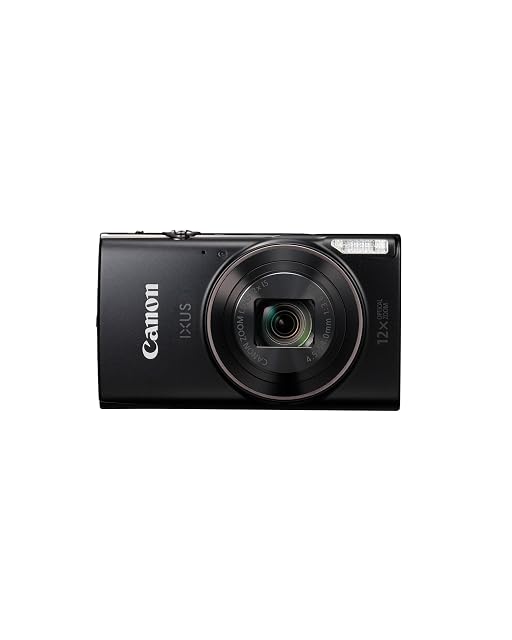
20.2 MP stated · 12× OPTICAL zoom · no aperture published · Full HD video · WLAN and NFC · metal body · no sensor size, screen movement or dimensions published
A slim metal point-and-shoot with a 12× optical zoom and wireless sharing, listed at 369 € to 400 € across euro stores — the same money as cameras on this shelf that offer 4K and a one-inch sensor.
Best for: Someone who specifically wants a slim metal Canon in a pocket and will use the 12× reach and the phone transfer.
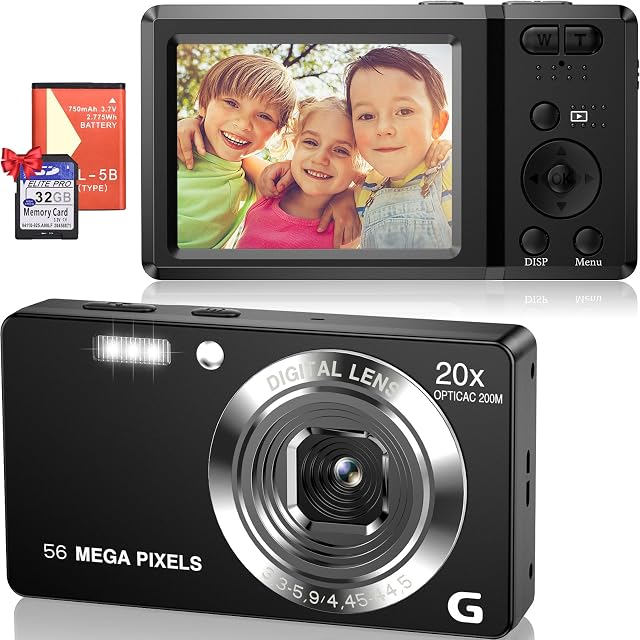
No sensor type published · 20× zoom stated as digital, not optical · no aperture published · 2.7 inch LCD · 4K video claimed · 56 MP stated image size · autofocus · tripod thread · 32 GB card included
A thirty-euro compact whose second bullet states in the maker’s own words that its 20× zoom is not optical, and which publishes a tripod thread and a webcam mode where dearer cameras here publish neither.
Best for: A cheap second camera for a desk, where the tripod thread and the webcam mode matter more than any figure on the page.
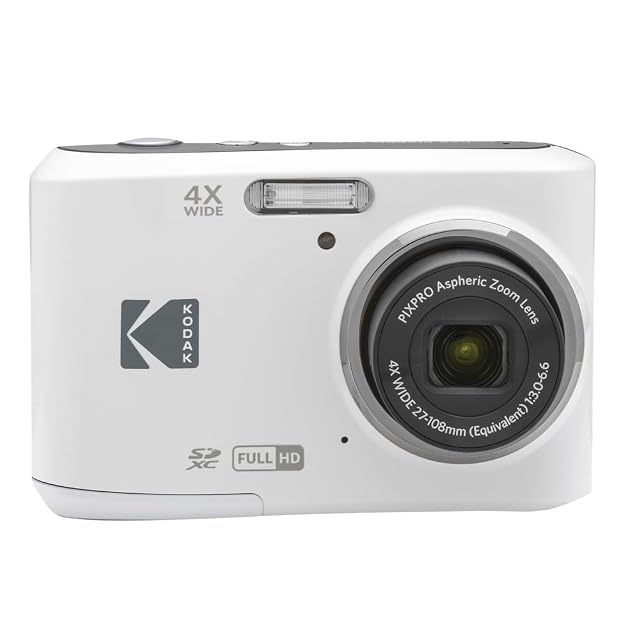
16 MP sensor stated · 4× OPTICAL zoom · no aperture published · 2.7 inch tilting LCD · 720p video · optical stabilisation mode · runs on AA batteries · no sensor size published
No compact here costs less and still offers a genuinely optical zoom with an optical stabilisation mode, running on AA batteries rather than a proprietary cell — and stopping at 720p video.
Best for: Travel somewhere batteries are easier to find than sockets, or a camera for someone who should not have to manage charging.