A travel zoom that publishes its focal range in millimetres, 24 to 720, with five-axis stabilisation and a manual control ring — and never states the aperture at either end of it.
The bottom line The most complete specification on this shelf below the Sony, and the only travel zoom here that publishes its range in millimetres and its stabilisation by name. The gap is the aperture, absent at both ends of a 30× lens, which is exactly the figure this family should be judged on.
On the listing
A 30× zoom covering 24-720 mm with a Leica DC lens and integrated five-axis hybrid OIS plus; 4K 30p video and a 4K photo function, with HD slow motion at 120 frames per second; a travel-ready design with a 7.6 cm flip touch monitor of 1.84 million dots for selfies; WLAN and Bluetooth with a dedicated function button for sharing; a 20.3 MP MOS sensor with DFD autofocus and 49-area focus, claimed to hold up in poor light; and manual control through a lens ring, manual focus, focus peaking and RAW.
It publishes the number that matters most
Twenty-four to seven hundred and twenty millimetres. Seven of the nine cameras on this shelf give a zoom factor and no focal length, which tells a reader nothing: 20× from an unknown starting point could begin anywhere. This listing gives both ends in millimetres, and a 30× factor beside them that can actually be checked.
The one figure still missing
No aperture, at either end. The hub above is explicit that a compact is its lens and that the aperture at the long end is the real specification, because that is the value which collapses as the barrel extends. On a 720 mm long end it matters more here than on any other camera in this family, and six bullets never mention it.
Manual control, published in unusual detail
A lens ring, manual focus, focus peaking and RAW, all in the last bullet. That is a list aimed at someone who knows what focus peaking is for, and it is rare on a fixed-lens camera at this price. Taken with the 49-area DFD autofocus in the bullet above it, this is the most control any listing on this shelf describes.
What it does not say
The sensor is MOS and 20.3 MP, and its size is never given, so it cannot be set against the one-inch type on the Sony. No dimensions and no battery figure appear, on a camera whose third bullet is about being ready for travel.
Availability
Between 549 € and 599 € on the German, French, Italian and Spanish Amazon stores when this page was last checked.
The American and British Amazon stores carry it too, priced in local currency. Those amounts are deliberately absent from the range above, which reads euro stores only.
Everything in this section is the figure Keepa carried on the day of the last update to this page. Availability and prices shift without notice.
Prices quoted in this text were read on 13 September 2026. The live price is at the top of the page.
What it does well, and what it gives up
Strengths
Publishes its focal range in millimetres, 24-720 mm, which only one other camera on this shelf does
Five-axis hybrid stabilisation integrated with the lens, named as such rather than left as anti-shake
Manual control is published in detail — a lens ring, manual focus, focus peaking and RAW files
Compromises
No aperture at either end of a 30× zoom, which is the specification the hub above says decides a compact
The sensor is named MOS and 20.3 MP with no size given, so it cannot be placed against the one-inch type above it
Neither dimensions nor battery are published on a camera sold on being travel-ready
Specifications
Sensor type
A 20.3 MP MOS sensor, stated in the fifth bullet with DFD autofocus and 49-area focus beside it. MOS names the construction; the sensor size is not published
Focal range
24-720 mm, stated in the title and the first bullet as a 30× zoom with a Leica DC lens. It is one of only two listings on this shelf to publish a focal range in millimetres rather than a bare factor
Aperture at both ends
Not published on the listing — six bullets cover the zoom, video, the design, sharing, image quality and manual control, and no f-number appears at either end. On a 30× zoom the long end is where the aperture collapses, and it is the figure the hub above says to read
Viewfinder provision
Not published on the listing — the third bullet describes the flip monitor and no eye-level finder is mentioned
Screen articulation
A 7.6 cm flip touch monitor with 1.84 million dots, stated in the title and the third bullet as available for selfies at any time
Stabilisation
Five-axis hybrid OIS plus, stated in the first bullet as integrated with the lens. Hybrid means optical and electronic acting together; no stop figure and no protocol are published for it
Dimensions
Not published on the listing — the third bullet calls the design travel-ready and gives no measurement or mass
Charging
Not published on the listing — no battery capacity, charging method or box contents appear in the six bullets
Amazon reference
B0DQYMHFND (same reference on 6 Amazon marketplaces)
EAN
5025232978755
What people ask before they commit
How much reach is 720 mm in practice?
It is the long end of a thirty-times range starting at 24 mm, which means a wide view of a street and a tight frame on a window across it, from the same spot. That span in one fixed lens is the argument for a travel zoom. What the listing does not publish is the aperture out there, and a long end is always darker than the wide one — usually by two stops or more.
What does hybrid stabilisation combine?
The maker names it as five-axis hybrid OIS plus, integrated with the lens, which describes optical correction in the lens working together with electronic correction in the body. The advantage is claimed rather than quantified: no stop figure appears and no protocol is named, so what it achieves cannot be compared with another camera from this page.
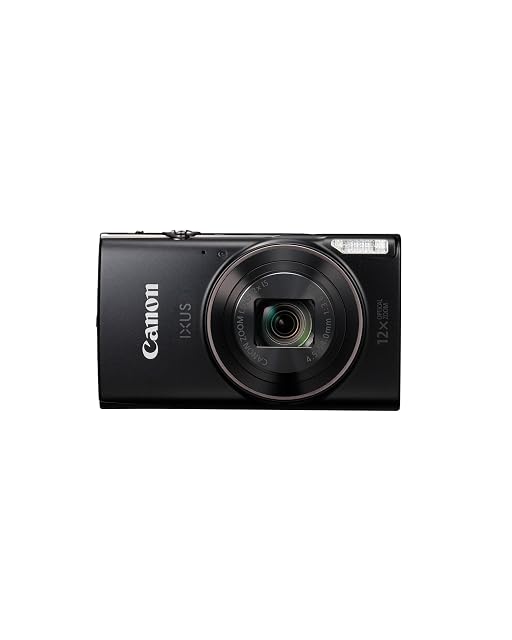
20.2 MP stated · 12× OPTICAL zoom · no aperture published · Full HD video · WLAN and NFC · metal body · no sensor size, screen movement or dimensions published
A slim metal point-and-shoot with a 12× optical zoom and wireless sharing, listed at 369 € to 400 € across euro stores — the same money as cameras on this shelf that offer 4K and a one-inch sensor.
Best for: Someone who specifically wants a slim metal Canon in a pocket and will use the 12× reach and the phone transfer.
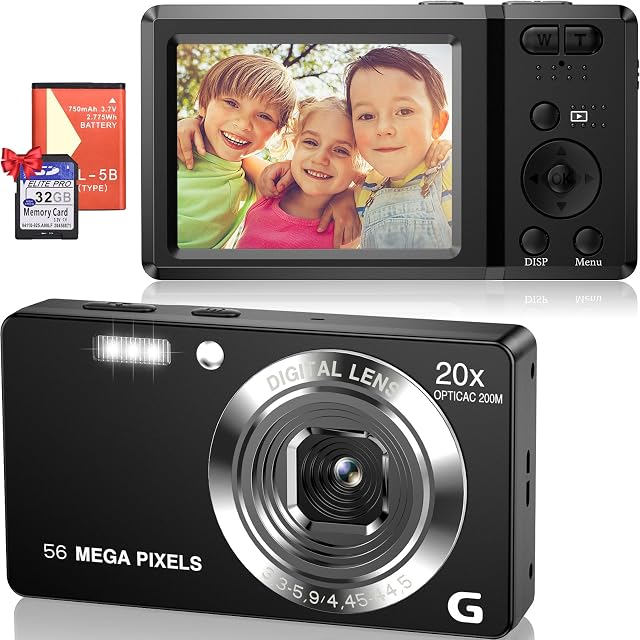
No sensor type published · 20× zoom stated as digital, not optical · no aperture published · 2.7 inch LCD · 4K video claimed · 56 MP stated image size · autofocus · tripod thread · 32 GB card included
A thirty-euro compact whose second bullet states in the maker’s own words that its 20× zoom is not optical, and which publishes a tripod thread and a webcam mode where dearer cameras here publish neither.
Best for: A cheap second camera for a desk, where the tripod thread and the webcam mode matter more than any figure on the page.
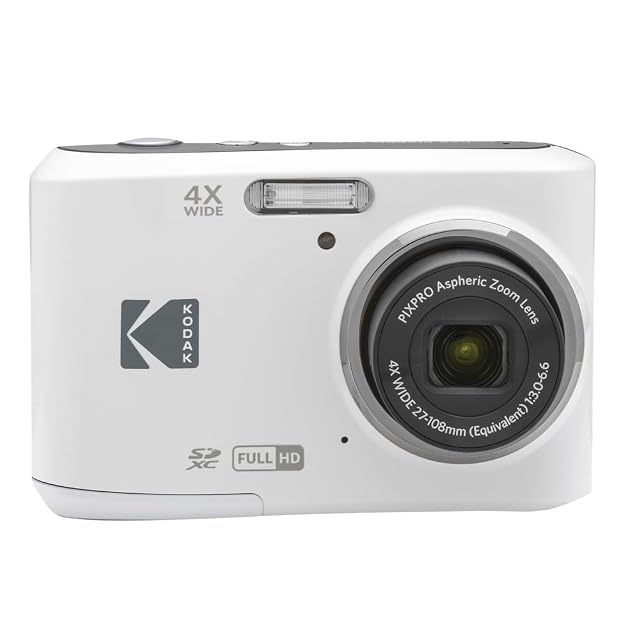
16 MP sensor stated · 4× OPTICAL zoom · no aperture published · 2.7 inch tilting LCD · 720p video · optical stabilisation mode · runs on AA batteries · no sensor size published
No compact here costs less and still offers a genuinely optical zoom with an optical stabilisation mode, running on AA batteries rather than a proprietary cell — and stopping at 720p video.
Best for: Travel somewhere batteries are easier to find than sockets, or a camera for someone who should not have to manage charging.