The magnification ratio is the specification, and 1:1 is the dividing line · review
TTARTISAN 100mm F2.8 Macro 2X for GFX, manual focus review
The only lens of the seven here that reaches twice life size, at 389 €, with twelve blades and four accessory mounting points on the barrel — and a distance published as a focusing distance rather than a working one.
The bottom line Twice life size for 389 € is a genuine outlier and the twelve blades and the barrel mounting points show a lens designed by someone who has done this work. What it does not publish is the working distance, the minimum aperture, the thread or the weight — and it focuses by hand at a magnification that leaves almost nothing in focus.
On the listing
Five bullets, written in English on the German listing. True 2X life-size reproduction, described as capturing eyelash-level detail on insects or pollen structure on flowers at a 9.8 inch focusing distance; a twelve-blade aperture for smooth background blur with subject separation at f/2.8 and edge-to-edge sharpness, named for product photography and jewellery; a cold shoe expansion hub with four reinforced mounting points for ring lights, microphones or wireless triggers; six high-refractive elements with a multi-layer coating against chromatic aberration and flare; and an all-metal body in aerospace-grade aluminium.
Twice life size, which is past where this shelf starts
The hub above puts the dividing line at 1:1 and this lens is a stop beyond it. Nothing else of the seven here claims 2:1. What follows from it is less advertised: at that magnification the depth of field is a fraction of a millimetre, the light is blocked by the lens itself, and the whole operation moves onto a focusing rail.
Nine point eight inches, and what it measures
The bullet says focusing distance, which is measured from the sensor. The gap in front of the glass — the one that decides whether an insect stays and whether a light fits — is shorter by the whole length of the camera and lens, and the page never gives it.
Twelve blades, and a cold shoe on a lens
Twelve is the highest blade count of the seven here by three. The four mounting points are rarer still: they accept the ring light that has to sit beside the front element because at 2:1 there is no room for light to arrive any other way. It is a lens built by people who know where the light goes.
Manual focus at a magnification that punishes it
No stabilisation is named and the title states manual focus. At twice life size, focus is usually set by moving the whole camera on a rail rather than by turning a ring at all, so this is less of a limitation than it sounds — and it does mean a tripod is part of the purchase, not an accessory to it.
Availability
About 389 € on the German, French, Italian and Spanish Amazon stores when this page was last checked.
Listed in the American and British Amazon catalogues with nothing on sale against the entry: the camera has a page there and no seller behind it.
Everything in this section is the figure Keepa carried on the day of the last update to this page. Availability and prices shift without notice.
Prices quoted in this text were read on 13 September 2026. The live price is at the top of the page.
What it does well, and what it gives up
Strengths
Twice life size, the only 2:1 claim among the seven here
Twelve aperture blades, the highest count of the seven here by three
Four cold-shoe mounting points on the barrel, so a ring light or a microphone mounts to the lens rather than the camera
Compromises
The 9.8 inch figure is a focusing distance, not the working distance this shelf is compared on
Manual focus and no stabilisation, at a magnification where depth of field is a fraction of a millimetre
No minimum aperture, no filter thread and no weight published
Specifications
Magnification ratio
2:1, stated as true 2X life-size reproduction in the first bullet. The hub above calls 1:1 the dividing line for this shelf; this lens goes a full stop of magnification past it, which is what the bullet means by diving deeper than standard macro lenses. It is the only lens of the seven here to claim it
Working distance
Not published as such. The first bullet gives a 9.8 inch focusing distance at maximum magnification — around 25 cm — and a focusing distance is measured from the sensor, not from the front of the lens. The gap that actually decides whether a subject can be lit, which is what the hub above defines as working distance, is shorter than that figure by the length of the lens and is not stated
Focal length
100mm, fixed, in the title. On the GFX medium-format bodies this lens mounts to, 100mm frames more widely than it would on full frame, which changes the working geometry the hub above describes
Maximum aperture
F2.8, in the title, with the second bullet claiming subject separation at that aperture alongside edge-to-edge sharpness. No minimum aperture is published, which matters more than usual here: at twice life size, depth of field is measured in fractions of a millimetre and the small apertures are where the work happens
Stabilisation
None named on the listing, and the title states manual focus. The hub above notes that stabilisation helps less than its figure suggests at high magnification, and at 2:1 that is emphatically true — this lens belongs on a rail or a tripod
Internal focus
Not stated. The page describes an all-metal body and six high-refractive elements and never says whether the barrel extends as it focuses — which at twice life size, where the front of the lens is already close to the subject, is the behaviour that decides whether a shot is possible
Filter thread
Not published in millimetres. The third bullet describes four reinforced mounting points for ring lights, microphones and triggers, so the page describes what can be attached to the barrel and never what screws onto the front
Weight
Not published in grams. The fifth bullet claims an aerospace-grade aluminium construction for stability, which is a material and not a mass
Amazon reference
B0H3ZZNQBL (same reference on 6 Amazon marketplaces)
EAN
0760762727750
What people ask before they commit
What does 2:1 mean against the usual 1:1?
At 1:1 a subject is projected onto the sensor at life size — a 10mm insect covers 10mm of sensor. At 2:1 it covers 20mm, so the subject is recorded at twice its actual size. The hub above treats 1:1 as the line that separates a real macro lens from one with a macro mode; this is the only lens of the seven here that goes beyond it.
Is 9.8 inches the distance from the lens to the subject?
The bullet calls it a focusing distance, which by convention is measured from the sensor plane, not from the front element. Subtract the length of the camera body and the lens barrel and the actual gap in front of the glass is considerably smaller. The hub above calls that gap the working distance and says it is what decides whether the work is pleasant. This page does not publish it.
What are the four mounting points for?
The third bullet names ring lights, external microphones and wireless triggers. At twice life size the lens is close enough to the subject to block most of the available light, so illumination has to come from beside or in front of the lens rather than from the camera. Mounting points on the barrel put the light where the lens is, which is the only place it can go.
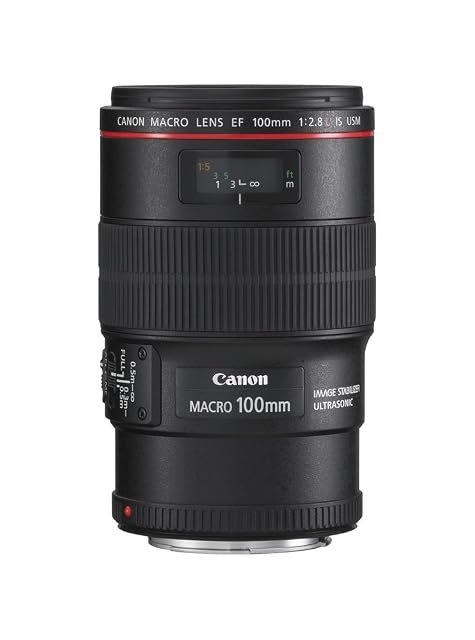
Canon EF mount · 100mm · F2.8 · Hybrid IS, no stop figure published · focus limiter · 9-blade aperture · UD element · L-series sealing against dust and splashes · 67mm filter thread · hood ET-73 and pouch LP1219 supplied · no magnification ratio published · no working distance published · no internal focus stated · no weight published
A sealed L-series macro with a focus limiter, Hybrid stabilisation and a 67mm thread for 762 € — and a listing that never once states the magnification ratio this shelf is built around.
Best for: Field macro work in unreliable weather on an EF body, where the limiter, the sealing and the hybrid stabilisation are what separate it from cheaper glass.
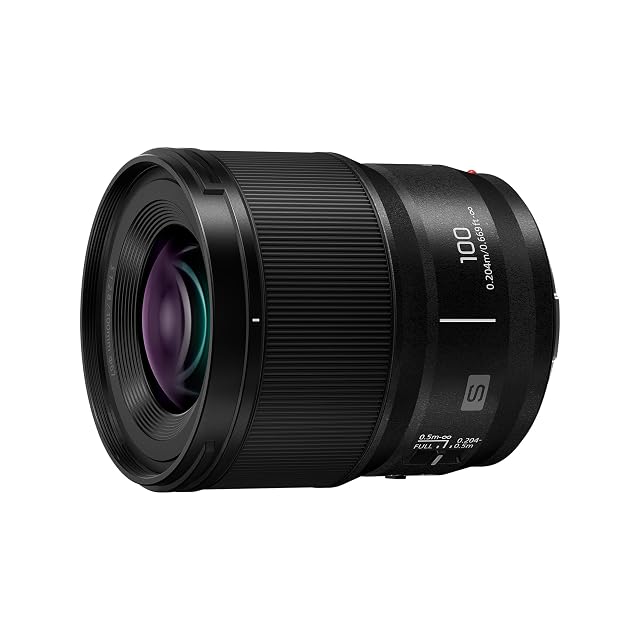
L mount · full frame · 100mm · F2.8 · 1:1 magnification · minimum focus 20.4 cm · 298 g · 3 aspherical elements · dual-phase linear motor, focus breathing suppressed · protection against dust, splashes and cold claimed · no working distance published · no stabilisation named · no internal focus stated · no filter thread published
A full-frame 1:1 macro weighing 298 g at 949 €, publishing its ratio, its minimum focus and its mass — and carrying a smallest-and-lightest claim the listing itself dates to 8 January 2024.
Best for: Full-frame macro work carried on foot, and video where a lens that does not change framing as it focuses is worth the price on its own.
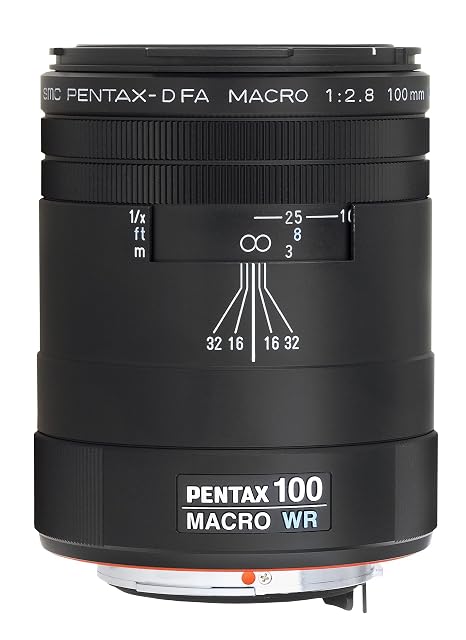
Pentax K mount · full frame · 100mm · F2.8 · 1:1, given as 1.00x · 13 cm from the front of the lens to the subject · stabilisation in the camera body, not in the lens · rear-element extension focusing · rounded iris from wide open to F5.6 · weather-resistant construction with dedicated seals · fluorine SP coating on the front element · Quick-Shift focus · aluminium outer body · hood PH-RBE49 and case S80-120 supplied · no filter thread published · no weight published
The only lens of the seven here that publishes a true working distance — 1:1 at 13 cm from the lens to the subject — across ten bullets, which is precisely the figure its own shelf says to buy on.
Best for: Macro work on a Pentax K-series body, where the body provides the stabilisation and 13 cm of working distance is the reason to choose this over anything else on the shelf.