A full-frame 1:1 macro weighing 298 g at 949 €, publishing its ratio, its minimum focus and its mass — and carrying a smallest-and-lightest claim the listing itself dates to 8 January 2024.
The bottom line A published 1:1, a published 20.4 cm and a published 298 g make this the best-measured macro on the shelf, and the breathing suppression is a real advantage for video. It names no stabilisation, gives no filter thread, and anchors its headline claim to a category it does not define and a date that has gone by.
On the listing
Five bullets. The world’s smallest and lightest macro lens in its category as of 8 January 2024, at 298 g, with protection against dust, splashes and cold; 1:1 magnification with a minimum focusing distance of 20.4 cm and an F2.8 aperture; three aspherical elements minimising aberration for high resolution and sharp detail, named for nature, wildlife and portraits; a workflow bullet aimed at professionals; and a dual-phase linear motor for fast, quiet focusing, with an optical design that suppresses focus breathing for smooth transitions in 4K video and vlogging.
One to one, published
Three lenses of the seven here state a ratio and this is one of them. Two of the dearest macros on this shelf never do. Life size on a full-frame sensor, stated in the title and the second bullet both.
Two hundred and ninety-eight grams, dated
The weight is a fact and the superlative around it is not. The first bullet claims the smallest and lightest in its category as of 8 January 2024 — a category the page never defines, and a date already behind us. The 298 g stands on its own without any of that.
Twenty point four centimetres is not working distance
It is the distance from the sensor, which is the convention, and it is measured through the camera body and the whole length of the lens. What is left in front of the glass is considerably less, and it is the figure that decides whether an insect stays put. The hub above says to buy on it; this page does not print it.
Focus breathing, suppressed
Named in the fifth bullet, and it is the one specification here that is purely about video. A macro lens racks focus a long way, so any change in framing while it does so is magnified. Suppressing it is difficult and expensive, and it is the reason this lens is the dearest on the shelf.
Availability
Between 949 € and 1009 € on the German, French, Italian and Spanish Amazon stores when this page was last checked.
The American and British Amazon stores carry it too, priced in local currency. Those amounts are deliberately absent from the range above, which reads euro stores only.
Everything in this section is the figure Keepa carried on the day of the last update to this page. Availability and prices shift without notice.
Prices quoted in this text were read on 13 September 2026. The live price is at the top of the page.
What it does well, and what it gives up
Strengths
1:1 magnification and a 20.4 cm minimum focus, both published as figures
298 g for a full-frame macro, with protection against dust, splashes and cold claimed
Focus breathing suppressed, named in the fifth bullet, which is the property that matters when the lens is used for video
Compromises
The working distance — the gap in front of the lens — is not published, only the distance from the sensor
No stabilisation of any kind named, where two lenses on this shelf claim it
No filter thread published, on an otherwise well-measured page
Specifications
Magnification ratio
1:1, published in the second bullet and again in the title. Life size on a full-frame sensor, which is the line the hub above draws for this shelf — and one of only three ratios published among the seven here
Working distance
Not published. The second bullet gives a minimum focusing distance of 20.4 cm, which is measured from the sensor plane; the gap in front of the lens is shorter by the depth of the camera and the length of the barrel. The hub above treats those as different figures for good reason, and this page gives only the first
Focal length
100mm, fixed, in the title. The longest on this shelf alongside the Canon, the Sigma and the Pentax, which by the hub’s geometry is the group that stands furthest back at life size
Maximum aperture
F2.8, in the title and the second bullet, which names it alongside the ratio and the focusing distance as the three figures of the lens
Stabilisation
None named on the listing. No optical stabilisation is claimed and no stop figure appears, which on an L-mount lens leaves the question to the body. The hub above notes stabilisation helps less than expected at high magnification, so this is a smaller gap here than it would be on a telephoto
Internal focus
Not stated directly. The fifth bullet claims a dual-phase linear motor with an optical design that suppresses focus breathing — the change of framing as focus shifts — which is a related but different property. Whether the barrel extends as it focuses is not said
Filter thread
Not published in millimetres, on a page that publishes the weight to the gram and the focusing distance to a tenth of a centimetre
Weight
298 g, published in the title and in the first bullet. For a full-frame 1:1 macro that is genuinely small, and the first bullet builds its whole claim on it — with a date attached
Amazon reference
B00KDXDOR0 (same reference on 6 Amazon marketplaces)
EAN
5025232953806
What people ask before they commit
What is the difference between 20.4 cm and the working distance?
The 20.4 cm is measured from the sensor plane, which sits inside the camera body. Subtract the depth of the body and the length of the lens and what remains is the gap between the front element and the subject — the working distance, and the figure the hub above says to buy on for anything alive. The page publishes the first and not the second, which is the industry convention and is still the less useful number.
What is focus breathing and why is it in the bullets?
A lens that breathes changes its framing slightly as it focuses, so a focus pull in a video appears as a small zoom. For stills it is invisible; for video it is distracting, and on a macro lens — where focus moves a long way — it is worse than usual. The fifth bullet claims the optical design suppresses it, which is a claim aimed squarely at filming.
How should the smallest and lightest claim be read?
As the listing writes it: the world’s smallest and lightest macro lens in its category, as of 8 January 2024. Both qualifiers are the maker’s own — a category that is not defined on the page, and a date that has passed. The 298 g figure beside it needs no qualification and is the part worth using.
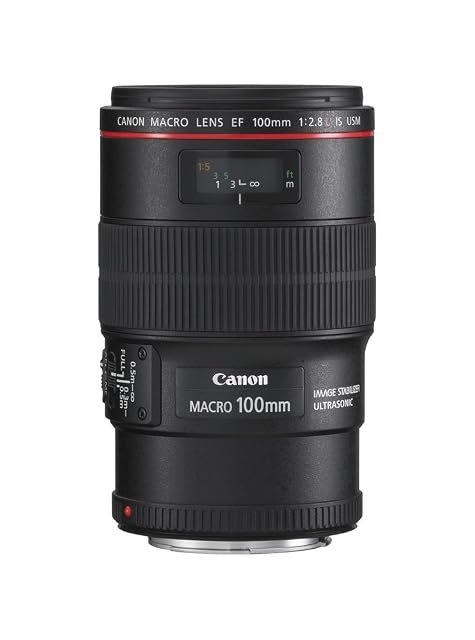
Canon EF mount · 100mm · F2.8 · Hybrid IS, no stop figure published · focus limiter · 9-blade aperture · UD element · L-series sealing against dust and splashes · 67mm filter thread · hood ET-73 and pouch LP1219 supplied · no magnification ratio published · no working distance published · no internal focus stated · no weight published
A sealed L-series macro with a focus limiter, Hybrid stabilisation and a 67mm thread for 762 € — and a listing that never once states the magnification ratio this shelf is built around.
Best for: Field macro work in unreliable weather on an EF body, where the limiter, the sealing and the hybrid stabilisation are what separate it from cheaper glass.
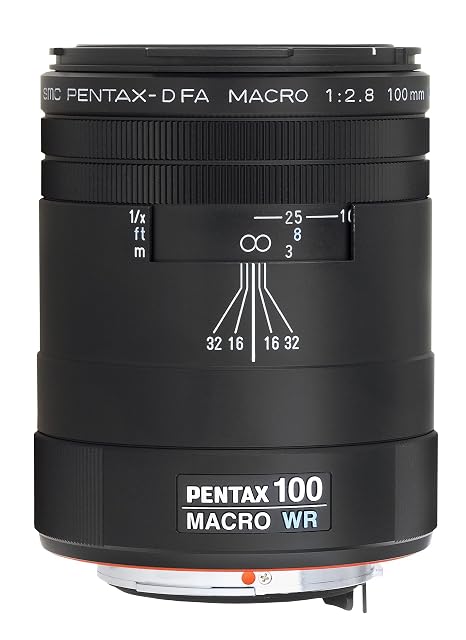
Pentax K mount · full frame · 100mm · F2.8 · 1:1, given as 1.00x · 13 cm from the front of the lens to the subject · stabilisation in the camera body, not in the lens · rear-element extension focusing · rounded iris from wide open to F5.6 · weather-resistant construction with dedicated seals · fluorine SP coating on the front element · Quick-Shift focus · aluminium outer body · hood PH-RBE49 and case S80-120 supplied · no filter thread published · no weight published
The only lens of the seven here that publishes a true working distance — 1:1 at 13 cm from the lens to the subject — across ten bullets, which is precisely the figure its own shelf says to buy on.
Best for: Macro work on a Pentax K-series body, where the body provides the stabilisation and 13 cm of working distance is the reason to choose this over anything else on the shelf.
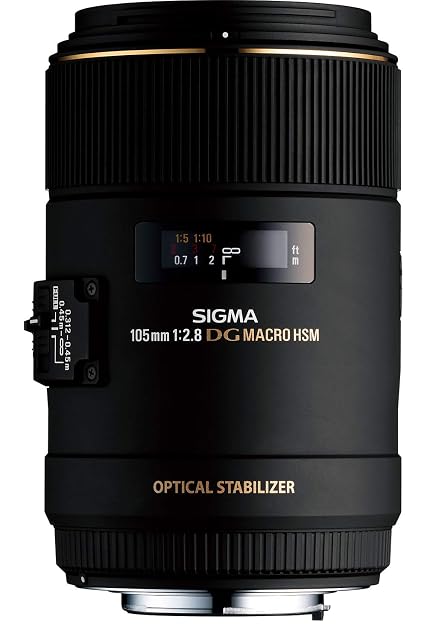
Canon EF mount · full frame, from the DG designation · 105mm · F2.8 · 1:1 magnification · Hyper Sonic Motor · optical stabilisation in the product name only, no figure published · no working distance published · no internal focus stated · no filter thread published · no weight published
A 1:1 macro at 105mm whose page states the ratio and then four adjectives — with an optical stabiliser announced in the product name and described in none of the five bullets.
Best for: Life-size work on a Canon EF body at the longest focal length on this shelf, for a buyer who will find the specification somewhere other than the listing.