An 11 inch key light that clamps to a desk and comes with a magnetic remote reaching 30 metres, for 48 € — publishing 600 lumens, which measures total light output rather than what lands on a face.
The bottom line The clamp, the ball head and the 30-metre remote are better specified than anything else on this shelf, and for a desk that is what matters. The output is published in lumens rather than lux, the colour index is the weakest of the four, and there is no battery at all.
On the listing
Five bracketed bullets. A 10 W streaming light with 0 to 100 per cent brightness, 2500K to 9000K, an 11 inch studio panel with a 120 degree beam and 192 high-brightness beads, edge-lit for even soft light, with CRI above 90 for natural skin; a magnetic anti-loss remote with 30 m range, a stable signal and 7 channels, able to control one light, several groups or all in sync; a pairing explanation — the number on the back of the panel is its channel, changed by holding CH on the remote or pressing CH on the light; a space-saving desk mount with a metal C-clamp taking 0 to 50 mm, adjustable from 30 to 80 cm on a 360 degree aluminium ball head; and a uses bullet naming streaming, TikTok, home office, video conferences, gaming, YouTube, Zoom, webcam video and photography.
Six hundred lumens, which answers a different question
The shelf asks how much light lands; this page says how much leaves. Lumens are a total emission; lux is what arrives on a surface at a known distance. Spread across a 120 degree beam from an 11 inch panel, 600 lumens is a soft wash rather than a punch — but how soft, at the distance a person sits from a desk, cannot be calculated from this page.
A mount specified to the millimetre
Nought to fifty millimetres of jaw, thirty to eighty centimetres of height, a 360 degree ball head, aluminium alloy. Every other panel on this shelf either supplies a small tripod or says nothing at all. For a light that has to survive a desk being tidied around it, this is the specification that matters.
Thirty metres, seven channels, and a magnet
More range than a desk could ever need, and the channels are the real feature: two or three panels can be set apart or moved together without reaching behind any of them. The remote sticks to anything ferrous, which is the sort of detail that comes from watching people lose remotes.
No battery, anywhere on the page
The third bullet says the light comes on when it is plugged in. No cell, no capacity, no runtime — this is a fixture for a desk with a socket, and the two cheaper panels on this shelf both run from their own cells.
Availability
Between 46 € and 52 € on the German, French, Italian and Spanish Amazon stores when this page was last checked.
The British Amazon store carry it too, priced in local currency. Those amounts are deliberately absent from the range above, which reads euro stores only.
Listed in the American Amazon catalogue with nothing on sale against the entry: the camera has a page there and no seller behind it.
Everything in this section is the figure Keepa carried on the day of the last update to this page. Availability and prices shift without notice.
Prices quoted in this text were read on 13 September 2026. The live price is at the top of the page.
What it does well, and what it gives up
Strengths
A fully specified desk mount: 0 to 50 mm clamp, 30 to 80 cm height, 360 degree ball head
A magnetic remote with 7 channels and 30 m range, able to control one light or several groups in sync
2500K to 9000K across an 11 inch edge-lit panel with a 120 degree beam
Compromises
600 lumens measures emitted light, not what reaches a subject, so it answers a different question from the shelf’s
CRI above 90 is the weakest accuracy claim of the four panels here
Mains only — no cell, no capacity and no runtime named anywhere on the page
Specifications
Output in lux with its distance
Not published in lux. The first bullet gives 600 lumens, which is a different quantity: lumens count the total light a source emits in every direction, while lux measures how much of it lands on a surface at a given distance. A wide 120 degree beam spreads those lumens over a large area, so the figure cannot be converted into the lux the hub above asks for without knowing the distance and the spread
Colour temperature range
2500K to 9000K, in the first bullet — the same span as the pocket panel on this shelf and wider than either studio fixture here
Accuracy indices
CRI above 90, in the first bullet, which adds that it makes skin look more natural. One index, and the lowest of the three figures published on this shelf: 98 on the Rollei, 95 or better on the RaLeno, 96 or better on the Neewer pair. Above 90 is usable and is the weakest claim among the four
Dimming
0 to 100 per cent, in the first bullet. No step count and no statement of whether it is continuous
Flicker
Not addressed on the listing. The first bullet describes edge-lit construction spreading light evenly across the emitting surface for soft, eye-protecting light, and no frame rates or flicker-free claim appear anywhere
Power options
Mains only, by implication: the third bullet says the light switches on automatically once plugged in, and no cell, no capacity and no runtime is named anywhere. Of the four panels here this is the only one with no battery option described
Mount
A solid metal C-clamp with a 0 to 50 mm jaw for most desks, height adjustable from 30 to 80 cm, on a 360 degree ball head in aluminium alloy — the fourth bullet. It is the most fully specified mount on this shelf, and it is a desk clamp rather than a shoe or a spigot
Amazon reference
B0DM1RB1J2 (same reference on 6 Amazon marketplaces)
EAN
6975357306331
What people ask before they commit
What is the difference between lumens and lux?
Lumens count all the light a source puts out, in every direction. Lux measures how much of that light falls on a square metre of surface at a stated distance. A light with a wide beam spreads its lumens thinly, so a high lumen figure can still give modest lux on a face. The hub above asks for lux with its distance because that is the figure describing what the camera actually sees.
What does the 7-channel remote allow?
Several lights, controlled separately or together. The second bullet says the number on the back of each panel is its channel, changed by a short press, and that the remote can drive a single light, several groups, or synchronise them all. For a two- or three-light desk setup that removes reaching behind each panel — and the remote is magnetic, so it sticks to anything ferrous.
Is edge-lit better than a direct panel?
It is softer. Emitters at the edges fire into a diffusing sheet, so the whole surface glows evenly rather than showing 192 individual points. The trade is output: some light is lost inside the panel. It is the same construction as the RaLeno on this shelf and the reason both give pleasant light at modest brightness.
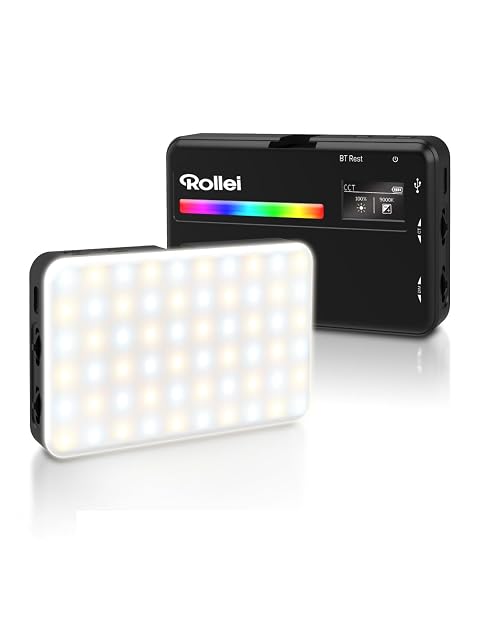
8 W · no output in lux and no distance published · 2500K to 9000K · 360 RGB colours and 13 effects · CRI and TLCI both 98 · stepless dimming from 0 to 100 per cent · internal cell, no runtime published · OLED screen and app control · 125 g · no mount published
A phone-sized panel at 24 € whose colour accuracy is published twice over — CRI and TLCI both 98, the highest figures of the four here — with no output in lux and no runtime.
Best for: A pocket light for faces and small objects where faithful colour matters more than power, and the light lives within arm’s reach of the subject.
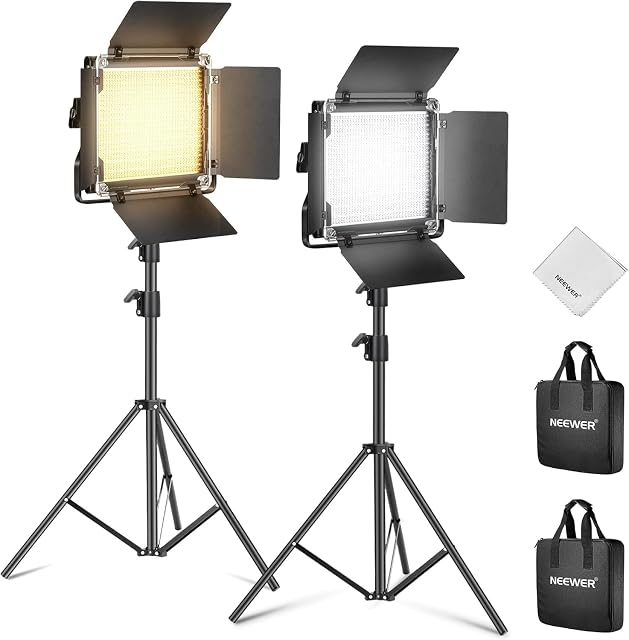
Two panels of 660 LEDs, 330 warm and 330 cool · 40 W each · 3300 lux at 1 m · 3200K to 5600K · CRI 96 or better · brightness 0 to 100 per cent · mains adapter supplied or NP-F550 and NP-F970 cells, not supplied · barn doors and U-brackets with 360 degree tilt · two stands from 66 to 190 cm · panels 232 by 200 by 48 mm · LCD screen · two carry bags
The only light of the four here that publishes an illuminance with its distance — 3300 lux at 1 m — as a pair of 660-LED panels with stands, barn doors and bags for 194 €.
Best for: A two-light setup for portraits, product work or streaming where the panels go on stands, the barn doors control spill, and a socket is available.
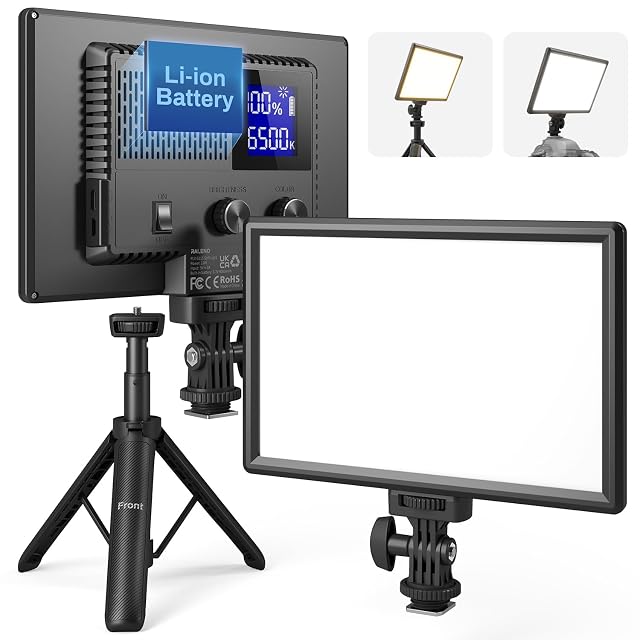
12 W · 600 lux published without a distance · 2500K to 6500K · 116 LEDs · CRI 95 or better · brightness 0 to 100 per cent · 4000 mAh cell, up to 90 minutes at full brightness · pass-through charging over USB-C and USB · 388 g · extendable mini tripod supplied · four-layer diffuser
A panel with a published runtime — 90 minutes at full brightness from 4000 mAh — pass-through charging and a mini tripod in the box for 37 €, with 600 lux quoted at no distance at all.
Best for: Video calls, streaming and desk work where the light has to run for an hour and a half without a mains lead and the tripod is already included.