The lens that stays on the camera, and its aperture tells you how it was built · review
Sony SELP18105G, 18-105mm F4 G OSS power zoom review
A constant F4 across 18-105mm with a powered stepless zoom and a barrel that never changes length, at 450 € — the video lens of this shelf, and it publishes five optical details while leaving every practical measurement out.
The bottom line A constant F4, a stepless powered zoom and a barrel that never moves add up to a filming lens, and the page argues that case well in five bullets. It then leaves the filter thread, the minimum focus, the sealing and the weight unstated, which makes four of the nine lines this shelf compares unanswerable at 450 €.
On the listing
An optical design with two extra-low dispersion elements and three aspherical ones, credited with G-series quality across the whole zoom range; a seven-blade circular aperture for background blur; a bullet calling the range and quality more than sufficient for most situations and naming the stepless power zoom as an added benefit; a focusing bullet claiming professional-grade technology, smooth, quiet and responsive, with the length of the lens staying constant while zooming or focusing; and a closing bullet on built-in Optical SteadyShot compensating for camera shake.
Five optical details, which is more than this shelf usually gives
Two ED elements and three aspherical ones, counted. The Sigma above it says superb image quality and stops there; the Canon below it does not describe its glass at all. This is the only page on the shelf that says what is inside the barrel and how many of each.
Seven blades, and they are round. The hub above explains why that figure is published: it decides how out-of-focus highlights are drawn and how many points appear around a bright light. Seven rounded blades is what the second bullet gives.
A barrel that stays the same length
The fourth bullet makes the claim for zooming and for focusing both. On a lens bought for filming this is not a detail: nothing that was balanced or clamped before the shot moves during it.
Where the page stops short
The stabiliser has no number. Optical SteadyShot is named and described, and the stops it is worth are never given — while the cheaper Canon on this shelf prints 4.5 in its title.
No thread, no close-focus distance, no grams. Four of the nine lines this shelf is compared on have nothing behind them, and the lens costs 450 € in Germany and 419 € on the British shelf.
Availability
Between 450 € and 599 € on the German, French, Italian and Spanish Amazon stores when this page was last checked.
The American and British Amazon stores carry it too, priced in local currency. Those amounts are deliberately absent from the range above, which reads euro stores only.
Everything in this section is the figure Keepa carried on the day of the last update to this page. Availability and prices shift without notice.
Prices quoted in this text were read on 13 September 2026. The live price is at the top of the page.
What it does well, and what it gives up
Strengths
F4 held across the whole 18-105mm range, so exposure does not shift as the lens is zoomed
The barrel does not change length while zooming or focusing, stated in the fourth bullet — the behaviour that keeps a filter, a matte box or a gimbal balance valid
A powered stepless zoom, which is a video control rather than a photographic one, and the only one on this shelf
Compromises
Optical SteadyShot is named without a figure in stops, so it cannot be compared with the lens below it
No filter thread, no minimum focus and no weight published, on a lens that costs 450 €
The maximum aperture on offer is F4 — a stop and a third behind the Sigma above it, for 53 € less
Specifications
Mount
E-mount, stated in the title, which also names the APS-C bodies it is for: the ZV-E10, the A6400 and the A6700
Format
APS-C, stated in the title. The third bullet calls the range more than sufficient for most shooting situations, which is a claim about the framing this format gives rather than about the glass
Focal range
18-105mm, in the title. Just under six times the short end — between the 18-150mm below it and the 18-50mm above
Maximum aperture at both ends
F4 at both, stated in the title as a constant aperture. This is the constant-aperture side of the division the hub above draws, and it is why the lens is longer and dearer than the variable one below it while covering less range
Stabilisation
Optical SteadyShot, built into the lens, named in the fifth bullet, which says it compensates for camera shake and makes clear images easier to take by hand. No figure in stops is published, so the claim cannot be compared with the 4.5 stops printed below it
Filter thread
Not published on the listing — five bullets cover the optical design, the bokeh, the zoom, the focus motor and the stabiliser, and no diameter appears
Minimum focus
Not published on the listing, and no magnification ratio either. The fourth bullet does say the length of the lens stays constant while focusing, which is the behaviour a close-focus user cares about, without giving the distance
Sealing
Not claimed on the listing. Neither dust nor moisture is mentioned, which is worth noting on a G-series lens where Sony does make that claim for other models in the same range
Weight
Not published in grams. The page never calls the lens light either, which is unusual restraint on a shelf where the other two both do
Amazon reference
B00ENZRQH8 (same reference on 6 Amazon marketplaces)
EAN
4905524956672
What people ask before they commit
Why does a constant F4 cost more than a variable F3.5-6.3?
Holding one aperture across the range means the lens has to gather the same amount of light at the long end as at the short one, which requires larger elements and more of them. The hub above puts it plainly: a constant-aperture zoom and a variable one are different tools on the same shelf. This lens covers less range than the cheaper one below it and costs 20 € more for keeping F4 throughout.
What is a powered zoom for?
The third bullet calls it stepless, which is the point: the zoom is driven by a motor on a rocker rather than turned by hand, so the movement can be slow and even in a shot instead of stepped. It also allows the zoom to be driven from a body or a grip. It is a filming feature, and it is the reason this lens sits on gimbals.
Does the lens change length as it zooms?
No, and the fourth bullet says so explicitly for both zooming and focusing. That matters more than it sounds: a barrel that grows shifts the balance of a rig, changes the distance to a mounted filter or hood, and moves the front element on a gimbal that was balanced beforehand. It is one of the five things this page does publish.
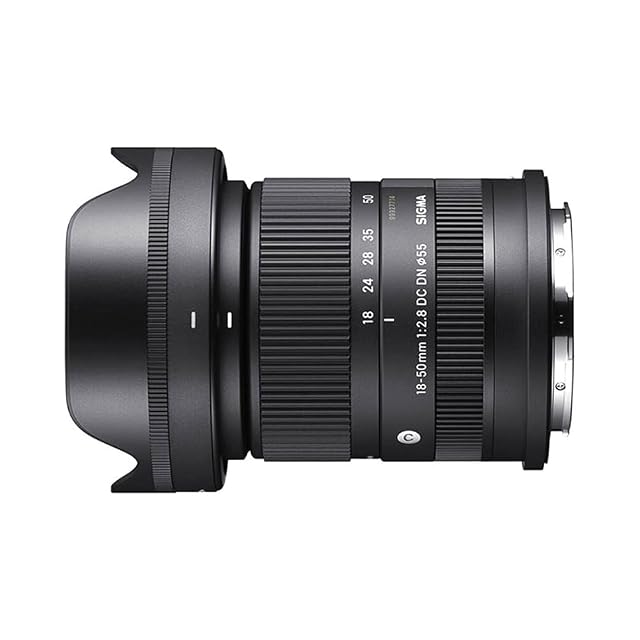
Sony E mount · APS-C, from the DC designation and stated twice in the bullets · 18-50mm · F2.8 held across the range · no stabilisation named · no filter thread published · no minimum focus published · no sealing claimed · no weight published · multi-layer coating claimed
The widest constant aperture on this shelf, F2.8 across 18-50mm, and the dearest lens here at 503 € — sold on five phrases of marketing copy that answer none of the nine things this shelf is compared on.
Best for: An APS-C E-mount body indoors, where F2.8 at every focal length is worth giving up both range and published specification for.
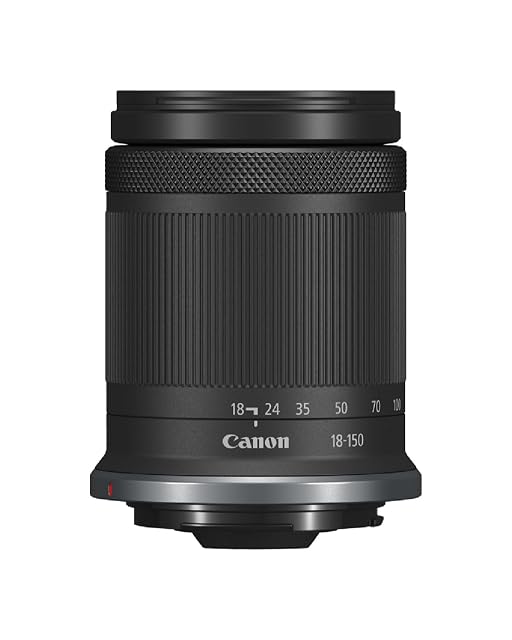
RF-S mount · APS-C · 18-150mm · F3.5 at the short end, F6.3 at the long one · 4.5 stops of stabilisation claimed · STM focus · no filter thread published · no minimum focus published · no sealing claimed · no weight published
The variable-aperture side of this three-lens shelf at 430 €, with eight and a half times the range of its own short end and a 4.5-stop stabiliser in the title, and six of the nine lines this shelf is compared on left blank.
Best for: One lens on an EOS R APS-C body for travel, where the range matters more than the aperture and the stabiliser carries the long end.
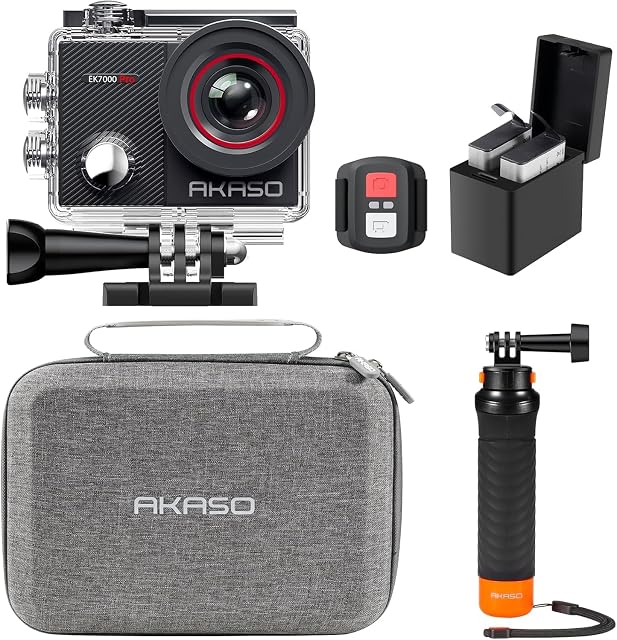
40 m waterproof housing · 4K 30, 2.7K 30, 1080p 60 · 20 MP stills · EIS stated · four selectable view angles: super wide, wide, medium, narrow · 2 inch IPS touchscreen · floating hand grip and bag supplied · no field of view in degrees
An established name at ninety-three euros, selling a touchscreen, three video modes and four selectable view angles — described by name rather than in degrees — with a floating grip in the box.
Best for: Water use where the floating grip and the touchscreen earn their keep, by someone who will buy a spare battery blind.