The mount ties every modifier you will ever own to one system · review
AMBITFUL Honeycomb grid, 60 by 60 cm, Godox S-type review
Thirteen euros for a honeycomb grid, not a softbox: the black lattice that stops a 60 by 60 cm box spilling light across a room, fitted by the velcro already sewn inside it.
The bottom line Thirteen euros is the right price for closing a gap, and this grid does exactly one job on a box that already exists. It publishes no depth and no beam angle, so how much it narrows the light is unknown until it is fitted — and it is not a softbox, which the title does not make obvious.
On the listing
Five bullets, each opening with a sunflower. Extremely easy to assemble using the velcro straps on the inside of the softboxes; the honeycomb attaches inside the box with the fastening tape sewn on the side; a nylon fabric construction called durable and lightweight; a variety of options suiting softboxes of various sizes; and an offer to make a honeycomb grid to a custom size on request.
A grid, and the title does not say so plainly
This is not a softbox. It is the black lattice that goes inside one, and the word “Softbox” appears in the title because that is what it fits. Anyone buying it expecting a light modifier with a mount will receive a fabric honeycomb and nothing to attach it to.
Sixty by sixty, and the velcro is already there
Square boxes of that size carry a strip of fastening tape along the inner rim. The first two bullets rely on it entirely: the grid presses in and peels out, with no rods and no frame.
Thirteen euros closes a real gap
The hub above counts grid provision among the things that separate one softbox from another, and notes that included or extra is a genuine cost difference. A box bought without one need not be replaced.
The depth nobody publishes
Grids are normally sold by beam angle — twenty degrees, thirty, forty — and the angle comes from how deep the cells are. This page gives neither figure, so how tightly this one controls the spill is a matter of trying it.
Availability
About 13 € on the German, French, Italian and Spanish Amazon stores when this page was last checked.
The British Amazon store carry it too, priced in local currency. Those amounts are deliberately absent from the range above, which reads euro stores only.
Listed in the American Amazon catalogue with nothing on sale against the entry: the camera has a page there and no seller behind it.
Everything in this section is the figure Keepa carried on the day of the last update to this page. Availability and prices shift without notice.
Prices quoted in this text were read on 13 September 2026. The live price is at the top of the page.
What it does well, and what it gives up
Strengths
Thirteen euros to add a grid to a softbox that shipped without one
Velcro fitting, using the strip already sewn inside the box
Custom sizes offered, which no other page on this shelf mentions
Compromises
It is not a softbox — it needs a 60 by 60 cm box to go into
No depth and no beam angle published, which is what distinguishes one grid from another
Nylon construction claimed durable, with no weight or packed size given
Specifications
Mount type
None of its own — and that is the first thing to understand about this page. A grid does not mount on a light; it mounts INSIDE a softbox, held by the velcro strip sewn along the box’s inner edge. The second bullet names that fastening tape explicitly. The Godox S-type mentioned in the title is the box this grid was cut for, not a fitting this product carries
Size and shape
Square, 60 by 60 cm, in the title. The dimension is the box it fits rather than a light-emitting surface, and the fourth bullet adds that other sizes suit other boxes — with the fifth offering custom dimensions on request, which is unusual and tells you this is a made-to-order accessory rather than a retail product
Depth
Not published, and on a grid the depth is what sets the beam angle: a deeper honeycomb narrows the light more sharply than a shallow one. It is the specification that would distinguish a 20 degree grid from a 40 degree one, and the page gives neither the depth nor the angle
Diffusion layers
None — a grid does the opposite of diffusing. It restricts where the light goes without softening it, which is why the hub above describes it as the accessory that turns a softbox from something that fills a room into something that lights a subject
Grid provision
This IS the grid, sold separately for a box that did not include one. That is the whole proposition: the hub above notes that whether a grid comes with the box is a real cost difference, and 13 € is what closing that gap costs
Assembly method
Velcro, in the first two bullets, described as extremely easy using the straps on the inside of the softbox. No rods, no frame, no ring: it presses into place and peels out
Packed size
Not published. The third bullet calls the nylon construction durable and lightweight, and gives no folded dimension — though a fabric honeycomb rolls rather than folds
Amazon reference
B08X19ZT4P (same reference on 6 Amazon marketplaces)
EAN
0744337345051
What people ask before they commit
What does a honeycomb grid actually do?
It stops light travelling sideways. The open cells let rays pass straight through and absorb those leaving at an angle, so the beam narrows without becoming harder. The hub above describes the effect as turning a source that fills a room into one that lights a subject — which is what lets a background stay dark while a face is properly lit.
Will it fit my softbox?
It is cut for 60 by 60 cm square boxes, and it relies on the velcro strip sewn inside them — which the Godox S-type and most boxes of that size carry. The fourth bullet says other sizes suit other boxes and the fifth offers custom dimensions on request, so a non-standard box is a conversation rather than a refusal.
Why does the missing depth matter?
Because depth sets the angle. A honeycomb 2 cm deep restricts light far less than one 5 cm deep, and grids are normally sold by their beam angle — 20, 30 or 40 degrees — precisely for that reason. This page publishes neither the depth of the cells nor the resulting angle, so how tightly it controls the light cannot be read before it arrives.
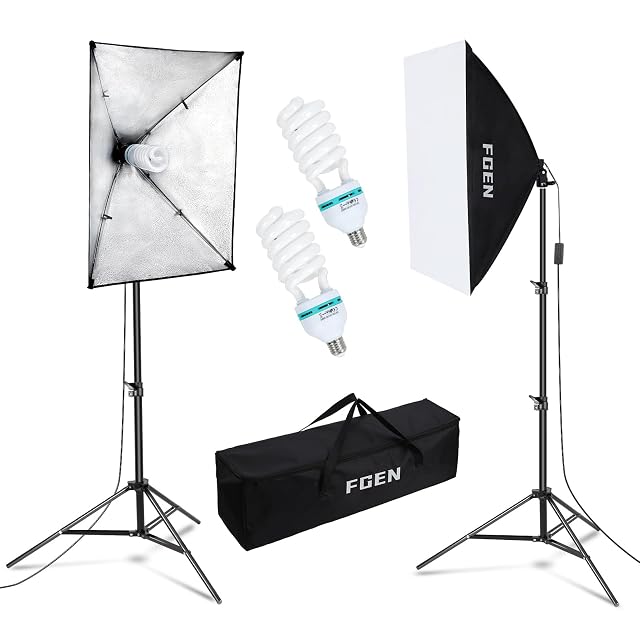
A COMPLETE KIT: two 50 by 70 cm boxes, two 135 W CFL bulbs at 5500K, two stands, a 2.5 m mains lead · colour rendering index above 90 · bulbs rated about 10,000 hours · stands adjust from 68 to 200 cm · silver stone-grain inner fabric with a nylon outer · E27 fitting · bulbs monochromatic and not adjustable, stated by the maker · no mount type published · no depth published · no grid
Two 50 by 70 cm boxes with 135 W daylight bulbs and a published colour index above 90, for 62 € — and a first bullet that tells you how to ask for the missing parts.
Best for: A home studio that needs two large daylight sources cheaply, where colour fidelity matters more than adjustable output.
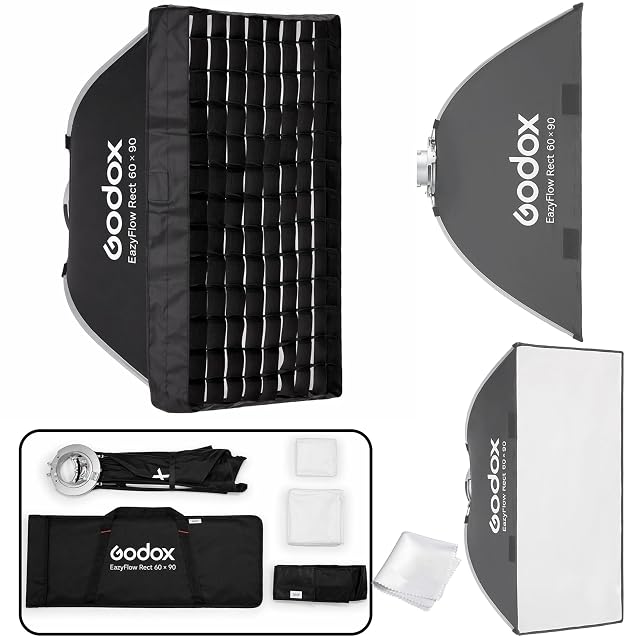
Bowens mount, named in the title · rectangular, 60 by 90 cm · named for fashion portraits, group photographs and studio work · the bullet list is a single slash character · no depth published · no diffusion layers described · no grid mentioned · no assembly method described · no packed size published
A 60 by 90 cm Bowens-mount softbox at 60 €, whose entire specification is its title: the bullet list is one slash character.
Best for: A Bowens-mount studio head that needs a rectangular source, for a buyer who already knows what the maker builds.
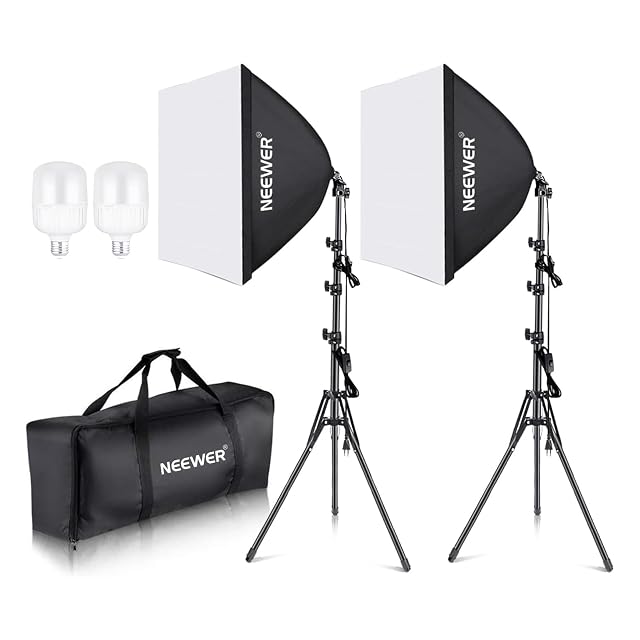
A COMPLETE KIT: two 60 by 60 cm boxes, two 35 W LED bulbs at 5700K, two 210 cm stands, a carry bag · 3450 lumens claimed per bulb · described as equivalent to 350 W incandescent each, 700 W in total · E27 fitting taking bulbs, fluorescent tubes or slave flashes · aluminium-alloy stands with single quick locks · no mount type published · no depth published · no dimming described · no grid
Two 60 by 60 cm boxes, 35 W LED bulbs at 5700K, 210 cm stands and a bag for 122 € — with an E27 socket that also takes a slave flash, which nothing else here mentions.
Best for: A home or small studio setup that may later be fired with flash rather than continuous light, where the E27 socket keeps that option open.