A box of even light, sized by the largest thing you will put in it · review
PULUZ 25 by 25 cm, 104 LEDs, CRI above 95 review
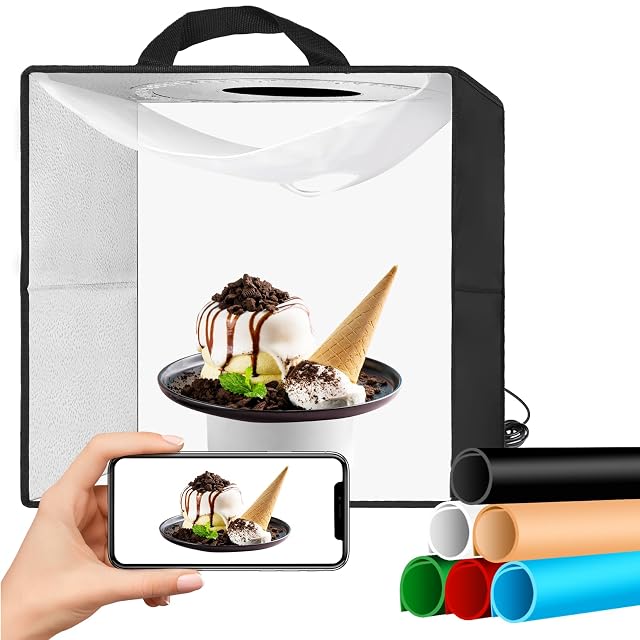
Twenty-five centimetres square with 104 LEDs and six double-sided backgrounds for 34 € — and a bullet that gives a colour rendering index where a colour temperature should be.
The bottom line A hundred and four LEDs, an index above 95 and twelve background surfaces for 34 € is a lot of small-object photography for the money. The page never publishes a kelvin figure — it puts the index in that slot instead — describes no dimming, and names no power source.
On the listing
Five bullets. A mini photo studio with 104 LED beads said to give enough brightness for shooting; a setup claimed to take three seconds on any surface, as a backdrop for small articles and products; a bullet describing a light ring with a colour temperature of CRI95, a worked-in stone-grain cloth and a good light-collecting effect; multi-angle shooting through a front horizontal window and a vertical one; and a versatility bullet naming jewellery, accessories, toys, watches and gadgets, for photographers, artists, online sellers and product promotion.
A hundred and four beads, in twenty-five centimetres
The LED count is high for a box this small, which is the point of a box this small. A quarter-metre of translucent wall lit from inside wraps a watch completely; the same output in a 40 cm cube would be half as bright on the subject.
Six sheets, twelve surfaces
Double-sided backgrounds are the quiet economy here. They halve the bulk of the part that takes the most room in the bag.
Two windows, front and top
A camera looking in horizontally and one looking down. On a 25 cm box those are the two positions there is room for.
Where the kelvin figure should be, an index
“A colour temperature of CRI95” is not a colour temperature. The index is worth having — above 95 is the threshold for trusting a colour — but the page leaves the kelvin slot empty and puts the wrong number in it.
Availability
Between 34 € and 36 € on the German, French, Italian and Spanish Amazon stores when this page was last checked.
The American and British Amazon stores carry it too, priced in local currency. Those amounts are deliberately absent from the range above, which reads euro stores only.
Everything in this section is the figure Keepa carried on the day of the last update to this page. Availability and prices shift without notice.
Prices quoted in this text were read on 13 September 2026. The live price is at the top of the page.
What it does well, and what it gives up
Strengths
A hundred and four LEDs and an accuracy index above 95, for 34 €
Six double-sided backgrounds, so twelve surfaces from six sheets
Two openings, front and top, on a box that claims a three-second setup
Compromises
The third bullet gives a rendering index where a colour temperature belongs
No dimming described, and no power source named
Twenty-five centimetres rules out anything larger than a small object
Specifications
Internal dimensions
25 by 25 cm, in the title. The intro above says to measure the largest object and then leave room around it, because a subject filling the tent brings the seams into frame. Twenty-five centimetres is jewellery, a watch, a phone — the listing names exactly those
Lighting provision
Built in: 104 LED beads, in the first bullet, credited with enough brightness for shooting. Where they sit — one strip, two, top only — is never said, and the intro above calls that the detail that decides how even the result is
Colour temperature and accuracy
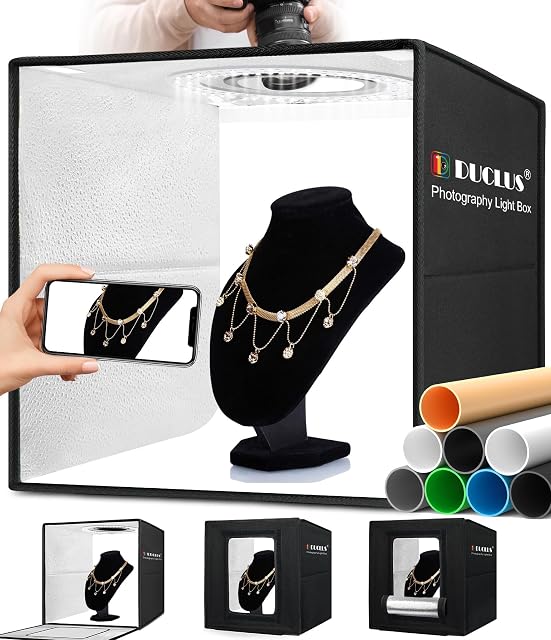
NOT PUBLISHED, and the third bullet makes the confusion visible: it describes a light ring with "a colour temperature of CRI95". A colour rendering index is not a colour temperature; the 39 € RaLeno and the 60 € DUCLUS both publish 5500K, and this page publishes no kelvin figure at all — Above 95, in the title and the third bullet. Five of the six tents on this shelf publish an index — the 62 € PYXEL publishes none because it contains no light — and 95 is the entry to being able to trust a colour straight out of the camera
Backdrop colours and shape
Six DOUBLE-SIDED colour backgrounds, in the title. Double-sided is the useful part: twelve surfaces from six sheets. Whether they curve up the back wall as a sweep or lie flat with a crease is not stated, and the intro above says that is what separates a usable background from one that needs retouching
Openings
Two, in the fourth bullet: a front horizontal window and a vertical one, for different shooting needs. That is a camera looking in from the front and from above, which on a 25 cm box is most of what can be asked
Folded size
Not published — and not one of the six tents on this shelf publishes one. The second bullet says it sets up in three seconds and stands on any surface, and never says what it measures folded
Amazon reference
B08RS75LVQ (same reference on 6 Amazon marketplaces)
EAN
0718202182591
What people ask before they commit
What is wrong with "a colour temperature of CRI95"?
It names two unrelated measurements as one. Colour temperature is where the light sits between warm and cool, in kelvin — 3000 is a tungsten lamp, 5500 is midday. A colour rendering index is how faithfully that light reproduces known colours, on a scale to 100. The bullet publishes the second and calls it the first, so the kelvin figure is simply missing.
Is 25 cm enough?
For the objects the listing names, yes: jewellery, accessories, toys, watches, gadgets. For a shoe, a handbag or a bottle, no — and the intro above is firm that a subject filling the tent takes the background with it. The same shelf carries a 40 cm cube for 40 € and an 80 cm one for 100 €.
Why does double-sided matter on a backdrop?
Because it halves what has to be stored and carried. Six sheets printed on both faces give twelve surfaces, and on a tent of this size the sheets are the bulkiest part of the package. What the page does not say is whether they curve into a seamless sweep or lie flat, which is the difference between a clean background and a visible line behind the subject.
40 by 40 cm · 160 high-brightness LED beads · 5500K daylight, fixed · colour accuracy 97 claimed · EIGHT backgrounds: six PVC in white, black, grey, light orange, blue and green PLUS two matte anti-reflective paper sheets in black and white · a diffuser cloth for lighting from above · front small window plus a top hole · highly reflective interior fabric, closed design to shut out ambient light · assembly claimed under one minute · USB power · no folded size published
Eight backgrounds — six PVC and two matte papers — with 160 LEDs at an index of 97 in a 40 cm box, for 60 €.
Best for: Glossy subjects — watches, cosmetics, models — where a matte background matters more than another twenty lumens.
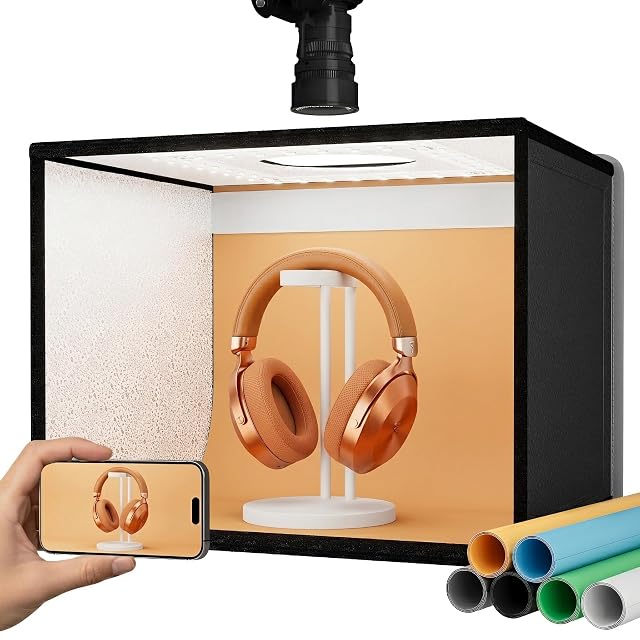
40 by 40 by 40 cm · 144 LED beads built in · colour temperature ADJUSTABLE, 2800 to 5800K — the only tent here that moves · colour accuracy above 95 · ten-step dimming · six waterproof PVC backgrounds in white, black, green, red, orange and blue · front horizontal window plus a vertical one · a light diffuser and a reflection board included · USB power lead · sturdy carry handle · no folded size published
A 40 cm cube whose colour temperature runs from 2800 to 5800K in ten dimming steps — the only tent on this shelf that changes the colour of its own light, at 40 €.
Best for: Photographing in a room lit by something other than daylight, where the tent has to match the colour of the light around it.
40 by 30 by 30 cm · 24 W of large-area LEDs, 2100 lumens claimed · 5500K, described as pure white · colour accuracy above 97 · six reinforced PVC backgrounds in black, white, grey, orange, green and blue · front, top and side panels removable in seconds, with DOUBLE front openings and a lid aperture · flicker-free dimming from 0 to 100 per cent on stable direct current · velcro assembly claimed under 10 seconds · carry bag supplied · no folded size published
Forty by thirty by thirty centimetres, 2100 lumens at 5500K, an accuracy index above 97 and flicker-free dimming from zero — the only tent on this shelf that publishes a lumen figure.
Best for: Small product work where the light has to be brought down for a reflective subject, and where the camera needs to come in from the front, the side and above.